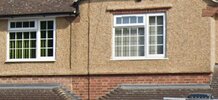
Do you think this wall has a cavity?

Has anyone ever built a solid wall that's 11.5" thick? Other than on a castle.

A castle wall, would be feet thick, at least. 11.5" thick could suggest lots of things, other than a cavity, and without more photos, I would not be ordering CWI based on a limited, quick photo, and a single measurement.
 
Tap your knuckles on the internal wall - on the interior, not the window reveal. Solid = cavity, hollow = something else, possibly solid with drylining or insulation.

I haven't made a mistake... solid = hollow sounding, cavity = solid sounding!
 
A photo from outdoors, showing the general construction, plus more indoors, similar to the one you posted, giving a wider view of the area.
Below is the picture of the front of the house and our neighbours (directly attached) house is similar, however, house next door is different with a smooth render.

Also attached picture of the room from inside.

Room.jpg

Front.jpg
 
Agreed, against my initial guess, it appears to be a solid (not-cavity) wall, presumably with a very thick render/pebbledash on the upstairs.
 
Thank you. In which case... which is the best way to install insulation on these walls?
 
Thank you. In which case... which is the best way to install insulation on these walls?
You can either opt for external wall insulation or by installing internal wall insulation.

Internal wall insulation is the opposite, where you install the insulation from the inside or by building a false stud wall and insulating it from the interior.

I insulated mine from the inside by using dot and dab insulated boards to the walls with plasterboard fixing foam.
 
Insulating it from the inside is more of a easy job for a DIYer.

External wall insulation involved in extending the roof overhang, extending the pipes, moving gas meters etc which can be a pain.

Don't forget the scaffolding too.
 
The brick pattern, in that bottom photo, appears to suggest there is no cavity.
So I managed to get into the loft and work my way to the edge of the house where the wall s and the build up of the wall in the loft doesn't add up.

I have ceiling plaster board which goes towards the brick wall and then behind the wall there is a brick which looks like a air brick, isn't this where the cavity would normally sit...?

Video Link
 
So I managed to get into the loft and work my way to the edge of the house where the wall s and the build up of the wall in the loft doesn't add up.

I have ceiling plaster board which goes towards the brick wall and then behind the wall there is a brick which looks like a air brick, isn't this where the cavity would normally sit...?

You will be struggling to form any opinion, by trying to look down, from inside the loft, the roof angle will prevent it. You would need to remove roof tiles at the eave, then see,

Your insulation choices, are to add insulation to the outside, or the inside. Outside, means your heating system would need to heat more of the fabric, before you feel the benefit of the heating, but it will give up the warmth, later, when the heating is off. There are a variety of methods of doing this, but the entire job would need to be done, as one.

Insulate the inside, and rooms will warm up quicker, and cool faster. That will involve battens fixed to outside walls, insulation between them, then plasterboard over the top, obviously you will lose some space in the process, but it could be tackled one room at a time, as DIY.

 
I've looked at the tops of dozens of walls from the inside of the eaves, for exactly this purpose. The inner skin or skins never go up to the underside of the tiles they stop at the wall plate. It can be awkward but by no means impossible.
 

If you need to find a tradesperson to get your job done, please try our local search below, or if you are doing it yourself you can find suppliers local to you.

Select the supplier or trade you require, enter your location to begin your search.


Are you a trade or supplier? You can create your listing free at DIYnot Local

 
Back
Top