
• Looking for a smarter way to manage your heating this winter? We’ve been testing the new Aqara Radiator Thermostat W600 to see how quiet, accurate and easy it is to use around the home. Click here read our review.

Door handle retention screws - Why so bad?

Joined
27 Dec 2011
Messages
101
Reaction score
2
Location
Essex
Country
United Kingdom
I need to buy these screws and would be grateful if you can advise which type, which screw driver and if I need to pre-drill a hole?

Over time, the retaining screws on my door handles seem to work themselves loose, causing the handle to wobble and eventually fall off. To make matters worse, my last carpenter — the lazy swine — only used two screws instead of four.

I’ve now seen this same issue in three different houses, across three different handle styles, all installed by different carpenters. So I’m starting to think this isn’t just bad luck — maybe it’s a design flaw.

  1. Are these handles actually fit for purpose?
    Can these tiny screws really withstand the constant load and shear force from pushing, pulling, and twisting the handle, or are they just a cheap, outdated gimmick that needs to be retired?
  2. What exact type of screw and screwdriver should I be using?
    I keep damaging the screw heads whenever I try to tighten them. I know people will say “don’t overtighten”, but if I don’t, the handle isn’t secure. So what’s the correct screw type and the right driver size to avoid stripping the heads?
  3. Should I be pre-drilling the holes?
    If so, what drill bit size should I use for these screws? I want to do it properly this time rather than chewing up the wood or the screw heads.
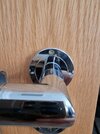
Thanks
 

Attachments

  • 1762685339174.jpeg
    1762685339174.jpeg
    260.6 KB · Views: 37
Round plates are fairly terrible at resisting the forces applied by pulling the door open. You can get them to last longer by putting your hand You'd achieve better success by putting the part of the handle perpendicular with the door between your index and middle finger, as the nearer to the switching end of the handle you pull the more the force your hand applies seeks to use the handle as a lever, flexing it/bending it away from the door surface (whereas the nearer your hand is to the shaft that emanates from the door the more its just a straight pull on the door)

For a stronger overall solution bolting the handles completely through the door so one bolt/nut pair clamps both sides works well. This is tricky if the handles have decorative caps intended to give a screw less look, but using hollow threaded bolts may work there as the heads will be relatively flush with the plate

Alternatively, fitting handles with larger mounting plates will helps, though they'll probably end up being rectangular ones
 
They are not intended to be secured to door timber , you use double end threaded screw which clamp the handle to the door along with grub screws in handle which grab the bar thru the door so the handles pull against each other not the door timber .

This video at 16.30 shows fixing to door .

 
Last edited:

Through screws will help (see above). That is assuming that you only have a tubular latch that will let you drill above and below. It will hold both sides of the handle in place.

Often, chippies will only use two screws because they are too lazy to shorten the supplied screws. That said, many handles are supplied with both screws and through screws.

I use a 1.5mm drill bit to predrill, then start to insert a screw to the left and right. I then remove the screw and cut the end off (if it is too long). Those screws normally need a PZ1 screwdriver, that said, I find a JIS 1 bit better. The latter is the Japanese Industrial Standard. A lot of eastern fittings seem to use them. PZ- pozidrive is under copyright, meaning that a licence fee is required. Philips is out of copyright. Not sure about JIS though.

Oh, and check to see if the chippy bothered to use the grub screw on the underside of the handle which holds it to the spindle. They help to reduce the likelihood of someone pulling the handle off.
 
Last edited:
Thanks all.

So are we saying that the screws my chippy has used are not even supplied with the handles?

The solution advised sounds great but with 13 doors to do, I don't think I can afford to go down that route if I bring in a new chippie. I'm very inexperienced with woodwork and will end up ruining them if I did myself.
 
I should think it's fairly low risk even for a novice DIYer to drill a few small holes between the pairs of handles. The "exit wound" is going to be covered by the handle, and there's already a hole anyway so there should be very little tear out.
At least you know what the solution is even if you don't pursue it at this time.
 
, I don't think I can afford to go down that route if I bring in a new chippie.
If you don't plan to make changes to how the handles are secured, you'll have to make changes to how they are used. This will be much harder because it involves changes to humans behavior, not all of which you may have adequate control of

What is proposed for through-bolting shouldn't take long for someone with the right toola. Minimally you need one through-bolt as close to the 7 o'clock position (maybe 8 if the catches don't need to withdraw much to release) as possible, as that is the area of the handle that suffers the most pull-out force when someone pulls on the handle in your picture this is the 9 o'clock hole, which hasn't even had any fixing fitted by the muppet that installed your handles (probably because it's "hard" to depress the handle to give more room for a cordless drill with a long bit to drive a fixing in, and they couldn't be bothered/work-out-how to remove the handle temporarily/use a manual driver/use an angled one)

Either that or replace the handles with rectangular plated ones, at probably a fiver per handle set, when they get ruined

will end up ruining them if I did myself.
Equally though, just using the door will also ruin things

At the very least consider taking the handle off one side, drilling through the door (getting it straight is the hardest part; you can get drill guides/drill blocks to help with that), and fitting just one of the bolts opps showed. If you repeatedly fail spectacularly to drill a straight hole you can try getting a helper to look from the side while you look down from the top. Each person has a role in keeping the drill straight. You can also drill from both sides with the aim of getting close enough. Don't be tempted to wriggle the drill around excessively as bits are easy to snap, but some small, slow circular motions to help clear the hole out, with the drill on a high speed, may be used. End of the day all you need is a nearly straight hole through the door

Those bolts have sections where there is no thread because that is where you cut them (a pair of pliers is usually sufficient as they're soft metal) so your cutting method doesn't ruin the thread making them hard to install
Cut them to length taking into account the thickness of the door handles; push them through the hole you've made so they stick out the other side, mark them close to the handle and cut them at the next smooth part along, next to the mark

After a bit of practice I would expect ten minutes per door for you to fit one bolt. Be careful with the screwdriver; them being soft metal makes for easy cutting but it's also easy to ruin with the wrong driver. There is a difference between a Philips and a Pozi even though they both have the same basic + shape. After you buy the screws (or similar ones) return here with a good clear picture of the + head and we'll tell you whether to use a PZ or a PH screwdriver, if you can't decide (neither driver fits the other screw properly; a PH driver in a PZ screw is loose and sloppy, a PZ driver doesn't go into a PH screw fully. When well matched you can hold just the driver and the screw remains stuck on the end when held horizontally)

If the screws work loose over time you may want to use some thread locking fluid
 
Last edited:
Lots of good advice here. It does seem a recurring problem.. I've seen entire office buildings where the joiners have bodged them with the short screws into the wood and then by the time all the handles are loose and falling off they are long gone. Through bolts are the way to go
 
Sleeve nuts are the strongest option, but if you are lucky enough to have a solid wooden doors, woodscrews are sufficient.

If you have a cheap modem hollow door made of air, with a thin coating of ornamental hardboard, only sleeve nuts will do the job,
 
Lots of good advice here. It does seem a recurring problem.. I've seen entire office buildings where the joiners have bodged them with the short screws into the wood and then by the time all the handles are loose and falling off they are long gone. Through bolts are the way to go
lots of handles with rose backplates come with just screws -which have to be short as they hit the lock / tubular latch etc

and even worse they get fitted to these modern doors made of a bit cardboard and air


office building doors should have proper handles with decent backplates and through fixings -or ideally D handles with stainless door plates
 
Haven't seen a handle without through bolts for a long time.
Probably because I don't buy them from Poundland?
However, I have seen lots of "carpenters" throwing away all screws in the handle packet and use their own, sourced from a dedicated bucket where every odd and damaged screw end up.
Recently I was asked by a neighbour to look at 5 fire doors installed in his house.
Not one screw was the same in the (upside down) hinges.
Handles holes were bigger than covering plates and handles only held by 2 small screws.
I know those handles come with through bolts because I recommended them to my neighbour.
A total mess but "carpenter" had already ridden his horse into the sunset.
"Wanna help fixing this mess?" I was asked.
No thanks. I'm sure there's a lot more to be uncovered, so I passed.
Another real carpenter charged £100/door to fix all that bodge, including resitting all frames.
 
OK, I'll give it a try. I've found a "low-risk" door to test with :D

Cheers.
 
Yes!


Yes. This is essential, if you don’t have some other gadget to make the hole straight. Make sure you agree about which way is up and which is down.
Agreed. I often ask someone else to confirm that I drilling "square" and if on my own, I will periodically stop and do a visual check.
 

If you need to find a tradesperson to get your job done, please try our local search below, or if you are doing it yourself you can find suppliers local to you.

Select the supplier or trade you require, enter your location to begin your search.


Are you a trade or supplier? You can create your listing free at DIYnot Local

 
Back
Top