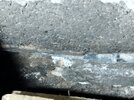
Dpc

OP,
Well done for your continuing investigation & finding the damp CWI & rubble that I referred to in post#8.
If you remove block down to FFL level then it would be clear if there now is a DPC at that level or does the DPM go under th blockwork?

You need to remove as much rubble as possible, and to remove all the reachable CWI - you could open the wall up further to the right? Wall openings should be a few feet apart for structural safety.
The render looks fine but definitely observe during rain - or when the exterior is being hose pipe sprayed.

Despite the render looking fine moisture is still maybe penetrating the wall? I think moisture is rising in the cavity rubble & CWI.
Has the gully trap been cleaned out?
Gully trap is clear.
Must admit i was concerned about taking anymore blocks out, thinking it might weaken the wall too much.

Will get on it again today. Didn't check the DPC/DPM DOH.

Will do that later
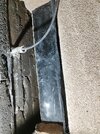
 
DPC is slightly higher than the internal one, which was below a row of bricks below first row of blocks if that makes sense.
 

Attachments

  • IMG_20261007_112900.jpg
    IMG_20261007_112900.jpg
    891.4 KB · Views: 12
  • IMG_20261007_112907.jpg
    IMG_20261007_112907.jpg
    691.8 KB · Views: 12
OP, So, now we can clearly see that the membrane is acting as the DPC, & all you now need to do is clear out whatever rubble & CWI you feel needs to go. Leave a clear cavity for 150mm below FFL.

The latest pics also confirm that the outside skin is blockwork that was built on a few brick courses and then rendered over.
Moisture might continue penetrating through the outside skin - but where you've cleared out CWI moisture will presumably drop or evaporate in the cavity not on your new decorated interior surface?
I've not noticed any wall ties but it doesn't seem to matter.
 
OP, So, now we can clearly see that the membrane is acting as the DPC, & all you now need to do is clear out whatever rubble & CWI you feel needs to go. Leave a clear cavity for 150mm below FFL.

The latest pics also confirm that the outside skin is blockwork that was built on a few brick courses and then rendered over.
Moisture might continue penetrating through the outside skin - but where you've cleared out CWI moisture will presumably drop or evaporate in the cavity not on your new decorated interior surface?
I've not noticed any wall ties but it doesn't seem to matter.
Cheers Ree, many thanks. I'm going to wait a few days as expecting heavy rain later tomorrow & Friday. Hopefully might be able to see if there are any issues.

Anything i need/should do before bricking it back up?
 
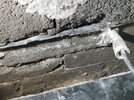
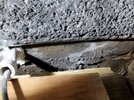
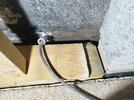
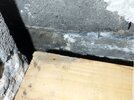
Had quite a bit of rain yesterday & overnight & can see by photos that water is getting in underneath the dpc due i think no bellcast as per earlier post.

It's hard to see from 3rd & 4th photo but the edge of the mortar above the dpc is damp there.

Going forward, i am assuming it's happening all the way around the property.

What are my options?

Can a bellcast be retrofitted? How serious is the situation going forward from what i have said & the photos.
 

Attachments

  • IMG_20261008_215643.jpg
    IMG_20261008_215643.jpg
    490.3 KB · Views: 8
  • IMG_20261009_083144.jpg
    IMG_20261009_083144.jpg
    731.5 KB · Views: 8
  • IMG_20261009_083156.jpg
    IMG_20261009_083156.jpg
    431.3 KB · Views: 8
  • IMG_20261009_083252.jpg
    IMG_20261009_083252.jpg
    516.5 KB · Views: 13
It's very unlikely to relate to the render, but it's impossible to tell from here.

Get someone in to look at it. Don't take advice from a random stranger on the internet who says he's from California.
 
It looks to me like you've got a wall built with 3 inch blocks on top of the DPC. Used to be quite common so the render came flush with the brickwork. The problem is that a small shrinkage crack firms at the bottom, and as quite a lot of water runs down the wall some of it tracks into the wall. Normally, the cavity deals with it, but any blockages can help damp get to the inner skin. It is possible to retrofit a Belcast which does have a drip edge.
 
OP,
A plastic Bell Cast can be fitted retrospectively, & it will shed water that runs down the face of the render.
The Bell Cast is pinned to the blockwork, and made good with fresh roughcast and external paint.

Why not install the Bell Cast, make good, & by leaving the openings open for a while you will be able to observe if moisture is still penetrating?
You could spray water test but nothing beats rainwater for penetration.
 
It looks like painted pebbledash to me, it will be porous so a lip of anything won't achieve anything. If the rain is getting through it then it may well have got in way above the bottom of it then run down through it.

You could overcoat it with render. But this would be likely to pull it away from the wall with the added weight. It may make more sense to take the lot off and render with a modern material incorporating a lip at the bottom.

Was it painted by a previous owner? If so that may be because it had all cracked. If so then its days are over anyway.
 
It's as waterproof as a sieve, it's full of holes...

Screenshot 2026-10-11 163349.png


I'm guessing it's painted pebbledash. There's no point in putting a bellcast, bell curve or bell bottoms on it, as the water will be flowing through it.

You're only seeing it at the bottom because that's where gravity takes it until it ends up sitting on top of the DPC and unable to run further.

If, as suggested previously, and as looks likely, the DPC projects beyond the blocks that the render is on then it needs a projecting bell cast, drip strip or whatever, but it also needs to be water-tight so the water will run down its outside surface and not within or behind it.
 
OP,
A plastic Bell Cast can be fitted retrospectively, & it will shed water that runs down the face of the render.
The Bell Cast is pinned to the blockwork, and made good with fresh roughcast and external paint.

Why not install the Bell Cast, make good, & by leaving the openings open for a while you will be able to observe if moisture is still penetrating?
You could spray water test but nothing beats rainwater for penetration.
Looking into it.
 
It looks like painted pebbledash to me, it will be porous so a lip of anything won't achieve anything. If the rain is getting through it then it may well have got in way above the bottom of it then run down through it.

You could overcoat it with render. But this would be likely to pull it away from the wall with the added weight. It may make more sense to take the lot off and render with a modern material incorporating a lip at the bottom.

Was it painted by a previous owner? If so that may be because it had all cracked. If so then its days are over anyway.
That wall was painted using McPherson's Powerkote if i remember. I know i can only see a tiny proportion of external wall but after heavy rainfall the other there are no signs of any ingress coming down internally.
 
The think to remember when you cut off the render to fit a render stop, is that you can get a horizontal shrinkage crack where the new meets the old, which can allow moisture in. It's worth using a bonding agent at the join to help prevent this.
 

If you need to find a tradesperson to get your job done, please try our local search below, or if you are doing it yourself you can find suppliers local to you.

Select the supplier or trade you require, enter your location to begin your search.


Are you a trade or supplier? You can create your listing free at DIYnot Local

 
Back
Top