Draining an indirect cylinder to change a faulty zone valve

Joined
25 Feb 2025
Messages
9
Reaction score
1
Country
United Kingdom
Hi - first post here, hoping someone can help.

I've got a Megaflo CL210 indirect hot water cylinder that has a 2 port Honeywell valve on the primary flow that is going to need replaced soon as the valve is sticking. I've got the replacement valve, but I was looking a bit of advice on the easiest way to drain the tank down before starting the work. There is no drain valve on the cold inlet that I can see, is it a case of removing the connection at the top of the tank and dropping a hose in to syphon off, what about the pressure in the tank - assume that would be best released before opening any connections?

I've got the manual for the tank and it does say that you should install a drain valve but for whatever reason the plumber installing the tank chose not to do one which is a bit short sighted but hey ho.

Any thoughts/advice?

Thanks

Gary
 
Why do you need to drain the main cylinder if the valves are on the primary?
 
Picture?

Probably the boiler needs draining rather than the HW storage. The HW is heated via a coil inside the tank from the CH system water (with inhibitor added). So drain the CH/Boiler down, remembering to add inhibitor when refilled.

But the valve may be sticking due to the motor / mechanism reaching end of life so just a new head needed and no need to drain down at all?
 
Picture?

Probably the boiler needs draining rather than the HW storage. The HW is heated via a coil inside the tank from the CH system water (with inhibitor added). So drain the CH/Boiler down, remembering to add inhibitor when refilled.

But the valve may be sticking due to the motor / mechanism reaching end of life so just a new head needed and no need to drain down at all?
The valve is sticking mechanically as I've taken the mechanism off and the valve is stiff to turn even with pliers.

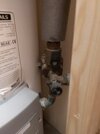
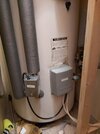
Here's a picture of the valve and one of the cold inlet if that is helpful.

So is it that as long as the stopcock is off and the boiler and heating controls are off that draining the CH at the boiler bleed valve will be sufficient - how will that take the level of water in the hot water cylinder down enough that I can remove and replace the 2-port valve?
 

Attachments

  • 20250221_072146.jpg
    20250221_072146.jpg
    126 KB · Views: 48
  • 20250221_072153.jpg
    20250221_072153.jpg
    208.2 KB · Views: 47
As above zone valve is part of heating system! That's what needs draining not cylinder.
Silly question perhaps then so if I drain the CH down will that also empty the cylinder?

There is a separate zone valve for the CH and one for the UFH.
 
So is it that as long as the stopcock is off and the boiler and heating controls are off that draining the CH at the boiler bleed valve will be sufficient - how will that take the level of water in the hot water cylinder down enough that I can remove and replace the 2-port valve?
Stopcock doesn't need to be off and the hot water cylinder doesn't need to be drained. You're changing the valve on the heating circuit so you just need to drain that
 
Stopcock doesn't need to be off and the hot water cylinder doesn't need to be drained. You're changing the valve on the heating circuit so you just need to drain that
Apologies if I'm being a bit dim here - just a DIY'er and have never had to work on a hot water cylinder before.

When I was diagnosing the existing valve the fault in the system was that there was no hot water in the taps but the central heating worked just fine. Once I took the cover off the 2 port valve and gave it a bit of adjustment with pliers to move the valve then the hot water started to work again. So what I'm not understanding is if I just drain down the central heating at the boiler - why does that ensure that when I then remove the old valve head and actuator that the current contents of the hot water cylinder won't just dump out?
 
The central heating water doesn't mix with the domestic hot water in the cylinder.
The central heating water is pumped through a sealed circuit within the cylinder called a coil.
You need to manually latch open the zone valve for domestic hot water ,and drain central heating water out of the system to a point lower than the zone valve.
Add inhibitor to the central heating system when refilling .
 
The central heating water doesn't mix with the domestic hot water in the cylinder.
The central heating water is pumped through a sealed circuit within the cylinder called a coil.
You need to manually latch open the zone valve for domestic hot water ,and drain central heating water out of the system to a point lower than the zone valve.
Add inhibitor to the central heating system when refilling .
Thanks very much for the details that's helpful but it raises another question from me...If the coil is a sealed circuit and it heats only the CH water, why when the valve was not operating was the fault that there was no hot water from the taps but the central heating was working just fine?

Is that just because when the call for hot water comes to the (closed) zone valve via the controller, that no heated CH water pumped from the boiler can be diverted into the coil circuit, so it can't heat the existing water in the tank - but it obviously is still able to flow to the rest of the CH circuit as the other valves are operating normally....Hoping that's the answer as it all makes more sense then :)
 
You are correct. The zone valve allows the central heating water to run through the coil when it is opened.
 
Is it the valve sticking in the valve body or the motor sticking in the valve head? If it’s the valve head then that can be changed without draining the heating circuit.
 

If you need to find a tradesperson to get your job done, please try our local search below, or if you are doing it yourself you can find suppliers local to you.

Select the supplier or trade you require, enter your location to begin your search.


Are you a trade or supplier? You can create your listing free at DIYnot Local

 
Back
Top