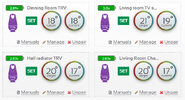
Drayton TRV4 numbers to temperatures

If those values are correct it is a good starting point, so that people have some idea what they are dealing with.

It is good to have some idea of the ballpark that the TRV is tuned to.

With my first experimenting with mine I have found on one that 3 is turning the rad off at about 18ºC, at 3.5 it is currently at 19ºC - so not a 5ºC leap as the previous poster suggested.

I am experimenting with mine but I would like some feedback on the results others are getting.

As for resurrecting old posts - I came acrosss this one via google - it would seem pointless to start a new thread summarising what went on on this thread when the info is already here.

:D
 
You have been selective with your reading!

Carry on being blinkered if it makes you feel better.

If you want to understand the situation in more detail then read all the posts ( particularly mine ) and try to understand whats going on.

To help you with such a difficult subject for you try to understand, the TRV is close beside a rad at about 60°C with the room at about 21°C on the other side.!

Tony
 
A bit caustic Tony :shock:

I'm well aware of the huge permutations of fluid dynamics that can occur in this situation...

But a ballpark figure to work from is often all that is required in these sort of situations to get a good starting point :lol:

We don't need a CFD analysis of each and every radiator and the surrounding area, but to know that at setting 1 the TRV will turn off at 10ºC I would submit is quite a helpful thing to know :lol:
 
I would say that its pretty irrelevant!

The only setting you need to be aware of, as a user, is the setting which gives you a comfortable temperature, thats "about 3".

The fact that the valve may be half closed when the head is at 25° is of no relevance because the temperature where the valve is situated is determined by the layout and temperature of the radiator and pipework and to a lesser extent by the room temperature. It will also be greatly determined by the thermal convection currents in the room which are determined by heat losses and layout.

Tony
 
i have removed one of these valves from an unused radiator. i cant comment
on the higher temperatures but on the low end the numbers on the dial correspond to:

"1" opens at 15degC
halfway between "1" and the snowflake opens at 13degC
the snowflake opens at and below 11.5degC

my problem is i have a guest bedroom with 3 external walls that i dont want to heat at all unless we have a guest.
even on the snowflake setting, when the weather is cold this valve opens and slowly leaks heat into the room until it warms itself up to 11-12degC.

i guess ill have to turn it off at the lockshield valve.....
 
my problem is i have a guest bedroom with 3 external walls that i dont want to heat at all unless we have a guest.
even on the snowflake setting, when the weather is cold this valve opens and slowly leaks heat into the room until it warms itself up to 11-12degC.

i guess ill have to turn it off at the lockshield valve.....

If you think about it, by having that room so cold, you're turning your internal walls into external walls from a Delta T perspective. Your other rooms, that share walls with it, will experience excessive heat loss. They will also likely have less thermal mass and insulation, than the external walls, so it might be worse than the heat loss experienced through the external walls.

I think you might as well just heat the room.
 
When this thread was started, I had no knowledge of electronic TRV heads, but things have moved on.

I had all my TRV's changed when I moved in, and was left old ones to play with, setting at around 2.5 found it was fully open at around 18.5°C and fully closed around 22.5°C which seems a massive amount, my problem is which needs adjusting, the lock shield valve or the TRV head.

I fitted Energenie TRV heads to start with, the anti-hysteresis was OTT, but at least setting it with degrees C 4 TRVs-1.jpg I could see both target and current so only needed to set the lock shield valve, if the current exceeded the target I closed the lock shield a tad.

Second set of electronic heads, far cheaper eQ-3, and they actually told you if under or over travel, plus had window open feature to turn off if sharp drop in temperature for a set time, handy when unloading car, as heating stops for set time, I set it to 30 minutes, but only shows target so not so good to set lock shield with, and price has gone up was £15 in 2019, so when one of the Energenie was damaged by carpet fitters, replaced it with a Kasa, thought it would connect to a thermostat, but found the thermostat which worked with it needed hard-wiring, and so was not a type I could use. So then went for Drayton Wiser, as will link to boiler, so now 4 makes of TRV heads. The eQ-3 are bluetooth so only link to one phone, but the other three, including the Nest Gen 3 thermostat, all connect to Google Home, so hey google set living room to 22°C will set the three different makes all with one command.

Having the living room heated in the day, and bedrooms at night, I am sure reduces energy used, and without electronic heads could not heat each room independently, but the problem was getting the boiler to run, so now three thermostats linked to boiler, wall one in living room, and wall one in hall, and TRV one in wife's bedroom.

There is a small problem, outside walls can cool the TRV if the radiator against it, until the air flow has been started, better if radiators on an inside wall, with radiators on an inside wall there is no need for a wall thermostat.

That was a problem with late mother's old house, getting the wall thermostat and TRV to work in harmony, I note now the Kasa can link to a wall thermostat so it is not upset when against a cold wall. What I find is there is a lack of reports to show what TRV head will do.
 

If you need to find a tradesperson to get your job done, please try our local search below, or if you are doing it yourself you can find suppliers local to you.

Select the supplier or trade you require, enter your location to begin your search.


Are you a trade or supplier? You can create your listing free at DIYnot Local

 
Back
Top