The lock shield valve controls heating speed, and the TRV controls room temperature, if the flow is too high, it will over shoot, with an electronic head if the lock shield is open too much we see
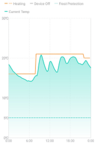
the sine wave is caused by the lock shield being open too much, actually with this one it was due to using an oil boiler which does not modulate, but the graph looks the same when with a gas boiler the lock shield is open too wide, or there is some device turning the boiler on/off rather than allow it to modulate.
We are told in the text books to set the outgoing around 15 degrees C lower than the incoming, but that needs a differential thermometer to read the difference, I tried with a point and aim the laser at the item to be measured, could not keep the unit steady enough to read, so step one was close the lock shield valve, let the pipes cool, then open quarter turn at a time until heat felt in one pipe.
This seems to work of sorts, but with electronic heads
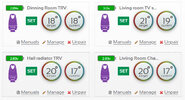
there is normally a display on the computer or phone, which shows target and current, if current exceeds target close the lock shield a little. I found once lock shield set, you could put the mechanical TRV head back on, as now only one thing to adjust, and 20 degrees C was around 2.5 on the *123456 scale, some cheap electronic heads only show target, the eQ-3 were like that, but only cost £15 each in 2019 when I got them, so what do you expect for £15?
But my Energenie and the Kasa (TP-Link) TRV heads both show target and current, the display is from the Kasa head. The electronic heads exercise the TRV pins and also work out what distance the pin will travel, and are normally within 0.5 degrees C of set point, and can also have times set, some even link to the hub which controls the boiler, but the mechanical is around 1.5 degrees C of set point, and have no time setting.



