- Joined
- 20 Oct 2025
- Messages
- 5
- Reaction score
- 1
- Country

Follow-on to previous post. Some developments, these are my thoughts but I would appreciate your opinion.
i just had a new door fitted. It is in a different position to the previous one. That was fitted to a collection of rubble in the cavity i.e. acting as a cavity closure.
When the old door came out about half of this could be seen to be loose and some just fell out. Picture attached. The plan had been to fit the new door to the external brick skin anyway so it didn't stop the installation going ahead.
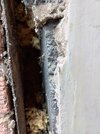
I now need to close up the cavity and finish off with plaster. I've read a lot of posts here about closing window and door cavities. This door cavity and the one on the opposite side are between 65mm and 75-80mm. There is a dpm about 130mm wide loosely held up. This side is in original condition, picture attached.
The top is closed being formed of cement finlock gutter and this part is firm and solid but all the plaster came down when the old door came out. I'm going to treat the underside of the aperture (overhang) like a ceiling ie not put too thick a coat on at a time, max 8mm and possible a slurry first and let dry before plastering.
The door fitters offered to put in building foam, that offer remains on the table for a few more days. There is cavity (bead) insulation with large gaps on one side and I wanted to get more rubble out of the cavity before deciding what to do next.
My options are:
1. Foam board insulation with some additional dpm (the existing dpm doesn't fully reach the top of the cavity), I'm not keen on using drywall in the door entrance. How would I plaster onto foam board insulation? Mesh?
2. Replace the block infill at the entrance to the cavity and fill in gaps with expanding foam and perhaps push in some bead insulation (would Rockwool work also?) to fill the voids I can reach. This gives me a better surface for plastering onto and I can use Gyproc Hardwall and Multifinish. Which was successfully used elsewhere in this space. This is putting back what was there but without the weight of a door attached to it.
3. Infill with aerated block, after pushing some insulation bead or rockwool) addressing the gaps in dpm. I believe aerated block means I can't use Gyproc Hardwall and Multifinish. I'd use another product in this case.
4. Have the fitters do expanding building foam, and then how do i plaster on top of that and will in stand up to being in a narrow doorway when say furniture is being brought in or taken out of the building? Won't it potentially get dunched in? This is what makes me prefer the options 2 and 3 with something firm to plaster against. Part of me likes the foam insulation board both for insulation, ease and being ale to deal with the sagging dpm but will the plaster finish be vulnerable to being knocked in a narrow doorway.?
I have not added bespoke cavity closures, they seem quite flimsy, give little insulation and do they provide a good surface to plaster onto?
A day after the fitting there was heavy rain against the door and I noticed some dark staining of the floor in RH corner viewed from inside. On investigating there is a 130 hollow down to below floor level which as full of grit, rubble, sandy soil (possible brought in by insects). I removed all within reach, the rest seems bonded to the inside of the brick or block walls that form the cavity. The rain stopped and this has now dried out. Its not in front of the door it is to one side and wasn't anything to do with the fitters and wasn't coming under the door. The cavity dpm does not go down into the void. I am thinking to leave it empty, or at most extend this 130mm strip of dpm down into the void and wedge it with maybe a piece of foam insulation board so it remains in contact with the inner edge of the external brick wall and not touching the block wall. I wasn't planning to fill it up with cement. Is that the right approach? I should add that i have not had damp issues to-date.
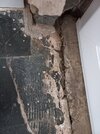
There is also another task to address. The floor immediately inside the door is cracked and hollow sounding. I have removed a few loose fragments and i can see the top of a brickwork course 30mm below. Picture attached. I'm considering taking this hollow sounding cracked area up and will put down new cement to the level of the separate cement door threshold. I have seen comments about making a dpm trough and filling it with cement. I'm not sure if that is an option here as
I cannot remove the separate strip of cement under the new door. I can do the new cement and monitor for damp for several winter months and re-evaluate if damp is appearing. Or do the dpm as part of floor levelling and a later stage after replacing the cracked and hollow cement. I'm thinking sand and cement without stones. It looks as though the cement immediately under the new door has stones (texture like porridge). I was going for a smooth finish like the rest of the floor.
The floor finish will be ceramic tiles.
If I knew more I'd use fewer words.
i just had a new door fitted. It is in a different position to the previous one. That was fitted to a collection of rubble in the cavity i.e. acting as a cavity closure.
When the old door came out about half of this could be seen to be loose and some just fell out. Picture attached. The plan had been to fit the new door to the external brick skin anyway so it didn't stop the installation going ahead.
I now need to close up the cavity and finish off with plaster. I've read a lot of posts here about closing window and door cavities. This door cavity and the one on the opposite side are between 65mm and 75-80mm. There is a dpm about 130mm wide loosely held up. This side is in original condition, picture attached.
The top is closed being formed of cement finlock gutter and this part is firm and solid but all the plaster came down when the old door came out. I'm going to treat the underside of the aperture (overhang) like a ceiling ie not put too thick a coat on at a time, max 8mm and possible a slurry first and let dry before plastering.
The door fitters offered to put in building foam, that offer remains on the table for a few more days. There is cavity (bead) insulation with large gaps on one side and I wanted to get more rubble out of the cavity before deciding what to do next.
My options are:
1. Foam board insulation with some additional dpm (the existing dpm doesn't fully reach the top of the cavity), I'm not keen on using drywall in the door entrance. How would I plaster onto foam board insulation? Mesh?
2. Replace the block infill at the entrance to the cavity and fill in gaps with expanding foam and perhaps push in some bead insulation (would Rockwool work also?) to fill the voids I can reach. This gives me a better surface for plastering onto and I can use Gyproc Hardwall and Multifinish. Which was successfully used elsewhere in this space. This is putting back what was there but without the weight of a door attached to it.
3. Infill with aerated block, after pushing some insulation bead or rockwool) addressing the gaps in dpm. I believe aerated block means I can't use Gyproc Hardwall and Multifinish. I'd use another product in this case.
4. Have the fitters do expanding building foam, and then how do i plaster on top of that and will in stand up to being in a narrow doorway when say furniture is being brought in or taken out of the building? Won't it potentially get dunched in? This is what makes me prefer the options 2 and 3 with something firm to plaster against. Part of me likes the foam insulation board both for insulation, ease and being ale to deal with the sagging dpm but will the plaster finish be vulnerable to being knocked in a narrow doorway.?
I have not added bespoke cavity closures, they seem quite flimsy, give little insulation and do they provide a good surface to plaster onto?
A day after the fitting there was heavy rain against the door and I noticed some dark staining of the floor in RH corner viewed from inside. On investigating there is a 130 hollow down to below floor level which as full of grit, rubble, sandy soil (possible brought in by insects). I removed all within reach, the rest seems bonded to the inside of the brick or block walls that form the cavity. The rain stopped and this has now dried out. Its not in front of the door it is to one side and wasn't anything to do with the fitters and wasn't coming under the door. The cavity dpm does not go down into the void. I am thinking to leave it empty, or at most extend this 130mm strip of dpm down into the void and wedge it with maybe a piece of foam insulation board so it remains in contact with the inner edge of the external brick wall and not touching the block wall. I wasn't planning to fill it up with cement. Is that the right approach? I should add that i have not had damp issues to-date.
There is also another task to address. The floor immediately inside the door is cracked and hollow sounding. I have removed a few loose fragments and i can see the top of a brickwork course 30mm below. Picture attached. I'm considering taking this hollow sounding cracked area up and will put down new cement to the level of the separate cement door threshold. I have seen comments about making a dpm trough and filling it with cement. I'm not sure if that is an option here as
I cannot remove the separate strip of cement under the new door. I can do the new cement and monitor for damp for several winter months and re-evaluate if damp is appearing. Or do the dpm as part of floor levelling and a later stage after replacing the cracked and hollow cement. I'm thinking sand and cement without stones. It looks as though the cement immediately under the new door has stones (texture like porridge). I was going for a smooth finish like the rest of the floor.
The floor finish will be ceramic tiles.
If I knew more I'd use fewer words.