
Floating sockets..

Joined
7 Sep 2022
Messages
4,921
Reaction score
1,427
Country
United Kingdom
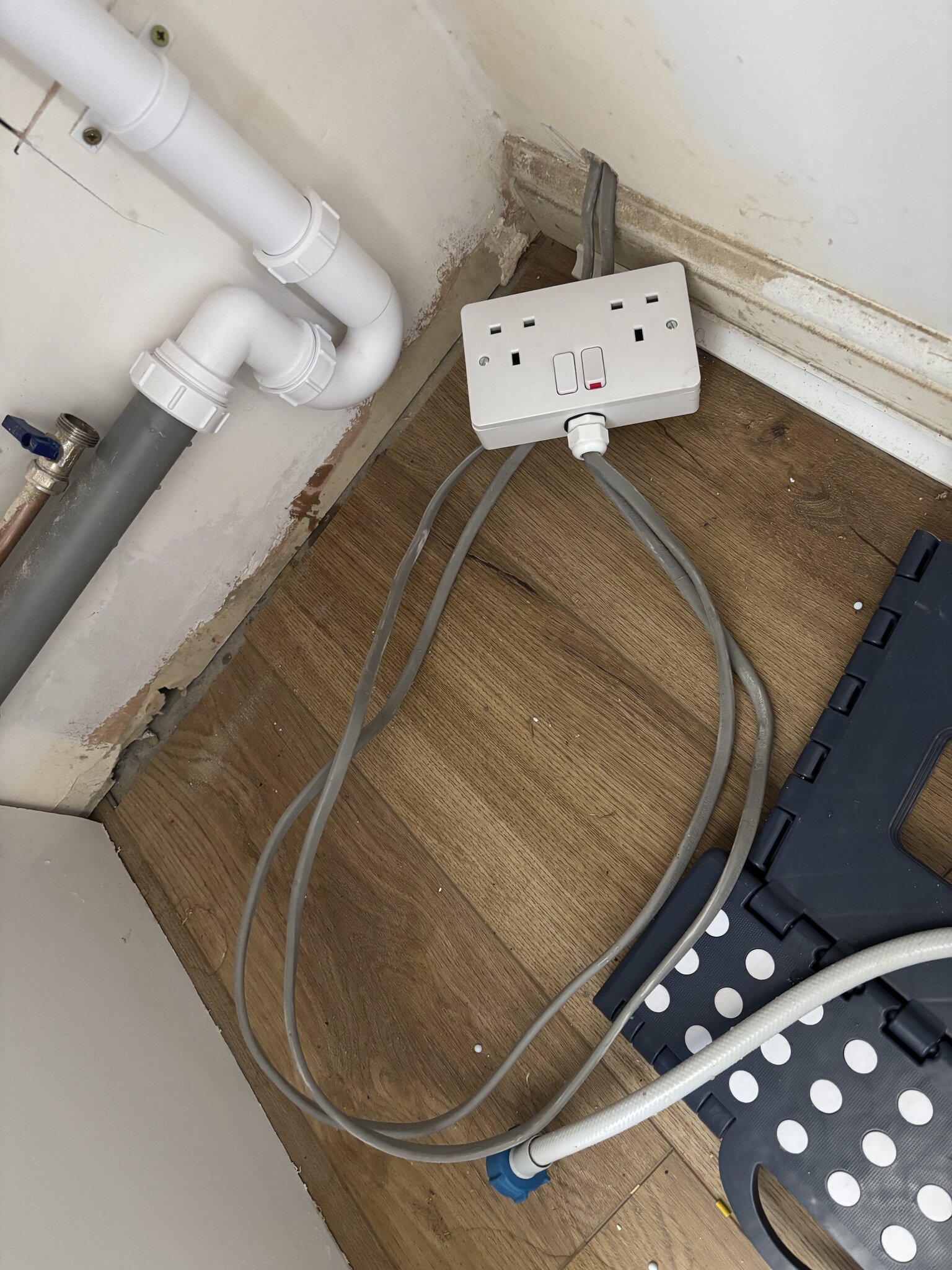
Amusingly coincidentally on the heels of the thread about a pair of double sockets on T&E into a plug and whether it’s not/part of an installation, I pulled the washer out of a relatively newly fitted kitchen, during a friend’s house move and found this..
1780387510631.jpeg
 
At least the stuffing gland hopefully provides strain relief. Most times I‘ve seen setups like this there was flex with exposed cores hanging out of the pattress box.

PS: that floating power strip wasn’t plugged in. A Swiss news web site tracked down an entire album of pictures from that event and at least one of the pics clearly showed the plug on the ground, no socket anywhere to be seen.
 
Amusingly coincidentally on the heels of the thread about a pair of double sockets on T&E into a plug and whether it’s not/part of an installation, I pulled the washer out of a relatively newly fitted kitchen, during a friend’s house move and found this..

I wouldn't personally say that there is any doubt that that socket is 'part of the installation', given that it is hard-wired with T+E and, as has been noted, probably even has adequate 'strain relief'. The only sense in which it appears to be 'unconventional' is that the socket is 'floating', and I wouldn't say that stops it being part of an installation, and quite possibly not even non-compliant with BS7671.

Let's face it, if such a socket had originally been attached to a wall, but had 'fallen off', I don't think anyone would seriously suggest that that 'falling off' meant that it was no longer part of the electrical installation!, would they?
 
You don't have to quote a reg with a code but as you've asked if I remember correctly (I cant remember many numbers) good workmanship 134.1.1
I would say that one has to be prepared to provide a reg 'if challenged' - otherwise things could be coded (and not necessarily only C3) on the basis of an inspector's personal opinion, even if it were completely compliant with BS7671.

As for 134.1.1, that's about as vague as one can get, and certainly very subjective (i.e.'debatable')!
 
I would say that one has to be prepared to provide a reg 'if challenged' - otherwise things could be coded (and not necessarily only C3) on the basis of an inspector's personal opinion, even if it were completely compliant with BS7671.

As for 134.1.1, that's about as vague as one can get, and certainly very subjective (i.e.'debatable')!
Yes, but would you say that socket is good work?
 
Yes, but would you say that socket is good work?
Of course not. However, the regs are meant to be primarily about explicit aspects of safety, aren't they, and the only real way one can 'find fault' with this situation would seem to be anything but 'explicit'.

Put this way, what do you feel is specifically 'dangerous' about it? Do you feel that it is significantly more dangerous than would be the end of an 'extension lead' lying on the floor in the same place?
 
Of course not. However, the regs are meant to be primarily about explicit aspects of safety, aren't they, and the only real way one can 'find fault' with this situation would seem to be anything but 'explicit'.

Put this way, what do you feel is specifically 'dangerous' about it? Do you feel that it is significantly more dangerous than would be the end of an 'extension lead' lying on the floor in the same place?
True but I didn't say dangerous just that it could do with improvement, but only if someone wants, they could choose to keep the C3
 
Of course not. However, the regs are meant to be primarily about explicit aspects of safety, aren't they, and the only real way one can 'find fault' with this situation would seem to be anything but 'explicit'.

Put this way, what do you feel is specifically 'dangerous' about it? Do you feel that it is significantly more dangerous than would be the end of an 'extension lead' lying on the floor in the same place?
Not really imo, there's plenty of hard and fast rules in the regs (max zS values for instance) but equally there's lots of regs where competent persons are encouraged to use their judgement. I'm pretty sure I could find reasons to c2 a loose socket on the floor underneath a washing machine standpipe and water main.

Fixed equipment is supposed to be fixed - it's in the name
 
I'm no electrician (although an Electrical Engineer, supposedly). If I found that in a house I'd be really unhappy. B-i-L who is an electrician did make some less than positive comments about it.

If the washer plumbed into that area leaked those sockets really could be floating...!
 

If you need to find a tradesperson to get your job done, please try our local search below, or if you are doing it yourself you can find suppliers local to you.

Select the supplier or trade you require, enter your location to begin your search.


Are you a trade or supplier? You can create your listing free at DIYnot Local

 
Back
Top