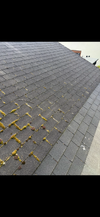
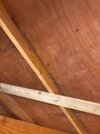
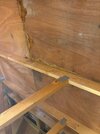
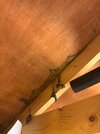
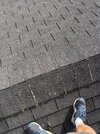
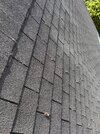
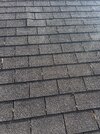
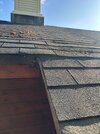
That pattern is indicative of moisture penetration and mould feeding on it. However, it does look like its small amount, so potentially is not allowing constant or persistent moisture to get in - unless you know otherwise?
So that tends to be either directional rain, or a specific set of circumstances that allows a very small amount of moisture to get around the shingles. In these cases, you are looking for gaps, loose shingles, excess moss, poor overlap issues up at the ridge and suchlike that is allowing rain to get in or be blown up and under the shingles.
The location looks like it's on a board edge, so you would be looking directly above the mould or vertically up the roofslope above it, say about 500mm either side and up to the ridge.
If there is nothing wrong there, then one other possibility is condensation - damp air and a cold spot on that board joint causing it to condense on the felt underside and seep back in and appearing like small amount of penetrating moisture.
This would be feasible, but when this happens it tends to occur in many places, but it may well be appearing in just one place if the local conditions are just right there
So,
- First thing check the roof again to confirm there are no obvious issues. If there is, deal with those, but avoid ripping the shingles off unless there is an obvious problem
- Clear all that mould, sterilise the board for 500mm either side and the timber truss. Let that dry properly and then give the area a light sand to expose clean timber so you can see if it gets damp again.
- Monitor and see if anything reoccurs
- If it does, determine if its after rain or not. Is it after particular weather - cold, windy etc. If it does get worse after raain then its a shingle issue
- If not worsening after rain, then the likelihood shifts to condensation
- See if you can seal any board joints with a mastic and coat the underside with an oil like decking oil or fencing oil, or clear preservative. This should at least prevent mould coming back there.