

- Joined
- 14 Oct 2025
- Messages
- 32
- Reaction score
- 5
- Country

Hi all,
Planning to upgrade the electrical supply to my detached garage at some point in the future and trying to establish how a sparky would normally approach this before getting quotes. Currently the garage is supplied from the kitchen cooker circuit via SWA buried under the patio. It is rough to say the least. I'd like to replace this with a dedicated submain.
The proposed setup is fairly straightforward:
I've been looking at two possibilities:
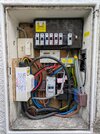
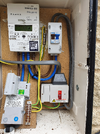
Option 1: One of those small plastic domestic switch-fuses (Contactum/FuseBox type), mounted inside the meter cabinet, with the SWA properly terminated separately using an appropriate gland and earthing arrangement, similarly to the attached pic.
Option 2: A small metal-clad switch-fuse, such as the LIVE MCFS100/3F (225 × 115 × 82mm), mounted vertically on the inside right-hand wall of the meter cabinet, assuming adequate clearance. This would potentially allow the SWA to be glanded directly into the metal enclosure.
I've seen examples of both arrangements in other domestic meter cabinets, but appreciate that doesn't necessarily mean either is acceptable in mine.
The third option would be to retain an existing external Proteus solar CU and use a suitably rated MCB to protect the submain, although the whole idea behind it is to eliminate that enclosure if possible so I wouldn't have wires and random boxes all over the house.
What would you normally do in this situation? Is mounting a compact switch-fuse inside a domestic external meter cabinet acceptable practice, assuming there's sufficient clearance? Would you generally favour the metal-clad switch-fuse with direct SWA termination over a compact plastic unit with a separate gland arrangement?
Not looking for instructions on working with meter tails or DNO equipment. Just trying to understand what a professional installer would consider the neatest, most sensible solution so I can specify the job properly when requesting quotes.
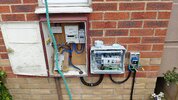
Photos attached showing my existing cabinet and an example installations(I'm aware its a messy pic but shows how a sparky installed it!).
Planning to upgrade the electrical supply to my detached garage at some point in the future and trying to establish how a sparky would normally approach this before getting quotes. Currently the garage is supplied from the kitchen cooker circuit via SWA buried under the patio. It is rough to say the least. I'd like to replace this with a dedicated submain.
The proposed setup is fairly straightforward:
- 100A supply, TN-C-S/PME.
- Existing Henley blocks with a spare connection.
- Approx. 16m of 16mm2 3-core SWA to the garage, mostly underground ducting with a drawstring and that's part of this job that I'll be doing myself.
- I think a 63A switch-fuse at the supply end, subject to what sparky says.
- New garage CU with 100A mains switch, SPD and individual RCBOs when I tidy this up. Again, its an inherited total mess.
- Existing 3.6kW grid-tied solar inverter would eventually connect to the garage CU on its own protected circuit instead of the current Proteus CU.
I've been looking at two possibilities:
Option 1: One of those small plastic domestic switch-fuses (Contactum/FuseBox type), mounted inside the meter cabinet, with the SWA properly terminated separately using an appropriate gland and earthing arrangement, similarly to the attached pic.
Option 2: A small metal-clad switch-fuse, such as the LIVE MCFS100/3F (225 × 115 × 82mm), mounted vertically on the inside right-hand wall of the meter cabinet, assuming adequate clearance. This would potentially allow the SWA to be glanded directly into the metal enclosure.
I've seen examples of both arrangements in other domestic meter cabinets, but appreciate that doesn't necessarily mean either is acceptable in mine.
The third option would be to retain an existing external Proteus solar CU and use a suitably rated MCB to protect the submain, although the whole idea behind it is to eliminate that enclosure if possible so I wouldn't have wires and random boxes all over the house.
What would you normally do in this situation? Is mounting a compact switch-fuse inside a domestic external meter cabinet acceptable practice, assuming there's sufficient clearance? Would you generally favour the metal-clad switch-fuse with direct SWA termination over a compact plastic unit with a separate gland arrangement?
Not looking for instructions on working with meter tails or DNO equipment. Just trying to understand what a professional installer would consider the neatest, most sensible solution so I can specify the job properly when requesting quotes.
Photos attached showing my existing cabinet and an example installations(I'm aware its a messy pic but shows how a sparky installed it!).


 Three incompetent box slingers and not a single four legged horse between them? Sounds like the entire industry is in desperate need of better training, stricter entry requirements and a competent farrier.


