• Looking for a smarter way to manage your heating this winter? We’ve been testing the new Aqara Radiator Thermostat W600 to see how quiet, accurate and easy it is to use around the home. Click here read our review.

Gravity feed shower - tank volume sufficient?

Sorry for any confusion in my posts above. No, it's just the one shower we have. We do have a bath, but it's never used.

We're replacing (have now replaced) an old electric shower which had a cold water feed coming off the mains, for a new gravity feed shower, with the cold feed coming off the CW tank in the attic.

All the above advice looks very encouraging er that tank's capacity, and has been immensely helpful. In summary: current tank is sufficient, but we need a CW feed to the HW cylinder to be above the CW feed to the shower. Our plumber will be able to sort that.
 
we need a CW feed to the HW cylinder to be above the CW feed to the shower
Not with you there. If you have CWST in the loft, HW cylinder on 1st floor, and shower on ground floor, you're OK. There'll be a vent pipe from the top of the HW cylinder going up and over the CWST, and one way is to tee off that for the hot feed to the shower. Tee as low as poss in the loft, or in the airing cupboard. Or depending on the house layout, it might be easier to tee into a pipe between the HW cylinder and the downstairs taps
 
The only time you may be concerned about the cistern running out of water is if you are showering and the mains fails, your TMVs (thermostatic mixing valves) showers will give protection if the cold water runs out first, its probable that both hot and cold will die down together in any case. There are thousands of unvented cylinders about both with and without a balanced cold supply, the balanced cold ones will run out of hot&cold together but the TMVs give protection if the cold is inadvertently shut off on the unbalanced.
 
Last edited:
Not with you there. If you have CWST in the loft, HW cylinder on 1st floor, and shower on ground floor, you're OK. There'll be a vent pipe from the top of the HW cylinder going up and over the CWST, and one way is to tee off that for the hot feed to the shower. Tee as low as poss in the loft, or in the airing cupboard. Or depending on the house layout, it might be easier to tee into a pipe between the HW cylinder and the downstairs taps
That sounds interesting. Could you explain a little more how that would work? To confirm, you're right. Tank in the loft, HW cylinder, on the floor below (1st), and shower on the ground floor.

So at present, the HW outlet at the top of the HW cylinder goes up out of the centre of the HW cylinder and splits two ways. One way to the shower as the HW supply, on the ground floor, and the other way goes off to the HW taps on 1st and ground floors. This last pipe splits a bit further along at a T-junction. As you stated, one arm of the T goes vertically straight down to the basin taps (on the 1st floor and ground floor), and the upper part of the T-junction is the vent that vertically returns upwards to the loft space and in the loft space bends over the lid of the tank, before entering into the tank through a hole in the lid.

If I'm understanding your suggestion correctly, that's similar to what we already have in place, except the feed off to the shower is higher and nearer the cylinder HW outlet.

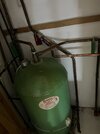
Here's a photo, but I'm not sure if that helps. But here goes.

So the pipe coming down the back wall, nearest to the L of centre, which has a blue lever on it and a red tag (tagged so my partner knows which pipes are which if I'm away and she needs to know urgently!) is the current cold feed coming down from the CW tank in the loft. Just after, and below the blue lever you can see if splits two ways. One going to the base of the HW cylinder to feed cold in, and the other is the temporary CW supply to the shower downstairs (the shiny new copper), running horizontally L to R and then downwards.

The top of the HW cylinder has the HW feed, and the first junction going to the R and also initially horizontal, feeding the HW to the shower. Above this junction to the shower, the pipe continues and levels out briefly horizontally, and runs towards the back of the airing cupboard, where it splits vertically. Up is the vent to the tank in the loft, down is HW to the HW taps. The vertical pipe behind it with the brass stop tap on, and a green tag, is the mains CW supply to the tank in the loft. The other horizontal feed coming off the mains supply also with a brass stop valve feed to a field trough behind the house. Other piping is CH related.

That's probably as clear as mud!

 

Attachments

  • pipes.jpg
    pipes.jpg
    218.5 KB · Views: 31
@Madrab suggests that the cold water supply is taken off higher up in the CWSC than the cold water so as the HW will stop (run out) before the cold water does.
The outlet from the HW cylinder top might be a Surrey Flange or similiar where the lower T off goes to the showers.
 

Attachments

So at present, the HW outlet at the top of the HW cylinder goes up out of the centre of the HW cylinder and splits two ways. One way to the shower as the HW supply, on the ground floor
Is that for the new shower? You said the original shower was mains fed. Is your pic the original setup, or has some work been done?

Teeing into the vent pipe in the loft is useful in the more common setup where the shower is on the 1st floor. Just run the pipes (H and C) to directly above the shower, and drop down. I've done 2 houses that way. Dedicated connection on the CWST for shower cold supply, but same level as the other connection, which supplies the HW cylinder and the cold taps. Didn't think about Madrab's point on different levels, but not scalded anybody yet!
However, for shower on the ground floor, might be easier (depending on the house) to tee in somewhere else. But still best to have a dedicated CW connection, might even be mandatory. From your pic you already have a Surrey flange, so why not use that? I believe a Surrey flange is recommended for a pumped shower, to stop air bubbles entering the pump, but OK with a gravity shower.
 
Is that for the new shower? You said the original shower was mains fed. Is your pic the original setup, or has some work been done?

Teeing into the vent pipe in the loft is useful in the more common setup where the shower is on the 1st floor. Just run the pipes (H and C) to directly above the shower, and drop down. I've done 2 houses that way. Dedicated connection on the CWST for shower cold supply, but same level as the other connection, which supplies the HW cylinder and the cold taps. Didn't think about Madrab's point on different levels, but not scalded anybody yet!
However, for shower on the ground floor, might be easier (depending on the house) to tee in somewhere else. But still best to have a dedicated CW connection, might even be mandatory. From your pic you already have a Surrey flange, so why not use that? I believe a Surrey flange is recommended for a pumped shower, to stop air bubbles entering the pump, but OK with a gravity shower.
Yes, this set up in the photo is for the new shower with the work done, albeit that the CW supply to the new shower is temporarily coming off the CW supply going to the bottom of the HW cylinder (just to see if the tank capacity is sufficient as it stands). That's the bit that will be changed so it permanently comes off the CW tank in the loft.
 
If I can suggest that if you are using gravity supplies to anything that they use their own dedicated feeds for each supply. The trouble with gravity supplies is that they can be very susceptible to a drop in output when other outlets on the same supply pipe are used, unless there is an ample head of pressure from the CWSC.

We were always taught to run separate feeds to anything that didn't use full flow low pressure outlets. Showers, by their very construction, tend to be very sensitive to changes in pressure/flow unless they are pumped.

Whoever tapped the HW cylinder before looks to have known what they were doing by providing a separate supply through the flanged output to avoid that specific drop out scenario, almost as if it was also being setup for a pumped shower.
 
If I can suggest that if you are using gravity supplies to anything that they use their own dedicated feeds for each supply. The trouble with gravity supplies is that they can be very susceptible to a drop in output when other outlets on the same supply pipe are used, unless there is an ample head of pressure from the CWSC.

We were always taught to run separate feeds to anything that didn't use full flow low pressure outlets. Showers, by their very construction, tend to be very sensitive to changes in pressure/flow unless they are pumped.

Whoever tapped the HW cylinder before looks to have known what they were doing by providing a separate supply through the flanged output to avoid that specific drop out scenario, almost as if it was also being setup for a pumped shower.
Cheers Madrab, that's good to know.

I'll now ask the plumber to ensure we have a permanent and separate CW feed to the tower from the CW loft tank, which is basically what he was suggesting, also making sure the CW supply to the HW cylinder is the outlet above the CW supply to the shower (again what he was suggesting). We can precede now as we know the CW tank's capacity seems to be sufficient and additional tanks in the loft are not needed (they would have had to be a series of smaller linked tanks in order to fit through the loft hatch and it would have been v. tricky to find a place for them to sit up there too!)
 
Didn't think about Madrab's point on different levels, but not scalded anybody yet!
This harks back to the manual shower days before TMV2/3's where these days if the shower detects temps above 45deg, it should shut down. The trouble with that though is it can take a sec or 2 to do that, depending on where the valve came from. TMV3 is a higher NHS spec more for heath care settings and has faster reaction times when working with higher pressures than a TMV2.

Trouble with all of that though is, not all showers are TMV's never mind 2/3 compliant, especially if using a hot and cold manual mixers or some of the far eastern cheaper thermo valves, therefore it is always good practice IMO. I have lost count of the number of cheap thermo valves that clients have supplied that have had to be calibrated down properly, so many are set too high.

More reputable manufacturers seem to take calibration a bit more seriously as I have found very few that have had to be calibrated down and all of them were lower than spec rather than higher.
 
I'll now ask the plumber to ensure we have a permanent and separate CW feed to the tower from the CW loft tank, which is basically what he was suggesting, also making sure the CW supply to the HW cylinder is the outlet above the CW supply to the shower (again what he was suggesting).
Excellent - Sounds like you have a plumber that's experienced and knows what he's doing with gravity fed systems (y), so many don't these days.

Worst case with the cisterns is, if you do run into issues with the supply then it can always be retrofitted quite easily, especially with an experience professional to hand
 

If you need to find a tradesperson to get your job done, please try our local search below, or if you are doing it yourself you can find suppliers local to you.

Select the supplier or trade you require, enter your location to begin your search.


Are you a trade or supplier? You can create your listing free at DIYnot Local

 
Back
Top