I'm confused about junction box rules

First world problems? Ashley are much easier to work with imo.
Much easier than what? We're talking abut the Ashley/Hager J803s and J804s.
Arguably an unhelpful comparison given so many EICRs involve only inspection of selected circuits. Rumour has it that some sparkies regard the actual house as inaccessible so conduct a drive by assessment.
The requirement of BS7671 is that (non-MF) joints must be "accessible for inspection and testing". If no-one is going to inspect/test things, it becomes rather moot, if not silly.

I was merely offering a suggestion as to what 'test' one should apply when trying to interpret what the regs mean by "accessible". If, as seems to be the case, you don't think that 'whether or not anyone will bother to access' is a good test, what would you suggest as a better alternative?
 
...and yes I would like to know where the 1/8 idea actually stems from, even as a quick approximation.
OK. I think I've worked out what was probably the thinking underlying the "1/8" idea, but have also demonstrated that it is essentially useless as a 'rule of thumb'!

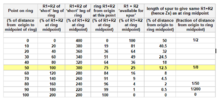
I have calculated, for various points on a ring, what length of spur would result in the same Zs at the end of the spur as at the midpoint of the ring. The 'extreme case' is that in which Zs at the midpoint is already 'at' the 'maximum Zs' for the circuit, but my calculations apply equally for any Zs. See the table below.

As can be seen, as Sunray said, at the point which is half way between origin and mid-point of the ring, the "1/8" rule is exactly correct - i.e. at the end of a spur originating at that point, the Zs will be the same as it is at the midpoint of the ring if the length of the spur is 1/8 (12.5%) of the distance from origin to midpoint of ring.

However, that 1/8 only works at that one point on the ring. For other points (origin of spur) the length of spur that would give the same Zs as the midpoint of the ring varies from zero (at mid-point of ring) to 1/2 (50%) (at origin of ring) - hence essentially useless a s a general 'rule of thumb'!
1760877314095.png


Kind Regards, John
 

Attachments

  • 1760877003979.png
    1760877003979.png
    21.9 KB · Views: 12
So - the 'rule' is actually not correct, therefore wrong; i.e. a mistake.

Not least of course because it does not mention the length of the ring circuit.
 
Another thing is when people ask about connecting a spur to a ring circuit. is heard the familiar cry of "it's better if you extend the ring".

I suppose in the thinking of the OSG this is never actually possible.
 
So - the 'rule' is actually not correct, therefore wrong; i.e. a mistake.
It does not claim to be 'a rule'. It describes it as a 'rule of thumb', in which case one would not expect it to always (if ever) be exactly 'correct'. However, I have illustrated/suggests that it is pretty useless, even as a rule of thumb. It would be much closer to being 'correct', and a bit more useful, if it were prefaced with something like "For spurs originating roughly half way between origin and midpoint of a ring final ....". Indeed, as I've shown the 1/8 is 'exactly correct' if the spur originates exactly half-way to the midpoint.
Not least of course because it does not mention the length of the ring circuit.
The length of the ring circuit does not affect my calculations, which merely ensure that the Zs at the end of the spur is the same as the Zs (whatever it may be) at the midpoint of the ring.

Since their rule of thumb results in the maximum permissible spur length approach zero as its origin approaches the midpoint of the ring, they seem to be assuming that the rings Zs is AT the 'maximum permitted Zs' for the circuit.
 
It does not claim to be 'a rule'. It describes it as a 'rule of thumb', in which case one would not expect it to always (if ever) be exactly 'correct'. However, I have illustrated/suggests that it is pretty useless, even as a rule of thumb.
Therefore a mistake.

It would be much closer to being 'correct', and a bit more useful, if it were prefaced with something like "For spurs originating roughly half way between origin and midpoint of a ring final ....". Indeed, as I've shown the 1/8 is 'exactly correct' if the spur originates exactly half-way to the midpoint.
It is not exactly correct if the ring circuit is less than the maximum.

The length of the ring circuit does not affect my calculations, which merely ensure that the Zs at the end of the spur is the same as the Zs (whatever it may be) at the midpoint of the ring.
But that Zs value is irrelevant if the ring circuit is less than the maximum.

Since their rule of thumb results in the maximum permissible spur length approach zero as its origin approaches the midpoint of the ring, they seem to be assuming that the rings Zs is AT the 'maximum permitted Zs' for the circuit.
Well, of course they are assuming that which is a mistake.
 
Furthermore as you have said the value only applies at one point on their assumed maximum Zs circuit which is even more of a mistake.
 
Which is 106m from memory...
That is what the OSG says is 'the maximum' (and, as EFLI has said, many/most are shorter than that). However, in most cases that has got nothing to do with Zs (consideration of which would probably often allow for a longer ring) since, in most cases, the 'maximum length' figure given by OSG is based on voltage drop (something which most people do not worry much about) ....

1760884291908.png
 
Another thing is when people ask about connecting a spur to a ring circuit. is heard the familiar cry of "it's better if you extend the ring". I suppose in the thinking of the OSG this is never actually possible.
As you know, it's only "not possible" if the Zs of the ring is already at the maximum allowed for the circuit.
 
It is not exactly correct if the ring circuit is less than the maximum.
It is correct (at that one point on the ring) in terms of what I was determining - i.e. the maximum spur length such that the Zs at the end of the spur would be no greater than the Zs at the midpoint of the ring. As I wrote, that Zs may or may not (usually the latter) be the maximum permitted for the circuit.
But that Zs value is irrelevant if the ring circuit is less than the maximum.
In that situation, it is indeed irrelevant in terms of whether the Zs at the end of the spur is acceptably low - since, per what I calculated, if the Zs of ring circuit is less than maximum,then so will be the Zs at the end of a sour of length I have indicated.
Well, of course they are assuming that which is a mistake.
It seems that they may well be, but it is far from unusual for regs to consider 'worst-case scenarios' - which, in this case, would mean that the midpoint of the ring already had the maximum permitted Zs - which, in turn, would mean that a spur originating at the midpoint would not be possible AND, as you have observed, that the ring could not be extended.

You are taking a totally different attitude to this than I am. I was simply intellectually interested in working out what thinking was behind this "1/8" rule-of-thumb, and I think I have achieved that, to my intellectual satisfaction - and that has also convinced me that it is a pretty useless rule-of-thumb. You are more concerned with going on about (the lack of) 'correctness' and 'mistakes' etc. - which is your prerogative, but of little interest to me, since I can do my own sums and don't need a 'rule-of-thumb'

 

If you need to find a tradesperson to get your job done, please try our local search below, or if you are doing it yourself you can find suppliers local to you.

Select the supplier or trade you require, enter your location to begin your search.


Are you a trade or supplier? You can create your listing free at DIYnot Local

 
Back
Top