• Looking for a smarter way to manage your heating this winter? We’ve been testing the new Aqara Radiator Thermostat W600 to see how quiet, accurate and easy it is to use around the home. Click here read our review.

Insulation resistance test

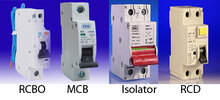
what is a RCD? where can I find it? The fuse box for this shower is in the garage.
 
Issuing such a document seems rather OTT without a proper explanation of what they did and for what reason …..
Quite so.
My guess is that they tested L - N and included an indicator light on the isolation switch
Yes, possibly - but given that they seemingly measured the Zs and reported a result which was 'too high' (but didn't 'warn about', or 'code', that in their 'report' document), if they had undertaken an IR test and got an 'unsatisfactory' reading (resulting in the warning/coding in their 'report') wouldn't one expect them to have mentioned what IR reading they got (for whatever reason) ?
 
For a B40 MCB to trip the magnetic part, it needs 3 to 5 times that current. We also include 5% safety margin, so 230/200=1.15Ω times 95% = 1.10Ω which is less than 2Ω, so there is nothing in what you show that is a fault.

It does not really need to be so low if there is an RCD or RCBO PartID_CU.jpg.
The meter used to test insulation resistance uses 500 volt DC, and it is unlikely to show 2Ω it would show 2MΩ, but the only thing it shows is
1744959481524.png
and to do that the circuit would need disconnecting at the consumer unit, as an MCB only switched the line, not the neutral, and the neutral is linked to earth, the whole home could be tested by turning off the Isolator, or part of home if there is an RCD, but to test just one circuit some RCBOs are double pole, but in the main it would need to open the consumer unit, and disconnect inside the unit to test.

It seems the installer does not know the difference between earth fault loop impedance and insulation resistance. Which is very worrying. I looked for instructions clearly old as refers to IEE, and it has been IET for nearly 20 years. But does say
For new installations a 30mA Residual Current Device (RCD) must be incorporated into the electrical supply to the shower in accordance with the current wiring regulations. When replacing an existing electric shower we recommend that a 30mA RCD is incorporated in accordance with current wiring regulations if not already provided.
So what we would expect is the test details of the RCD, it should trip at 30 mA, and we would normally enter either the speed, and the current at which it tripped, mainly to show it had been tested.

Fact it refers to installation certificate and minor works certificate the certificate you show is clearly not a version of the minor works certificate, so you should have one of them as well.

 
Safely isolate the supply and do a before and after LN reading, the after is with the cables temporarily connected outside of the switch. That will confirm if it’s led interference. That is a simple test for a diyer. But if as seems likely you are not even basically proficient either ignore it or get a sparkie in. Your call.
 
For a B40 MCB to trip the magnetic part, it needs 3 to 5 times that current. We also include 5% safety margin, so 230/200=1.15Ω times 95% = 1.10Ω ...
Indeed, actually 1.0925 Ω, which the tabulation of 'maximum Zs' in BS 7671 rounds down to 1.09 Ω.
.... which is less than 2Ω, so there is nothing in what you show that is a fault.
I think the point is that the Zs is reported as "less than 2 Ω" - which obviously could mean as high as 1.99 Ω- which would be unsatisfactory. The fact that they have reported it as *** demonstrates that they didn't 'know what they were doing' :-)
It does not really need to be so low if there is an RCD or RCBO
Even if there is residual current protection, in a TN installation t does need to be 'that low' to be compliant with BS 7671, and the L-N loop impedance also needs to be 'that low' to provide adequate protection to the table (albeit the L-N loop impedance will be a bit lower than the L-E/Zs one)
It seems the installer does not know the difference between earth fault loop impedance and insulation resistance. Which is very worrying.
Quite so. As I've said, that is the worry.
 
Safely isolate the supply and do a before and after LN reading, the after is with the cables temporarily connected outside of the switch. That will confirm if it’s led interference. That is a simple test for a diyer.
Yes, for some DIYers, but probably not this one (as I'm sure he would admit himself). As you go on to say ...
But if as seems likely you are not even basically proficient either ignore it or get a sparkie in. Your call.
Yes, very likely, given that he had to ask what an RCD is. However, as I've said,before he turns to an electrician, it would probably be sensible to try to find out why the installer is suggesting that an IR test is required - since I suspect that there might well not be any reason for that!
 
what is a RCD? where can I find it? The fuse box for this shower is in the garage.
Residual Current Device which you expect to find in your Consumer Unit (CU) (aka Fuse Box). The usual advice is to post a picture of the CU so that we can see all the "switches" and their labels.
 

If you need to find a tradesperson to get your job done, please try our local search below, or if you are doing it yourself you can find suppliers local to you.

Select the supplier or trade you require, enter your location to begin your search.


Are you a trade or supplier? You can create your listing free at DIYnot Local

 
Back
Top