
Is this main breaker box and subpanel setup correct?

Joined
10 Jun 2024
Messages
15
Reaction score
0
Country
Mauritius
Hello

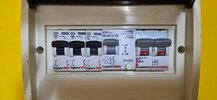
This is the main breaker box in the house downstairs:
7866ef4c-c0bc-4f50-b585-8192ab756329.jpeg

And this is the other breaker on the first floor found right above the main breaker box:
f3bcbdeb-a5da-48e3-9a11-418ed323199d.jpeg

I want to understand what these breakers mean (are these values correct?) and if the setup has been done correctly (i checked some YouTube videos and it seems like the main breaker in this case might be the 63A but it should have been installed on the far-left side?). I counted the breaker total Amps and it comes to 66A but the main breaker is only 63A??

I also want to check if the neutral busbar (if it even exists in this connection box?) has been connected to the ground busbar in the main breaker box. Is it safe for me to unscrew it just to check inside? I can see two Philips screws on each side of the panel.

Thanks in advance for any help.
 
I counted the breaker total Amps and it comes to 66A but the main breaker is only 63A??

That is quite normal.

It is considered highly improbable that all the circuits in your house would be drawing maximum current at the same time (or, indeed, ever).


The principle is called "diversity " and there are some rules for calculating it, I don't know what they will be in your country, but your figures look fine.
 
I also want to check if the neutral busbar (if it even exists in this connection box?) has been connected to the ground busbar in the main breaker box. Is it safe for me to unscrew it just to check inside? I can see two Philips screws on each side of the panel.
DO NOT connect the ground to the neutral without consulting local regulations first.

Americans bond ground and neutral in the main breaker panel, but this is a quirk of american practices, not a universal global standard.
 
These Legrand MCBs have shrouded terminals. Check if the 63 A disconnects all power to the house. If it does you can safely remove the front cover and have a look at the wires.
 
DO NOT connect the ground to the neutral without consulting local regulations first.

Americans bond ground and neutral in the main breaker panel, but this is a quirk of american practices, not a universal global standard.
Not really.

The TN-C-S system requires that the Neutral be bonded to the Earth.

How else can the "Neutral" be a Neutral, unless it is bonded to the Earth?

TN-C-S is used almost universally in North America and Australia.
It is also used in the UK - and many other countries

See https://en.wikipedia.org/wiki/Earthing_system
 
Last edited:
Not really.

The TN-C-S system requires that the Neutral be bonded to the Earth.

How else can the "Neutral" be a Neutral, unless it is bonded to the Earth?

TN-C-S is used almost universally in North America and Australia.
It is also used in the UK - and many other countries

See https://en.wikipedia.org/wiki/Earthing_system

Remind me what the "S" stands for in TN-C-S
 
The TN-C-S system requires that the Neutral be bonded to the Earth.
In the UK it's up to the supplier to determine if a supply is suitable for TN-C-S. If it is then they will supply an earth terminal which is bonded to their neutral wire. In normal installations neutral and earth are kept entirely seperate on the neutral side.

I stand by my position that people should not go adding neutral to earth bonds based on stuff they have read on foreign websites.
 
Back
Top