Maybe I'm scraping the very same barrel as you, with your need to have the alarms on your lighting circuit

.... As Sparkamarka pointed out, most/all such alarms, bleep annoyingly, anyway, making them incredibly difficult to ignore.
I would suggest you are wrong there, one would need to be really stupid, not to be able to appreciate that a regular noise from an alarm, was meant to convey that something was amiss with the alarm.
I thought I was right, but have just studied the Aico documentation to confirm and, furthermore, have 'done the experiment' to further confirm (as far as I can) that the documentation is telling the truth [although I do
not have any switch, or FCU, I do have easy access to the point where the alarms are fed from the downstairs lighting circuit, so was easily able to disconnect the mains supply to the alarms ].
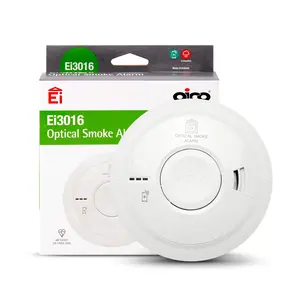
I have four interconnected Aico 3000 series alarms. When I disconnect the mains,
ALL that happens is that the (usually constantly 'on') green LED on each alarm goes out and, instead flashes (for a fraction of a second) once every 48 seconds. I doubt that many people would notice that, particularly in a house like mine with very high ceilings. Of most importance to the discussion,
nothing 'beeps'.
I obviously have to take Aico's word for it but, apparently, if the state of battery charge gets worryingly low, it then starts beeping (I suspect very briefly) (they call it 'chirping') once every 48 seconds - but that could presumably be weeks or months after the mains supply had failed and, even then, might not be 'compelling enough' to result in immediate action by the occupants (since occasional 'chirps' might well not be very 'annoying').
I would say that this underlines my personal view that, at least with Aico alarms, it is much more sensible to have them powered from a constantly-used lighting circuit than from a 'dedicated' circuit of their own.


 www.aico.co.uk


