• Looking for a smarter way to manage your heating this winter? We’ve been testing the new Aqara Radiator Thermostat W600 to see how quiet, accurate and easy it is to use around the home. Click here read our review.

Leak at abutment, apex extension roof

Joined
9 Nov 2010
Messages
33
Reaction score
0
Location
Cheshire
Country
United Kingdom
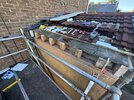
While replacing fascias and soffits on my 90’s extension, I found the joist and rafter adjacent to the main house wall is soaking wet, which coincides with a mound patch on the roof inside.
Tiles are Marley Ludlow major, and use lead flashing at the abutment. The felt underneath has folded down after the last rafter, which I suspect is the problem.
Would the best option be to fit soakers instead to resolve the damaged felt and stop the leak?
 

Attachments

  • IMG_6718.jpeg
    IMG_6718.jpeg
    548.1 KB · Views: 41
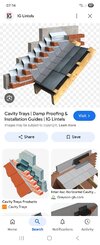
The flashing is poorly fitted and cavity trays should be fitted . And of course turn the felt up the wall . Soakers won't help
 
Thanks for the reply and excuse my ignorance on this subject, but why do I need cavity closers? I can see when they are used, but no additional openings where created in the existing wall, they even left the original aluminium back door as the door into the extension, the only new holes are for plumbing and the extractor fan. The rafters are not keyed into the existing house wall. They run parallel to the wall.
The damp is
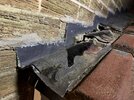
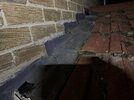
Concentrated in the corner of the ceiling in the extension at this side, the other side is fine. The flashing hasn’t been done very well at all, and is covered with quite a few layers of flashband, which doesn’t hide the fact that the flashing doesn’t underlap the next tile (the other side seems to have been done better).

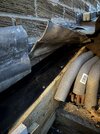
I’ve notched it for now, using a modified section of felt support tray to fashion a short gully down to the fascia to try and help until a proper fix is done (tray does run down toward the wall despite how it looks in the image!) I also had to add a section of replacement membrane underneath the felt because the cowboy that built it decided not to check pipework before fitting and the hot water and central heating pipes enter the wall in the corner, with the bend so high it’s damaged the felt…

if I remove the flashing and first row or two of tiles, I could underlay new membrane across the first two rafters and secure through the existing felt, but that will
Need some form of support to keep it curled up the wall wouldn’t it?

I’ve no idea how to do lead flashing like this, so I’m pondering doing a diagonal cut up the wall and running a single run of flashing from top to bottom and fix into the new groove; that way it could saddle the ridge as well?
Would I need to add any additional protection under the tiles, or just secure the flashing to the first tile?

If I’m completely off here, observations and suggestions how to easily to this would be appreciated!

 

Attachments

  • IMG_6730_sml.jpg
    IMG_6730_sml.jpg
    372.6 KB · Views: 20
  • IMG_6722.jpg
    IMG_6722.jpg
    427.6 KB · Views: 22
  • IMG_6734sml.jpg
    IMG_6734sml.jpg
    304.9 KB · Views: 21
Last edited:
Cavity trays not closers.
 

Attachments

  • Screenshot_20251122_071423_Google.jpg
    Screenshot_20251122_071423_Google.jpg
    146.5 KB · Views: 20
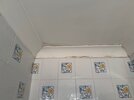
What does this damp patch look like and location - wall or ceiling?

Is the wall below dry lined or wet plastered?

Damp from a wall with no cavity trays is often different to damp from a roof abutment leak.
 
Hi. Thanks for the message, I’m pretty certain it’s not a cavity tray based leak, as the marks are just in the top coving section, which makes me think it’s flashing defects, plus the rafter was only wet the last 100mm or so.
Wall is dry lined, attached photo for better idea!
 

Attachments

  • IMG_6773.jpeg
    IMG_6773.jpeg
    226.3 KB · Views: 18
Yup I know the gradient is nowhere near right- 15 degrees at rafter level. Been like that since cowboy built it in 99, been ok until recently, hence why I’m not changing it yet (and can’t afford to!)
 

If you need to find a tradesperson to get your job done, please try our local search below, or if you are doing it yourself you can find suppliers local to you.

Select the supplier or trade you require, enter your location to begin your search.


Are you a trade or supplier? You can create your listing free at DIYnot Local

 
Back
Top