

That's all in relation to the 'old-fashioned' method of 2-way switching (per your diagram above). As I said, I was talking about the 'modern' method.The capacity between Live and Switched Live determines how much current flows when the light is OFF ... Which ever way the switches are set to OFF ( both to L1 or both to L2 ) the Live and Switched Live run side by side in the two strappers so that capacity is the same for both OFF states ... The difference in capacity between the two OFF states depends on whether the strapper closest to the returning Switched Live is connected to the Live or the Switched Live. ... When switch A is on L2 the live strapper is closer to the returning Switched Live than the other strapper which is live when switch A is on L1
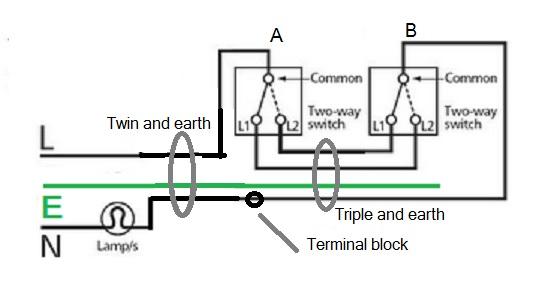
With the 'modern' system, with one 'off configuration' two of the conductors are connected to the L, and if one is using eric's plan of having the grey (alone on one side of the CPC) as the 'always permanent L', then that means that the other L is immediately adjacent (without intervening CPC) to the feed to the lamp ('switched live', if you wish). With the other 'off configuration', there is a CPC between the L conductor and the other two (then joined) conductors which feed the lamp ('switched live') - so, a greater physical distance between L and S/L, and an earthed CPC between them.
Kind Regards, John


