• Looking for a smarter way to manage your heating this winter? We’ve been testing the new Aqara Radiator Thermostat W600 to see how quiet, accurate and easy it is to use around the home. Click here read our review.

Loft clear-out and rewire

Joined
30 Jul 2024
Messages
17
Reaction score
1
Country
United Kingdom
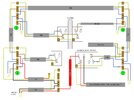
Hi all, after removing all the fibreglass insulation and vacking out the loft, a rewire is required to take the cables above the insulation, and conform with the brown/blue code. Following the clear-out, I pulled back all the switches, and uncapped the roses, and then mapped out what I found. Would anyone mind having a look at the attached image to see if it's in order before I begin?

Just one thing: Currently, the entire layout is the old colour code, and the brown/blue is for my reference when the rewire begins. But after discovering a ceiling rose in the loft beneath the insulation and tracing its function, I decided to leave in the old red/black colours for your opinion(s). It looks like the neutral has been borrowed from room 4 for the landing light. Possibly because the switch wires run down through old, steel conduit, and I'm wondering if three T&Es wouldn't squeeze through, so they opted to use two twins and a single. Anyway, what they did, and left behind, isn't pretty...

Upstairs Lighting Circuit.jpg

Landing light junction box.jpg
 

Attachments

  • Upstairs Lighting Circuit.jpg
    Upstairs Lighting Circuit.jpg
    114 KB · Views: 18
Last edited:
Because they'll be in the way when I build a raised timber/plywood floor. If ever any wiring needs changing in the future, I wouldn't want to find it beneath a new floor and 300mm of insulation.
 
The landing light switch is not wired correctly.

Is there only a T&E running from there to the downstairs switch?
 
Hi EFLImpudence, thanks for replying, and you're right of course. Having pulled upstairs and downstairs switches from the wall, I'll need to revise the diagram. Taking pictures isn't sufficient, so I'm now armed with a torch, notepad and stronger glasses. I'll get back later with a diagram revision and probably more pictures.
 
If things are as they appear, then -

1762954616761.png


Assuming upstairs and downstairs are separate circuits, then you do indeed have a borrowed neutral.
 
It would appear that nothing has been borrowed. In April '24, we had the CU replaced and relocated. Craig, the electrician, did a thorough walk around, checking continuity, voltage values and leakage. He discovered that all the house lights are on one circuit, bar the kitchen, which has its own. His remit was simply to upgrade the CU, which he did, quite nicely:
Consumer Unit.jpg


After my own walk around, I've had to revise the diagram posted earlier. Here's the latest version, and you'll notice that only one switched live has been identified in Room 4, at the light switch. For clarity, I've omitted all earths and changed the wiring code to the existing colour. Also, the switches are now representative of their physical construction:

Upstairs Lighting Circuit Red Black.jpg


Here are the Room 1/Landing Light, and Hall/Landing Light switches, side by side (notice black and red tape in use, or not):
Two Way Circuit Landing and Hall.jpg


Just so there's no doubt, upstairs switch:
Room 1 and Landing Light Switch.jpg


I must admit, without any formal electrical training, I'm struggling with this hiccup. The rest of it appears straight forward to upgrade, I think. I'd prefer to remove the ceiling rose abandoned in the loft, together with the red single it has for company, but don't really know how to deal with it. Any advice would be more than welcome.
 
^^ that’s a well labelled CU and probably says a lot about the competence of the installer.

Good on him

And there’s nothing wrong with only having 1 lighting circuit
 
Last edited:
You can't just remove the ceiling rose in your loft as it's basically being used as a junction box, you'd need to replace the cables completely to do away with it.

For me if everythings working correctly I'd use either a wago or hager maintenance free junction box, connect it all into the box, mount the box securely to a joist and forget about it.

The idea behind a maintenance free box is you shouldn't ever have to go back into it.

If you find any future alterations are required then that would be the time to run new cables between the switches,but it's unlikely you will.
 
Will you be removing the single from light 2 to switch and wiring it conventionally?
Do you have any reason for that and are you also suggesting changing the T&E and the single of the 2 way system to 3C&C & T&E?

Unless any of those are faulty none need to be changed.

The ceiling rose in theloft would ideally be changed as already mentioned,
 
Thanks guys. thomp1983, sorry, "remove" was the wrong word. If the diagram looks sound, then I'll replace the rose with a Wago, and replace the single in the switch drop. Needless to say, all switched lives will be identified at both ends, everywhere. The objective after all is to clear the insulation and flooring, improve visibility and accessibility of the wiring, and ensure it's all sound in the process.

EFLImpudence, yes, it has crossed my mind. In fact, I'll probably do it. The only snag might be the steel conduit: Each switch drop has one, and they each have a bend still installed at the top. I may have to Dremel the clamping screw to remove each bend, but I'll line the top of each tube with an offcut of rubber panel edging gasket left over from a canopy install. Back to the conduit; if I struggle to get two 1.5mm² T&Es down there, is it permissible to mix in 1.0mm² T&Es for the switch drops on a 6A RCBO, or would that be bad practise?
 
if I struggle to get two 1.5mm² T&Es down there, is it permissible to mix in 1.0mm² T&Es for the switch drops on a 6A RCBO, or would that be bad practise?
It would be fine.

1mm² T&E has a maximum current carrying capacity of 16A and so is suitable for use in any derating situation.
1.5mm² is just overkill.
 

If you need to find a tradesperson to get your job done, please try our local search below, or if you are doing it yourself you can find suppliers local to you.

Select the supplier or trade you require, enter your location to begin your search.


Are you a trade or supplier? You can create your listing free at DIYnot Local

 
Back
Top