

- Joined
- 27 Jan 2008
- Messages
- 29,637
- Reaction score
- 3,665
- Location
- Llanfair Caereinion, Nr Welshpool
- Country

I know pre-modulating boilers better quality thermostats used mark/space ratios to stop it over shooting,
 The instructions for the thermostat shown, said how it would start switching off and on before the set point slowly decreasing the on time reducing the hysteresis.
This messed up a modulating condensing boiler, as the boiler was designed to turn down output as the return water got hotter, which would happen as the TRVs closed and the by-pass valve opened, but each time switched off and on again, it had to start adjusting output from scratch again.
So with a modulating condensing boiler, the TRV is king. An on/off thermostat is only there to stop the boiler cycling as the weather improves.
This may be the theory, but in practice we tend to control the room temperature using the wall or freestanding thermostat, as it is easier to reach than the TRV head, yes I have set the programs on the TRV heads, but if I feel a little cool I tend to still used the wall mounted thermostat, and have the TRV heads set a couple of degrees higher than normally wanted in the same room as wall thermostat.
I note, when setting up the thermostats, both my Nest Gen 3 and my Wiser, ask if using oil or gas, and if using digital (on/off) or analogue (OpenTherm) control, as to what the difference is oil to gas I don't know.
Yesterday I felt a little cool, and I set the wall thermostat 0.5°C higher, 20.5°C to 21°C and since the radiator behind my back, was feeling it to see how warm. It never did get warm at bottom, and it took 1.5 hours before the flame icon on the thermostat app went off. However, later in the day, it was programmed to go to 22°C a jump of 1°C, and it took nearly the same time to go up 1°C as it had to go up 0.5°C. The radiator was quickly warm top to bottom, with no cold bit at the bottom, which got me asking why?
It could simply be other TRVs in the house had turned off, so more water pushed through the radiators in the living room, or it could be when set to oil, the thermostats still use a mark/space ratio to stop over shooting. Although, for my oil boiler that is good, as non modulating, non condensing, modern oil boiler do modulate, not as much as gas boilers, but they do modulate.
Oil boilers in general last a lot longer than gas boilers, which is just as well, as they also cost a lot more, but common to find 20-year-old oil boilers. So many oil boilers may work better using a mark/space ratio, well at least in terms of heating the home. As to fuel use, that's another story, as I know my system when turned off, has no cooling run on, the boiler cools by heating DHW, and there is no way to stop it heating DHW I am told because if it can't then there is more strain on the boiler as it overheats a bit every time it is turned off.
The graph for yesterday looks very good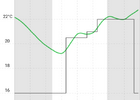 the room temperature followed the setting quite closely, so no real complaints, is this due to some clever algorithms used by the thermostat, or simply good luck? The Wiser system was selected as, one, wanted a wireless thermostat as no cables to the living room, and two, it could take a demand from the TRV head in the wife's bedroom. In runs in parallel with the Nest Gen 3, which was left in place, one, to control DHW if wanted in the summer, and two, so should I not notice Wiser batteries failing, I would still have a way to turn on the heating. There were cables to the hall for a thermostat, which is why Nest fitted in the hall, did consider wireless for Nest, but it would mean having a USB battery pack to work it. Using a wall USB outlet would mean CH would fail if there is a grid power failure.
I know this is a central heating question, but all about control which is electrical, so put in electric section. We see many questions on thermostats, and I for one, had never considered if modern thermostats still use a mark/space ratio?
This messed up a modulating condensing boiler, as the boiler was designed to turn down output as the return water got hotter, which would happen as the TRVs closed and the by-pass valve opened, but each time switched off and on again, it had to start adjusting output from scratch again.
So with a modulating condensing boiler, the TRV is king. An on/off thermostat is only there to stop the boiler cycling as the weather improves.
This may be the theory, but in practice we tend to control the room temperature using the wall or freestanding thermostat, as it is easier to reach than the TRV head, yes I have set the programs on the TRV heads, but if I feel a little cool I tend to still used the wall mounted thermostat, and have the TRV heads set a couple of degrees higher than normally wanted in the same room as wall thermostat.
I note, when setting up the thermostats, both my Nest Gen 3 and my Wiser, ask if using oil or gas, and if using digital (on/off) or analogue (OpenTherm) control, as to what the difference is oil to gas I don't know.
Yesterday I felt a little cool, and I set the wall thermostat 0.5°C higher, 20.5°C to 21°C and since the radiator behind my back, was feeling it to see how warm. It never did get warm at bottom, and it took 1.5 hours before the flame icon on the thermostat app went off. However, later in the day, it was programmed to go to 22°C a jump of 1°C, and it took nearly the same time to go up 1°C as it had to go up 0.5°C. The radiator was quickly warm top to bottom, with no cold bit at the bottom, which got me asking why?
It could simply be other TRVs in the house had turned off, so more water pushed through the radiators in the living room, or it could be when set to oil, the thermostats still use a mark/space ratio to stop over shooting. Although, for my oil boiler that is good, as non modulating, non condensing, modern oil boiler do modulate, not as much as gas boilers, but they do modulate.
Oil boilers in general last a lot longer than gas boilers, which is just as well, as they also cost a lot more, but common to find 20-year-old oil boilers. So many oil boilers may work better using a mark/space ratio, well at least in terms of heating the home. As to fuel use, that's another story, as I know my system when turned off, has no cooling run on, the boiler cools by heating DHW, and there is no way to stop it heating DHW I am told because if it can't then there is more strain on the boiler as it overheats a bit every time it is turned off.
The graph for yesterday looks very good
the room temperature followed the setting quite closely, so no real complaints, is this due to some clever algorithms used by the thermostat, or simply good luck? The Wiser system was selected as, one, wanted a wireless thermostat as no cables to the living room, and two, it could take a demand from the TRV head in the wife's bedroom. In runs in parallel with the Nest Gen 3, which was left in place, one, to control DHW if wanted in the summer, and two, so should I not notice Wiser batteries failing, I would still have a way to turn on the heating. There were cables to the hall for a thermostat, which is why Nest fitted in the hall, did consider wireless for Nest, but it would mean having a USB battery pack to work it. Using a wall USB outlet would mean CH would fail if there is a grid power failure.I know this is a central heating question, but all about control which is electrical, so put in electric section. We see many questions on thermostats, and I for one, had never considered if modern thermostats still use a mark/space ratio?


