
• Looking for a smarter way to manage your heating this winter? We’ve been testing the new Aqara Radiator Thermostat W600 to see how quiet, accurate and easy it is to use around the home. Click here read our review.

Masonry/mortar bees?

Ah right, if it's old then it's excusable.

Cement works, but lime mortar has something of a cult following these days. I've pointed with cement over lime mortar, it looked great and didn't immediately explode. Many will tell you all the bricks will spall, but this doesn't seem to actually happen in the real world. Old bricks can crumble at any time, but if there's cement pointing then some immediately jump on this as the cause.

A mate of mine is a pointer. He only uses lime if the customer specifies it and wants to pay an extra 20(ish)% premium. Over 95% of the houses he works on are Victorian or Edwardian. The majority of those houses have soft red rubber bricks on the front. I have only known him for about 10 years, but I have seen houses that he pointed 35 years ago. None of the red rubber bricks have spalled.

Here is a house in Ealing that had been rendered (same render as the house to the right). He manually hacked away the render- 9" wall, so he couldn't use an SDS chisel.
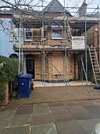
colin-render.jpg

And this is the house once he finished.
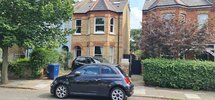
colin render 2.jpg

I was there on day 1 to use my Festool tracksaw angle grinder to cut a straight line in between the two properties and then back to paint the front elevation.

My understanding is that lime mortar smudges the bricks and requires brick acid to remove the smudges when using weather struck pointing. Additionally, the acid can slightly change the colour of the newly applied pointing.
 
I suspect there's a lot of internet waffle being spouted about lime mortar, it seems to have become some kind of trendy wonder product.

My old house was sand and lime. But all the lime seemed to have long since dissolved away, leaving something like apple crumble behind. Definitely flexible and breathable, but utterly useless for keeping the weather and whatever else out. You could wiggle out any brick fairly easily if you wanted, leaving you with a pretty clean brick. I chiselled out and pointed with sand and cement, nothing exploded and it looked lovely.

Cement seems to be a huge improvement over lime.
 
I suspect there's a lot of internet waffle being spouted about lime mortar, it seems to have become some kind of trendy wonder product.

My old house was sand and lime. But all the lime seemed to have long since dissolved away, leaving something like apple crumble behind. Definitely flexible and breathable, but utterly useless for keeping the weather and whatever else out. You could wiggle out any brick fairly easily if you wanted, leaving you with a pretty clean brick. I chiselled out and pointed with sand and cement, nothing exploded and it looked lovely.

Cement seems to be a huge improvement over lime.
There is a lot of myth surrounding 'breathability' issues. A lot are unfounded.

The main issues are soft bricks and hard mortar. That, and the fact that some listed/heritage sites require lime mortar etc.
 
There is a lot of myth surrounding 'breathability' issues. A lot are unfounded.

The main issues are soft bricks and hard mortar. That, and the fact that some listed/heritage sites require lime mortar etc.

You might be correct.

Most of the houses that I work in have 9" victorian walls. They would have originally had, internal, lime plaster. Most have been re-skimmed at some point with gypsum plaster. Additionally, even the original lime plastered walls have been painted with modern latex/acrylic emulsions.

I do not doubt that some buildings need lime plaster and "breathable" paints, but where I live and work, I have not encountered any such issues.
 
I suspect a lot of confirmation bias backs up these theories. If an old wall was repointed with cement and the bricks spall, then the pointing gets the blame. If it wasn't pointed but still spalls then it's just accepted that it was natural ageing.

There are loads of houses that were originally lime that have been repointed with cement, almost all have no issues and all have massively better weatherproofing.
 
I suspect a lot of confirmation bias backs up these theories. If an old wall was repointed with cement and the bricks spall, then the pointing gets the blame. If it wasn't pointed but still spalls then it's just accepted that it was natural ageing.

There are loads of houses that were originally lime that have been repointed with cement, almost all have no issues and all have massively better weatherproofing.

I am about to start an exterior re-dec. Colin has had to replace about 100 red rubbers on the front elevation. The pointing was the original victorian lime mortar. Unfortunately, for me, the customer has warned me that they have run out of money and want me to repaint the exterior as cheaply as possible. Ordinarily, I wouldn't want to "tosh" a finish but needs must.


Edit- nope it was 350 bricks. No wonder she is now broke.
 
Last edited:

If you need to find a tradesperson to get your job done, please try our local search below, or if you are doing it yourself you can find suppliers local to you.

Select the supplier or trade you require, enter your location to begin your search.


Are you a trade or supplier? You can create your listing free at DIYnot Local

 
Back
Top