What I'm understanding, then, is that there is no right and wrong, as long as BS7671 is used for guidance. I have only ever worked in industries where there is only 1 or 2 correct ways to do things and the standards are restrictive to most other solutions. e.g. rail, aviation, O&G.
I like the lollipop solution. And that would reduce the size of the enclosure I need (and therefore the size of the hole in the wall). Is there a standard for the "Slightly heavier duty wire" eg, use 3.0mm or 4.0 mm for a 2.5mm ring?
You are correct, but then that statement was followed by 2 pages of documentation discussion, so it sounds again like there are no absolutes? (and that is a question)
Not to mention that the original question was about sunken enclosures bigger than a double/triple pattress.
If I use a Pattress and blanking plate, does that create the safe zone I need. The standard talks about electrical accessories and doesn't mention blanking plates but I read on this Forum that a Blank is good enough.
Yes. It has to be correct for the protection device on the circuit. So, lets suppose that the ring is wired in 2.5mm² and protected by a 32A MCB.
The size of cable for your (stupid idea, IMO) lollipop must satisfy the requirments of a cable carrying 32A in whatever installation method the cable runs in.
So, use the fine document as you say
and refer to the tables in Appendix 4 (probably 4D1A - it depends on the cable) and bingo, you know the size of the cable to use!
You are right about there being 1 or 2 correct ways to do things, and the method you have chosen is not one of them. If engineered properly it is not unsafe, but it is not correct and will confuse the bejabers out of some poor unsuspecting electrician who comes to site in 20years time to do an inspection report.
I know its a little more work, and a few more terminations, but just use the same cable size and convention to extend each circuit. ie if it is a ring, make it a ring at the consumer unit too.
How dare you think that you can do work like this when you don't have a clue about the most basic aspects of circuit design, and don't even know what size cables are available?
You are correct, but then that statement was followed by 2 pages of documentation discussion, so it sounds again like there are no absolutes? (and that is a question)
Thank you Taylor for your guidance and support, which I still believe these forums are about.
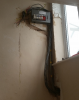
I'm going to continue the rings as you suggested. Now I have a pic, when I said
the cables pop out of the wall to go to the CU at the moment and then chase down the corner to disappear into the (currently empty) electricity cabinet, so creating a safe zone/danger zone by using specifically a blanking plate(accessory, installation is not necessary.
The ring circuit cables disappear into the cavity through a gobbed up hole in the brickwork that I intend to remove to install the enclosure for the joints. Metal box, metal lid, under an inconspicuous removable panel.
Have it tested by a pro. and have him notify building regs.
Anything else before I start?
Thanks to all for your input.
Thank you B-A-S for the motivation. I never could resist a dare. . . . . (or an emoticon)
I wonder if you can resist the dare of actually acquiring some vital knowledge of basic things like what cable sizes exist, and how to chose sizes and design circuits before deciding that your complete ignorance of things like that should not be a reason for you not to attempt things which are outwith your competence?
If you need to find a tradesperson to get your job done, please try our local search below,
or if you are doing it yourself you can find suppliers local to you.
Select the supplier or trade you require, enter your location to begin your search.
Please select a service and enter a location to continue...
Are you a trade or supplier? You can create your listing free at DIYnot Local



 . . . . (or an emoticon)