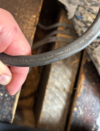
Old black cable - possibly rubber?

Joined
23 Jan 2009
Messages
72
Reaction score
9
Location
Cheshire
Country
United Kingdom
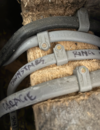
In advance of extending the upstairs ring main in my 1930's house, I have pulled up some floor boards to see what the state of play is. To my surprise, it looks like one side of the ring main at the CU is possibly old black rubber cable? It is stamped "250 VOLTS B.S.S.7 MADE IN ENGLAND". I found a reference to BSS 7 cable on Google which would indicate it could be an old 1950's standard for rubber cable with flexible cores. I've had all of the sockets off upstairs and only one of them appears to be served by this black cable (stranded silvery wire, possibly tinned copper?) the rest of which are all connected to modern grey PVC cables. The previous owner had much of the house rewired and a new CU in the mid-noughties, so it's a bit odd that this was left in. To be fair, it is in pristine condition for its age, no signs of any deterioration whatsoever. Still feels nice and supple and nothing is coming away if I scratch the surface. We've also had zero electrical issues in seven years of ownership. Curious as to how critical getting this wire replaced might be? I was originally planning on extending off the socket the black cable serves, but I think I'll tee into the modern cable now!

Photos attached, these are taken at the point the cables go down to the CU.
 

Attachments

  • Screenshot 2025-04-25 111556.png
    Screenshot 2025-04-25 111556.png
    943.3 KB · Views: 101
  • Screenshot 2025-04-25 111626.png
    Screenshot 2025-04-25 111626.png
    826.9 KB · Views: 97
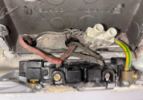
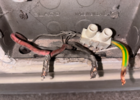
I have had a closer look at the socket served by the old cable. Photos attached as I found it. Apart from being dusty, the insulation is in better condition than I expected. The sleeving is still soft and pliable, not disintegrating at all. I have since sleeved and tidied up the bare earth wires. Anything of immediate concern to seasoned eyes?
 

Attachments

  • Screenshot 2025-04-25 132752.png
    Screenshot 2025-04-25 132752.png
    1.3 MB · Views: 90
  • Screenshot 2025-04-25 132816.png
    Screenshot 2025-04-25 132816.png
    1.5 MB · Views: 100
Anything of immediate concern to seasoned eyes?

The metal back box, needs to be earthed - probably the easiest way, would be to drill a hole in the back and use a self-tapper.

That socket, obviously, either feeds a second socket, or is part of the ring = worth checking which. It looks like 7/029.
 
The usual advice with old rubber is to avoid touching it as much as possible, until you plan to rewire.

That said, my current property was wired in cable very similar to yours, and when I pulled it out during the rewire it also seemed to be in surprisingly good condition. I wonder if some of the rubber formulations used towards the end of the rubber era were much better than the earlier rubbers.
 
The metal back box, needs to be earthed - probably the easiest way, would be to drill a hole in the back and use a self-tapper.

That socket, obviously, either feeds a second socket, or is part of the ring = worth checking which. It looks like 7/029.

I plan to replace it as the back box itself is a tad loose despite me tightening up. New holes/rawl plugs should do the trick. Should get an earth terminal then. It doesn't appear to be feeding another socket; I suspect one side is going into a hidden junction box as there are no black cables in any of the other sockets on this ring.

The usual advice with old rubber is to avoid touching it as much as possible, until you plan to rewire.

That said, my current property was wired in cable very similar to yours, and when I pulled it out during the rewire it also seemed to be in surprisingly good condition. I wonder if some of the rubber formulations used towards the end of the rubber era were much better than the earlier rubbers.

To be honest, I'm starting to wonder if it was left in place because there's not a lot wrong with it.
 
Or, it was an especially difficult/disruptive cable run to replace?
Definitely a possibility, but doesn't look any more difficult than other cables which have been replaced.

I have a bit of a dilemma on my hands now. I know deep down it needs ripping out. But on the other hand it's a lot of aggro for a cable that appears to be in excellent condition.
 
Definitely a possibility, but doesn't look any more difficult than other cables which have been replaced.

I would be splitting the two cables apart, and checking whether it is, or is not on the ring - if not on the ring, test other sockets to see if they are fed from that socket.

If it's not on the ring, and doesn't feed anything else, then consider leaving that redundant cable disconnected - you said it might be terminated at a JB.
 
Disconnect it.
Indeed - but one ideally first needs to know where the other end goes - lest it has (or could have) a live feed at the other end [even if the cable is not live now, it would be nice to be sure that it never would/could be].

However, if one disconnects it from the socket and then terminates it in some safe way ('within something'), it will probably be no less safe than it currently is (other than that, if VIR, the insulation may have been damaged by handling]
 

If you need to find a tradesperson to get your job done, please try our local search below, or if you are doing it yourself you can find suppliers local to you.

Select the supplier or trade you require, enter your location to begin your search.


Are you a trade or supplier? You can create your listing free at DIYnot Local

 
Back
Top