• Looking for a smarter way to manage your heating this winter? We’ve been testing the new Aqara Radiator Thermostat W600 to see how quiet, accurate and easy it is to use around the home. Click here read our review.

one-coat recommendation for this window frame situation?

Joined
11 May 2015
Messages
25
Reaction score
0
Location
London
Country
United Kingdom
Hello,

Floundering non-professional here. I am restoring some 1930s wooden casement windows (i.e. "casement sashes" attached to the fixed frame with vertical hinges) in my house. This involves replacing the panes of glass with vacuum glazing and also routing a groove round the outer edges to put weatherstrip seal into (AQ21).

So this involves routing with a 3 mm groover bit, for a thickness of the weatherstrip (the thin part, the "tail" of the profile) of (officially) 2.7 mm. In fact the profile of the recess is more complicated than that if you want to install a "brush seal", but that's not important for this question.

The fit of the weaterstrip tail into that groove is obviously quite snug - I have already done some experiments without paint. Therefore I'm currently intending to just apply one coat in that groove before pushing in the tail of the weatherstrip. All the rest of the frame I can just apply a better arrangement, i.e. separate primer, undercoat and paint, probably.

But window frames are pretty exposed to weather, and you obviously don't want them to absorb moisture and expand.

Any recommendation for this one-coat paint to apply in the groove? I saw this thread. I understand so far from my research that "primer undercoat" is always water-based. But I assume (although this may be wrong) that oil-based paint would probably be better for maximum water-resistance, over many years. Is there any oil-based primer which would do this job? ... bearing in mind of course that the presence of this weatherstrip tail will hopefully be pretty good at keeping out the moisture.

In general, if this were your house, what would you apply in that groove? Oil-based white wood primer, on its own? Or something else?

PS any recommendations for the rest of the frame would also be welcome, bearing in mind that the frames are mostly already covered in paint (probably the original paint of the 1930s: sometimes bare wood is revealed, but all the wood is sound), and I have yet to try and research what the best way to approach that is. Sandtex seem to be pretty highly recommended paints...
 
DG longevity in wooden frames is a bit hit and miss, any water that gets in the grove can't drain away causing seal breakdown. I had a hardwood conservatory and panels broke down often despite what I thought was well sealed
 
If you were to get seals installed professionally I believe they would router a groove and push the seal strip in, without painting. Conclusion: paint with whatever you want and don’t worry about it.

I’d be interested to hear more about the vacuum glazing. Why not post a thread about it in “Your Projects”?
 
If you were to get seals installed professionally I believe they would router a groove and push the seal strip in, without painting. Conclusion: paint with whatever you want and don’t worry about it.
OK!

I’d be interested to hear more about the vacuum glazing. Why not post a thread about it in “Your Projects”?
Where is that? "Your projects" I mean: I can't find any such link in relation to my account here...

Long story short: what's really inspiring about vacuum glazing is that it means, in a situation like mine, where my South London semi has something like 53 panes, all of them casements (no sliding sash windows), and where all the wood is sound, that I don't have to spend eye-watering sums of money (10s of 000s of £) on getting some dodgy double-glazing outfit to rip out all these perfectly good frames and install horrible PVC double glazing systems (I hate plastic).

Instead I can keep all the frames and casements and merely change the panes from current single glazing to VG. From my research, the inert gas in most double glazing usually drains away quite quickly. By contrast, VG of my make (LandVac) is engineered so heavily that the vacuum should be maintained for many years ... and in fact the technical tests conducted (you can look this stuff up) suggest that LandVac VG panes are equivalent to TRIPLE glazing, in terms of both thermal and acoustic insulation. This is pretty impressive to me.

There are two "cons". One is the price: I paid for an initial batch of something like 20 panes ... and this cost me something like £2500 including delivery. It comes all the way from Japan (LandVac is Japanese). So one day an extremely robustly constructed wooden jig covered in Japanese writing was delivered to my house containing all this first batch of panes. The lead time was about 2 months.

The other con is the "plugs" and "edging". The agent who deals with LandVac sales in the UK didn't tell me about this, and you don't see this on LandVac's marketing videos. But right round the inner edges of the panes there is this rather ugly brown lining/edging. Fortunately this won't be visible when my panes are installed in the frames. However, there are also two "plugs", i.e. little round things, further in from the edge along one edge. These will not be possible to conceal with the current batch. However, I calculate that with the future batches I may be able to arrange things so that these plugs will also be concealed "by the woodwork", i.e. by ordering panes which are slightly longer, and by removing more wood, particularly from the wider batten at the bottom of the casement sash.

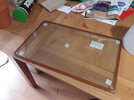
See the attached photo. NB the white squares are a small part of the protective packaging in which these panes were delivered. This pane measures 280 x 450 mm ... and the "plugs" which you can see at the bottom right and left corners are 6 mm in diameter. The brown lines, as I say, won't be visible when the pane is installed. I was actually quite amused by the horrified reaction of some people in another forum when they saw this. But it's to be expected that these panes actually need some fairly serious engineering if the vacuum is to be maintained for years. I think LandVac's marketing should be a bit more transparent though.

PS another con for many would be the work needed to be done on the sash frame to accommodate these panes. I have had to make the rabbet all around the sash both deeper and wider. Some might be skilful enough to use a router to do this, but I'm doing it by hand, with a hand chisel, finishing off with an oscillating multitool and Dremel (sanding etc.). It takes a bit of time, but this is the least of my worries.
 

Attachments

  • landvac pane.jpg
    landvac pane.jpg
    313.5 KB · Views: 32
The other con is the "plugs" and "edging". The agent who deals with LandVac sales in the UK didn't tell me about this, and you don't see this on LandVac's marketing videos. But right round the inner edges of the panes there is this rather ugly brown lining/edging.

Some of their competitors do mention it, i.e. they say that their competing vacuum products don’t have ugly “plugs”. Did you consider Fineo?
 
Have a look at this; this is how others do opening out the glazing rabbit.

As for bare wood treatment I'd use something like a wood preservative in the slot (Groove). Oil based wood primer is available in the UK - just search on the internet.
 
Last edited:
Some of their competitors do mention it, i.e. they say that their competing vacuum products don’t have ugly “plugs”. Did you consider Fineo?
I did look at the competitors before committing.

LandVac seemed the clear winner. Fineo as I recall seems to have some sort of marks in a grid all across the pane: not very noticeable, but there. Also from the specs point of view it just wasn't as good.

I would say that of course.
 
Have a look at this; this is how others do opening out the glazing rabbit.

As for bare wood treatment I'd use something like a wood preservative in the slot (Groove). Oil based wood primer is available in the UK - just search on the internet.
Interesting... I did't quite catch what they're doing exactly.

One problem there is that my least favourite power tools in the entire world are circular saws and routers. I only ever use my router in a router table arrangement (and don't have a circular saw). I would never use a circular saw or router by hand like they're doing. Call me a wuss, that's a fair criticism.

I love my DeWalt oscillating multitool though: I could probably get some good results using it and will see about using it even more on the next sash I have to process. Sometimes you find things like hidden nails in extremely old wood constructions (and occasionally rock-hard knots in the wood): the oscillator deals with such obstructions amazingly well. But I shudder at the thought of encountering these sorts of things when using a hand-held circ saw or router.

Oil-based wood primer: thanks for that. I was starting to hesitate between oil-based primer and one-coat water-based primer + undercoat (a good one like "10-year" Sandtex). I need to do quite a bit more research: would you say that for timber windows the "gold standard" is always going to be an oil-based solution? I mean, not least because our weather, although not extreme in terms of temperature, can occasionally be pretty wet, cold, and windy: not a great combination. Particularly if that means that the water gets into nooks, grooves and recesses and potentially lingers, evaporating only very slowly.

The paintwork dating from the 1930s on these frames must be oil-based (in fact someone told me to watch out for possible lead in the dust when sanding or routing). That paint has stood up for 90 years remarkably well. Of course it's possible that one or more owners of this house repainted all these windows at some time, but in fact I have reason to suspect that's not so.
 
Last edited:

If you need to find a tradesperson to get your job done, please try our local search below, or if you are doing it yourself you can find suppliers local to you.

Select the supplier or trade you require, enter your location to begin your search.


Are you a trade or supplier? You can create your listing free at DIYnot Local

 
Back
Top