
You are using an out of date browser. It may not display this or other websites correctly.
You should upgrade or use an alternative browser.
You should upgrade or use an alternative browser.
Phase and neutral (France)
- Thread starter beneix
- Start date

A UK switch Wall plate is (nominally) 8.5 cm x 8.5 cm = 72.25 cm²Interesting, seems a good system. Pity the switch plates are so big (US size) but I suppose you can’t have everything.
An Australian (US) wall plate - for both Switch and (dual) Socket-Outlet - is 11.5 cm x 7.5 cm = 86.25 cm²
A UK (dual) Socket-outlet is 8.8 cm x 14.5 = 123.25 cm² - almost 43% larger than the Australian dual Socket-outlet !!!
Hence, an Australian switch-plate is only about 20% larger than a UK switch-plate - BUT can accommodate up to six (16 mm x 16 mm) switch
"Mechanisms".
If one needs to fit switch mechanisms in a smaller space, "Architrave" switch plates are available, to take up to four mechanisms
(https://www.tradezone.com.au/produc...rchitrave-switch-cover-plate-white-25008.html.
The "Mechanisms" can be switches, neon indicators, 8P8C LAN Connectors, TV Connectors, RCA Audio connectors, DIN Audio connectors etc. - and "blanking plates" have their uses in that, where a certain "connector" is not "commercially available" it can often be "made up' by inserting it in a "blanking plate".
Of course, the "Extra Low Voltage" devices may not be used on the same plate as "Low Voltage" devices.
However, using the same size "wall plate" for both Socket-Outlets and "Switch" (and other) "Mechanisms" makes it possible neatly to combine Socket-Outlets and "Mechanisms" in close proximity.
Last edited:
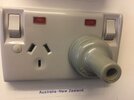
The socket-outlets concerned and "pictured" are "rated" at 10 A.
(I am not sure what you may mean by "all in one".
Your "example" is a bit "old style" - with the "screw heads" protected from contact by individual "covers".)
Each "Socket-Outlet" is controlled by a switch (as in the UK), the Neon indicators are "optional" but are available on a few (more expensive) examples.
Any number of 10 A socket-outlets may be installed on 2.5 mm² conductors and are protected by 16 A or 20 A Circuit Breakers/MCBOs
(Fuses are no longer allowed on new or 'upgraded" installations.)
Other similar (domestic and commercial) socket-outlets, rated at higher current do exist.
These are illustrated in https://en.wikipedia.org/wiki/AS/NZS_3112 and in https://commons.wikimedia.org/wiki/...cket_styles_for_different_current_ratings.jpg
Note that any plug can be inserted in a socket-outlet of the same or higher rating, but not into a socket-outlet with a lower rating.
So, a 10 A plug fits in each of the five types of socket outlet, but a 32 A plug can only be used with a 32 A socket outlet.
(See http://www.plugsocketmuseum.nl/Australian_3hd.html)
While 15 A socket outlets are often used in domestic situations (cook-tops, ovens and air conditioners) - and in Caravan Parks - very few people in Australia/NZ would have seen a 20 A, 25 A or 32 A socket outlet.
(This may change with the introduction of EVs.)
A 15 A plug cannot be inserted into a 10 A socket-outlet - and so on.
By the way, Schneider (Clipsal) "Australian NZ " style light switches are available on UK "Wall-Plates" - with up to 4 switches per wall-plate.

You may note that "Australian/NZ" Light Switches are rated at 10 A.
This is because "Lighting Circuits" in Australia/NZ are rated at 10 A (not 6 A) - using 1 or 1.5 mm² conductors.
Hence it is quite permissible and often done to use a "standard" 10 A surface-mounted Sacket-Outlet (without any extra individual switch) to supply a light fixture in a roof-space.
 www.sparkydirect.com.au
(I am not sure what you may mean by "all in one".
Your "example" is a bit "old style" - with the "screw heads" protected from contact by individual "covers".)
Each "Socket-Outlet" is controlled by a switch (as in the UK), the Neon indicators are "optional" but are available on a few (more expensive) examples.
Any number of 10 A socket-outlets may be installed on 2.5 mm² conductors and are protected by 16 A or 20 A Circuit Breakers/MCBOs
(Fuses are no longer allowed on new or 'upgraded" installations.)
Other similar (domestic and commercial) socket-outlets, rated at higher current do exist.
These are illustrated in https://en.wikipedia.org/wiki/AS/NZS_3112 and in https://commons.wikimedia.org/wiki/...cket_styles_for_different_current_ratings.jpg
Note that any plug can be inserted in a socket-outlet of the same or higher rating, but not into a socket-outlet with a lower rating.
So, a 10 A plug fits in each of the five types of socket outlet, but a 32 A plug can only be used with a 32 A socket outlet.
(See http://www.plugsocketmuseum.nl/Australian_3hd.html)
While 15 A socket outlets are often used in domestic situations (cook-tops, ovens and air conditioners) - and in Caravan Parks - very few people in Australia/NZ would have seen a 20 A, 25 A or 32 A socket outlet.
(This may change with the introduction of EVs.)
A 15 A plug cannot be inserted into a 10 A socket-outlet - and so on.
By the way, Schneider (Clipsal) "Australian NZ " style light switches are available on UK "Wall-Plates" - with up to 4 switches per wall-plate.
10A 4 Gang 2 Way Light Switch White
Made of high impact resistant polycarbonate components
www.cef.co.uk
You may note that "Australian/NZ" Light Switches are rated at 10 A.
This is because "Lighting Circuits" in Australia/NZ are rated at 10 A (not 6 A) - using 1 or 1.5 mm² conductors.
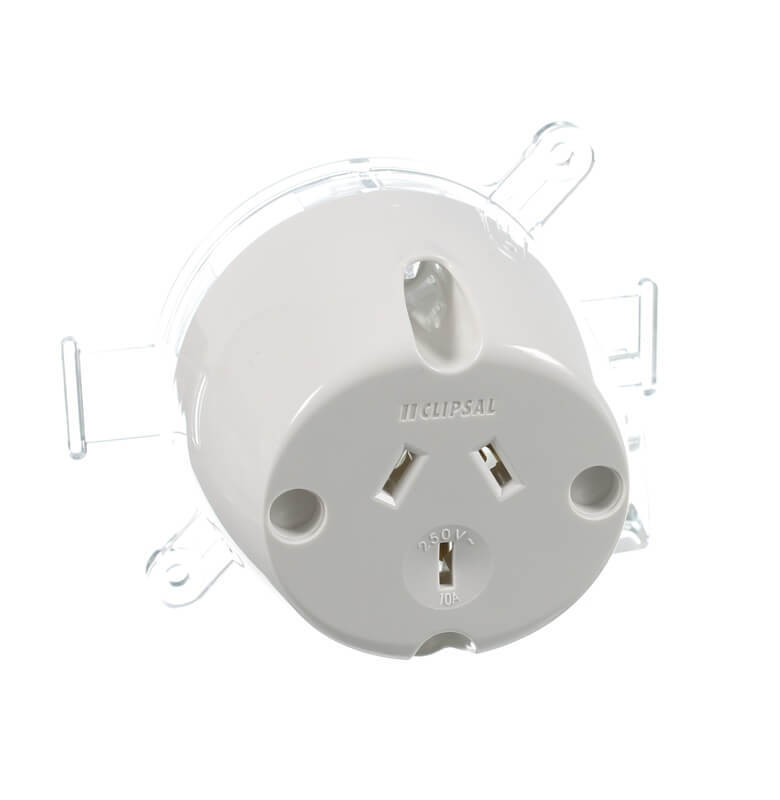
Hence it is quite permissible and often done to use a "standard" 10 A surface-mounted Sacket-Outlet (without any extra individual switch) to supply a light fixture in a roof-space.
Clipsal 413 | Surface Socket Back Wired 413WE
Save big on Clipsal 413WE | Surface Socket Back Wired 10amp today! Don't overpay when Sparky Direct offers lightning-fast delivery and unbeatable prices.
www.sparkydirect.com.au
Last edited:

Well I knew I'd eventually come across a bit of this. Just doing a bit of DIY and have to move some electrics. Red and Blue round T&E purchased in Forestell France:What do you mean? What do they use instead?
The T&E supplied to me in France by a French supplier to be installed in France was most certainly twin and earth. Exactly the same thing happened in Germany and Spain.

Three-way switching is a made-up and incorrect term. It's two-way and intermediate switching - an intermediate switch still only switches in two ways.What do you mean?
In the UK we use the terms two-way and three-way to denote the number of switches that operate the same light(s) - nothing to do with the number of wires..
IMO, two-way, three-way and multi-way switching ALL not really descriptive of the "situation".Three-way switching is a made-up and incorrect term. It's two-way and intermediate switching - an intermediate switch still only switches in two ways.
Actually, they are two-location, three-location and multi-location switching.

- Joined
- 21 Oct 2016
- Messages
- 11
- Reaction score
- 0
- Country

Coming back to this as we haven't done anything about it. In all the different sockets we have 230V between L and N. I understand what might be going on in socket 3, a reversal of L and N. What I can't figure out is how a mis-wiring can generate the results in sockets 1 and 4.In that case:
View attachment 285603
It would appear you have reversed polarity at socket 3.
Sockets 1 & 4 L to E something wrong.
L to E should always be ~230V
L to N should always be ~230V
N to E (or E to pipe if earthed) should always be very low Ohms - and very low Volts.
The apartment only has single-phase as far as I know, and with my old high school maths I can't see a way that those differences in potential would arise even if by mistake another phase were involved.
Does anyone have an explanation?
I can't see a way that those differences in potential [between line and earth] would arise even if by mistake another phase were involved.
Does anyone have an explanation?
High impedance in the earth wire. Likely floating, i.e. not connected to anything. You're only seeing a voltage because your meter has a high input impedance and there is capacitive coupling.
With the power off, you need to use your multimeter to measure the resistance between the earth terminal at the socket and another "known good" earth, e.g. at the incoming supply. You may need a long wire to do this.
- Joined
- 21 Oct 2016
- Messages
- 11
- Reaction score
- 0
- Country
Thanks @endecotp , you reminded me of ghost voltages. I borrowed an LoZ multimeter and concluded that on some sockets, there isn't any real earth and there also is no real voltage other than between L and N. On sockets in the kitchen and bathroom, there is earth; the weird voltages L-E are not there and I suspect there is no voltage between N and E but if I try to test it, the central RCD breaker trips (likely the multimeter low impedance combined with already present small leakage on the circuit). In France, this setup is common on installations created before 1991.
If I get a chance to test the whole circuit when it's off, I will perform your suggested E to "real earth" resistance test.
If I get a chance to test the whole circuit when it's off, I will perform your suggested E to "real earth" resistance test.
Similar threads
- Replies
- 3
- Views
- 4K
