
YOU CANNOT USE STRAIGHT CONCETRIC and comply to BS7671.
STRAIGHT Concentric stripped.
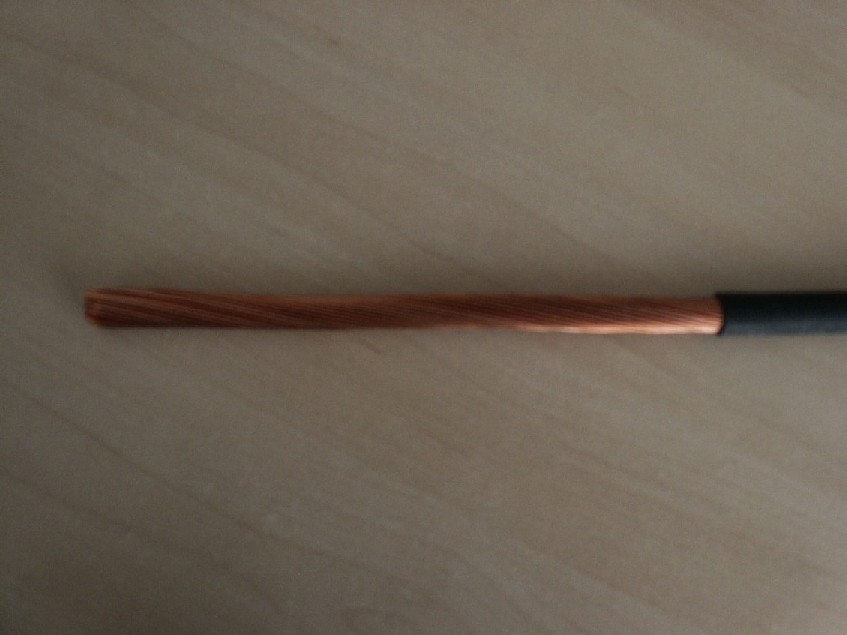
STRAIGHT Concentric prepped.
Is that just because there's no separate T and N and TN-C is not now allowed?

YOU CANNOT USE STRAIGHT CONCETRIC and comply to BS7671.
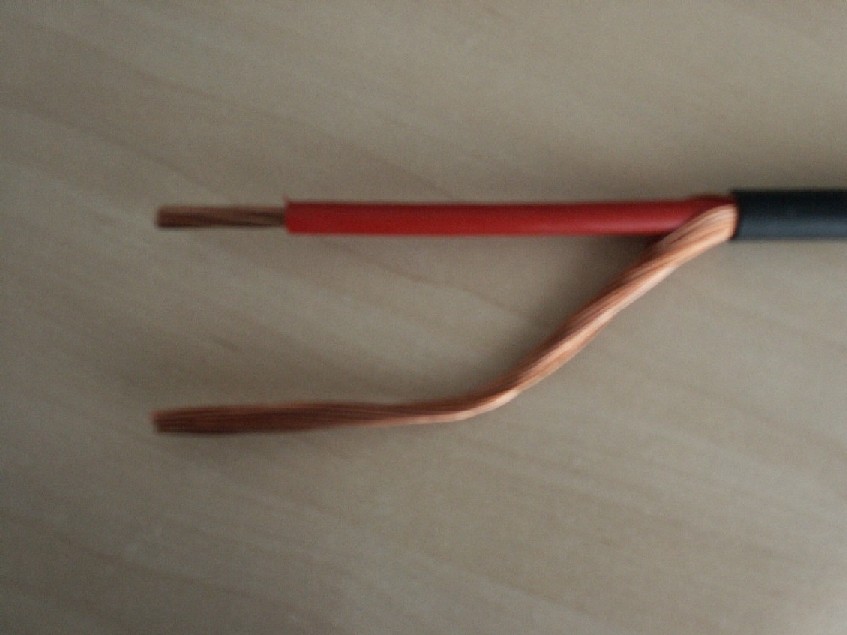
STRAIGHT Concentric stripped.
STRAIGHT Concentric prepped.
That's part of it - but even if it weren't for that (e.g. if one just wanted to use it as 2-core L+N, with no CPC), the outer conductor is only sheathed (not 'insulated and sheathed') and therefore would not (unless it were in conduit, I suppose) be acceptable for a neutral conductor under BS7671.Is that just because there's no separate T and N and TN-C is not now allowed?YOU CANNOT USE STRAIGHT CONCETRIC and comply to BS7671.

Exactly, and that's why it is not BS7671 compliant (unless in an enclosure/conduit) - in the same way that single-insulated singles are not.Well yes, it has no earth, but as said, the neutral is only single insulated by a sheath only.
Exactly, and that's why it is not BS7671 compliant (unless in an enclosure/conduit) - in the same way that single-insulated singles are not.Well yes, it has no earth, but as said, the neutral is only single insulated by a sheath only.
In contrast, split con is no different from T&E - both L and N conductors are 'double insulated'(insulated and sheathed, only the CPC conductors being bare. It can therefore be used anywhere that T&E can be used
Kind Regards, John
That all sound reasonable - although I'm not sure that there is a compelling reason to say that it is more suitable for external use (where additional mechanicalprotection is not required) than is T&E. Are you suggesting that the nature (material) of the outer sheath of split-con makes it more suitable for external use?what I always say - treat it as T+E. The benefits it has over T+E are that it can be pulled in far easier, cleated for easier and neater, used externally (where additional mechanical protection is not required), and it's earth is table 54.7 (old 54g) compliant.
Indeed so, but given that it has no sort of armour, I'm not sure why anyone would think that it could!It CANNOT be trenched, ducted, or used for 'penetration' protection under BS7671.
"Never say never or always"Penetration protection as in a nail or screw will always short live to N or E.
 Penetration resulting in an N/E short without touching L is theoretically possible. Also, if you were very lucky/unlucky, a nail could theoretically pass between the (insulated) N conductors and penetrate L without causing any short (but leaving a live nail)!
Fair enough - but that's just a question of 'what is available'. T&E could be made with a UV-stable sheath.It's black sheath is UV stable.
Having the live conductors surrounded by earthed metalwork is considered an acceptable means of protection for burried cables. The earthed metalwork does not have to be an armor.Indeed so, but given that it has no sort of armour, I'm not sure why anyone would think that it could!
Talking of availablility, how readily available is split-con? The likes of TLC and CEF don't seem to offer it.
Kind Regards, John
Fair enough.Having the live conductors surrounded by earthed metalwork is considered an acceptable means of protection for burried cables. The earthed metalwork does not have to be an armor.
Yes, that's the main issue. However, as I suggested in my last post, I think that there's also an additional issue with split-con due to the fact that the neutral conductors are individually insulated. This creates the possible (albeit very unlikely) scenario of something penentrating the L without coming in contact with neutral (or earth) conductors. Hence, even if I considered neutral to be 'earth', I would therefore personally be rather hesitant to accept something as acceptable 'surrounding earthed metalwork' if that metalwork consisted of individually-insulated strands. However, I can see that there is cope for debate - as you say the DNOs seem happy with both straight-con and split-con.The judgement call that standards writers must make is how to treat neutrals. Neutrals are normally earthed but under certain conditions they can become live. For this reason BS7671 treats the neutral as a "live conductor" though iirc in several places it excepts neutral condutors from rules that apply to other "live conductors".
Fair enough. As I say, I've never seen it in a catalogue (on-line or paper), but that doesn't prove much!Every wholesaler here stocks it in 16 and 25 at least, with many keeping 4 and 10mm too. 35mm is the largest it goes.
I'm sure that's largely true, but still believe in "Never say Never"!The neutrals and earth are so tightly bound tot he live there is no way you would split them to make way for a nail - the insulation on the neutral would be damaged for sure!

Looks like it would be a bit of a pig to use for a socket circuit instead of T/E...That' what I always say - treat it as T+E.
The benefits it has over T+E are that it can be pulled in far easier, cleated for easier and neater, used externally (where additional mechanical protection is not required), and it's earth is table 54.7 (old 54g) compliant.
It CANNOT be trenched, ducted, or used for 'penetration' protection under BS7671.
That was certainly my interpretation of what he meant. I feel sure that the disadvantages would outweight the advantages for most socket circuits, even if one could find split-con in small enough CSA.I think he was talking more in terms of submains and cooker circuits etc rather than a ring, could be wrong though

If you need to find a tradesperson to get your job done, please try our local search below, or if you are doing it yourself you can find suppliers local to you.
Select the supplier or trade you require, enter your location to begin your search.
Are you a trade or supplier? You can create your listing free at DIYnot Local


