
PIR Fault Finding

Joined
10 Jan 2010
Messages
254
Reaction score
52
Location
London
Country
United Kingdom
Dear Sparks,

I've installed this PIR above the entrance of my front door. Spurred of a nearby ceiling rose, installed without any problems. This was in Oct24. Pretty much exactly a year later, the light (LED bulb) started to flicker. But not instantly.. it would switch on and then maybe after 5 seconds the flickering starts in very irregular pattern. I put it down to a faulty/bad LED bulb and just put in a new one. Before discarding the old one, I've tested the faulty bulb in a regular switched fitting and it did indeed also flicker there so I thought must be faulty electrics inside the LED bulb.

No problems for another year and a few month. The light now starts to flicker again in the same manner >> switches on normally but after a few seconds I get irregular flickering until it switches off again due to the set timer. No other lights on the same circuit exhibit any flickering or any strange behaviour.

I don't want to buy a new bulb each year, so would I be best advised to swap the PIR sensor? I find it a bit strange that all works fine for a year. How would you go about fault finding this?
 
I don't want to buy a new bulb each year, so would I be best advised to swap the PIR sensor? I find it a bit strange that all works fine for a year. How would you go about fault finding this?

It sounds like another faulty LED lamp. Just replace it with a more robust one.
 
The link in your original post doesn’t do anything
works for me... if it helps:

1769620699731.png
 
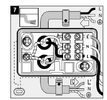
Is that PIR wired with L, N, switched live, and E - or just L, switched live, and E?
The PIR has N as well.

my feed is just a simple 1.5mm^2 (yes the unnecessary 1.5 not 1mm) t/e from a ceiling rose. Meaning the N from source feed goes into the choc block and I would've wired the N from the Lamp straight into the same. Pretty much as per guidance from the manual.

1769623089908.png
 
Robut equals not a cheapo.
Not necessarily. As I've reported before, I've personally had more problems (short lives) with expensive 'big brand' LED lamps/bulbs than with cheapo ones. That may be at least partially due to the fact that the expensive ones tend to have something more like a 'proper driver' (as compared with just a rectifier and a capacitor or two in the cheapo ones) - so 'more to go wrong!
 
my feed is just a simple 1.5mm^2 (yes the unnecessary 1.5 not 1mm) t/e from a ceiling rose. Meaning the N from source feed goes into the choc block and I would've wired the N from the Lamp straight into the same. Pretty much as per guidance from the manual.

OK, next question....

Does the light get often triggered, remain on for a particularly long time? What I have in mind, is a problem I had, with an LED lamp, in an enclosed outdoor lantern, type fitting. It went through two LED lamps, in no time. I arrived at a conclusion, that the air-tight enclosure, was just allowing heat to build up in the electronics of the LED lamp, and just added a tiny amount of ventilation through the enclosure. The 3rd replacement lamp, turned on from dusk, to 11pm, has survived fine ever since then, and for years.

I had a similar problem, with LED's, indoors, wall-lights, fitted in shades open at the bottom, socket at the top. Heat rose, and collected at the top/lamp base. Simply inverting the fittings, so they were open at the top, allowed the heat to escape, and the lamps have worked fine ever since.

Lack of adequate air-flow around an LED lamp, means they will not last long. They don't last long in an enclosed fitting.
 
....I arrived at a conclusion, that the air-tight enclosure, was just allowing heat to build up in the electronics of the LED lamp, and just added a tiny amount of ventilation through the enclosure.
Yes, possibly. As I recently wrote, that's a situation in which the cheap/anonymous ones may possibly last longer, since they have a lot less 'electronics' to upset than do some/most of the more expensive ones.
 
Does the light get often triggered, remain on for a particularly long time?
Yes, but not for a long time. The timer is set to I think around 30 seconds. But my front door is close to the pavement and it goes on every time someone walks along the pavement somewhat close to my front garden wall. But it has a nighttime sensor so it's only active from dusk til dawn.

My front door is recessed so it's actually protected from rain etc, therefore the lamp enclosure is actually open at the bottom. Anyone can reach up with a ladder and unscrew the light bulb by hand w/out any tools. So I doubt it's overheating.
 

If you need to find a tradesperson to get your job done, please try our local search below, or if you are doing it yourself you can find suppliers local to you.

Select the supplier or trade you require, enter your location to begin your search.


Are you a trade or supplier? You can create your listing free at DIYnot Local

 
Back
Top