- Joined
- 27 Jan 2008
- Messages
- 29,700
- Reaction score
- 3,676
- Location
- Llanfair Caereinion, Nr Welshpool
- Country

The intelligent control needs one to give access to the supply company, some solar, and some EV systems can allow the supplier to control when batteries charge and discharge. The Go and Flex Octopus tariffs both have an intelligent and a non-intelligent version, and clearly with the intelligent version you must have a battery which they can control.
I think my son has the intelligent version, and his off-peak rate is lower than mine, and if there is spare energy, his car may be charged at the low rate during the day.
The problem with the non-intelligent Flex is ensuring one does not use grid power 4 pm to 7 pm, I am sure one could manually charge one's batteries before 4 pm and discharge them so they just last until 7 pm, gaining the 30.68p/kWh export rate 4 pm to 7 pm, but 28.5p to 30.68p is not really enough difference to be sure the 2p gain is not lost in the charging and discharging of batteries.
And the 17.1p/kWh is higher than the 10.54p/kWh, so one needs to be careful not to charge the batteries more than required. If the off-peak is the same or less as the payment for export rate, as it is with Go, then one can fully charge the battery with off-peak, and not lose out if the battery is not fully depleted when the sun comes out.
So with Go I do not need to regulate how much the battery charges. With Flex I do. So Flex is not really any good unless using the intelligent system. I could try flitting between Flex in summer and Go in winter, but I want an easy life, and if I had an EV not sure I want to use the EV battery to power the house or the grid? The whole idea of the EV is you leave the home with a full battery, so never need to use a filling station during normal motoring, only when for example you are on holiday do you need to use EV charging points.
This is what I look at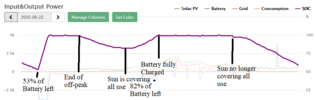 the dip in state of charge at its lowest point at 9 am I still had 82% of my battery left, not a problem with Go, but with Flex would want that to be down to around 20%.
I think my son has the intelligent version, and his off-peak rate is lower than mine, and if there is spare energy, his car may be charged at the low rate during the day.
The problem with the non-intelligent Flex is ensuring one does not use grid power 4 pm to 7 pm, I am sure one could manually charge one's batteries before 4 pm and discharge them so they just last until 7 pm, gaining the 30.68p/kWh export rate 4 pm to 7 pm, but 28.5p to 30.68p is not really enough difference to be sure the 2p gain is not lost in the charging and discharging of batteries.
And the 17.1p/kWh is higher than the 10.54p/kWh, so one needs to be careful not to charge the batteries more than required. If the off-peak is the same or less as the payment for export rate, as it is with Go, then one can fully charge the battery with off-peak, and not lose out if the battery is not fully depleted when the sun comes out.
So with Go I do not need to regulate how much the battery charges. With Flex I do. So Flex is not really any good unless using the intelligent system. I could try flitting between Flex in summer and Go in winter, but I want an easy life, and if I had an EV not sure I want to use the EV battery to power the house or the grid? The whole idea of the EV is you leave the home with a full battery, so never need to use a filling station during normal motoring, only when for example you are on holiday do you need to use EV charging points.
This is what I look at
the dip in state of charge at its lowest point at 9 am I still had 82% of my battery left, not a problem with Go, but with Flex would want that to be down to around 20%.