• Looking for a smarter way to manage your heating this winter? We’ve been testing the new Aqara Radiator Thermostat W600 to see how quiet, accurate and easy it is to use around the home. Click here read our review.

Power in Loft

Joined
25 Aug 2010
Messages
2
Reaction score
0
Location
Lincolnshire
Country
United Kingdom
I would like to add some lights and power skts in the loft to use as a computer / office room
In total i'd need around 4 x 60w lights & 15 skts (mostly for small wattage transformers)

In the loft in a now unused 10mm supply cable that was used for the old electric shower. (own fuse in main consumer unit)

My line of thinking is to use this and then connect it to a 2 way consummer unit and run two ring circuits from it one for lighting 6amp & 10 amp for the skts. I was thinks of installin multiway 5 x three way sockets.

Is this the correct way to do things? Is there a better idea.
I'm pretty confident in DIY electrics and I will be getting the 10mm cable connection to the new consumer unit fitted & all my work tested by a pro.
I just want to do the donkey work myself

Have I forgot anything? Any help / advise is more than welcome

Brian
 
1) Lighting circuits are not rings.

2) Socket rings have to be 32A, not 10A, but radials can be any size you want.

3) This is all notifiable, so if you care about being legal and having certificates then your plan to involve an electrician needs modifying - what you do will depend on whether you notify the work or want him to self-certify.

4) The loft will need strengthening - that's also notifiable.

5) Where is the insulation? Have you got a cold or warm roof?
 
3) This is all notifiable, so if you care about being legal and having certificates then your plan to involve an electrician needs modifying - what you do will depend on whether you notify the work or want him to self-certify.

Not sure on that as if a FCU is not notifiable can't see why any other fuse or MCB unit other than first from DNO supply should be. You say if told illegal ask where it says it. It is to me a grey area I would have said a FCU under the BS7671:2008 makes a new circuit but it seems the LABC do not see it that way.

I would however agree does not matter what the law says that all electrical installations do need inspection and testing and there is really no way any normal DIY person can really do the testing them selves mainly as the test gear is so expensive.

In theory we should tell nearly everyone asking for advice not to DIY as they can't test. About the cheapest tester at £180 are about the cheapest test meter to read earth loop impedance and the plug in tester at £45 is about the cheapest plug in device that can test the basic requirements.

What we need to ask our selves is do we stop giving advise because we know the DIY guy will not test what he fits or do we ignore the limitations and give advice hoping to at least reduce the risk?

I see nothing basic wrong with the proposals. I would agree does not really need to be a ring when only 10A could be radial but there is nothing stopping one from using a ring in order to get a better earth system for high earth leakage equipment.

The main point is computers do trip RCD's and I would always fit emergency lights where there is no natural light so if it does trip you can find your way out.

The beams in a loft are sometimes under size for it to be used as a room but my dad in house built in 1954 had a whole workshop in his loft and it never caused a problem even with band saws etc which must be worse than computers. Needs some common sense of course.

However I would say if your going to have work tested by a pro then why not also allow the pro to design the work? However hard we try we can't really see the problems without being on site and looking at what you have and to install then have it inspected and possible rejected seems flawed and I would advise you also get the installation designed by guy who is going to inspect it.
 
Eric great post.

Only going to throw something in here. As I don't have the GN3 to hand but on the case of testing doesn't it say:

PSCC at origin or points throughout the installation. Which I was told by an NICEIC inspector once could be at any protective device for a new circuit or CU. But not on a FCU

In some larger installation, mainly commercial I know you do take a Zdb reading on testing which you could at the OP local CU, again not on an FCU.

So would that constitute the need to notify LABC??

Great to get the brain cells working :lol:
 
Not sure why there's all this talk of FCUs...
My line of thinking is to use this and then connect it to a 2 way consummer unit ...10mm cable connection to the new consumer unit ...
You will not find adding a CU in Schedule 2B, therefore it's notifiable.


I would however agree does not matter what the law says that all electrical installations do need inspection and testing and there is really no way any normal DIY person can really do the testing them selves mainly as the test gear is so expensive.
People will happily spend a couple of £'00 more on a car, or a holiday, or a set of golf clubs, than is strictly necessary, in order to get a superior result.

So why not on tools for doing DIY?


What we need to ask our selves is do we stop giving advise because we know the DIY guy will not test what he fits or do we ignore the limitations and give advice hoping to at least reduce the risk?
Or do we stick to the principle that you do it properly or not at all?


I see nothing basic wrong with the proposals. I would agree does not really need to be a ring when only 10A could be radial but there is nothing stopping one from using a ring in order to get a better earth system for high earth leakage equipment.
It's only the cpc that needs to be a ring :wink:

And there's no point ignoring the fact that if the decision is to comply with P1 by complying with BS 7671, the latter does not recognise a 10A ring.


The beams in a loft are sometimes under size for it to be used as a room but my dad in house built in 1954 had a whole workshop in his loft and it never caused a problem even with band saws etc which must be worse than computers. Needs some common sense of course.
He was lucky - they'd stopped over-engineering houses by then. Not as bad as now, of course, with trussed roofs only strong enough to support the weight of plasterboard, but I guess the OP doesn't have one of those or he'd not be planning to make a room up there.
 
I agree with BAS re the tools - I suspect my toolkit is somewhat better than most pros', and it does include the proper test equipment. If a job's worth doing, etc.
 
Ok lets start again
1/ I'm not to worried about it being legal! As long as it's tested & safe.
2/ Loft is strong enough, Borded, the roof will have two Velux and I,m using very expensive insulation on the roof then plaster bording it all out. However I need to get the cabling & sockets in place first.
I'm open to all advise here. It's not that I'm tight, but I can't see why I should pay for the work I like doing myself as long as it's done properly and tested (Self Cert)
10mm Cable is in place direct from main CU
I need approx 15 skts to run 2x computers, 3x screens, Printer, Hub, 2x phones, Sound system, Radio, Battery charger, phone charger, TV distribution amp, Shredder, Laminator, cctv camera.
I will also need a plug for the oil filled radiator.
Lighting will be all LED spots (To keep heat down) Having an emergency light sounds like a good Idea.

How many circuits?
Radial / Ring

Any thing else I've forgot or could be useful to have?

Boomba
 
Is the ex shower circuit protected via an RCD at the main CU ?

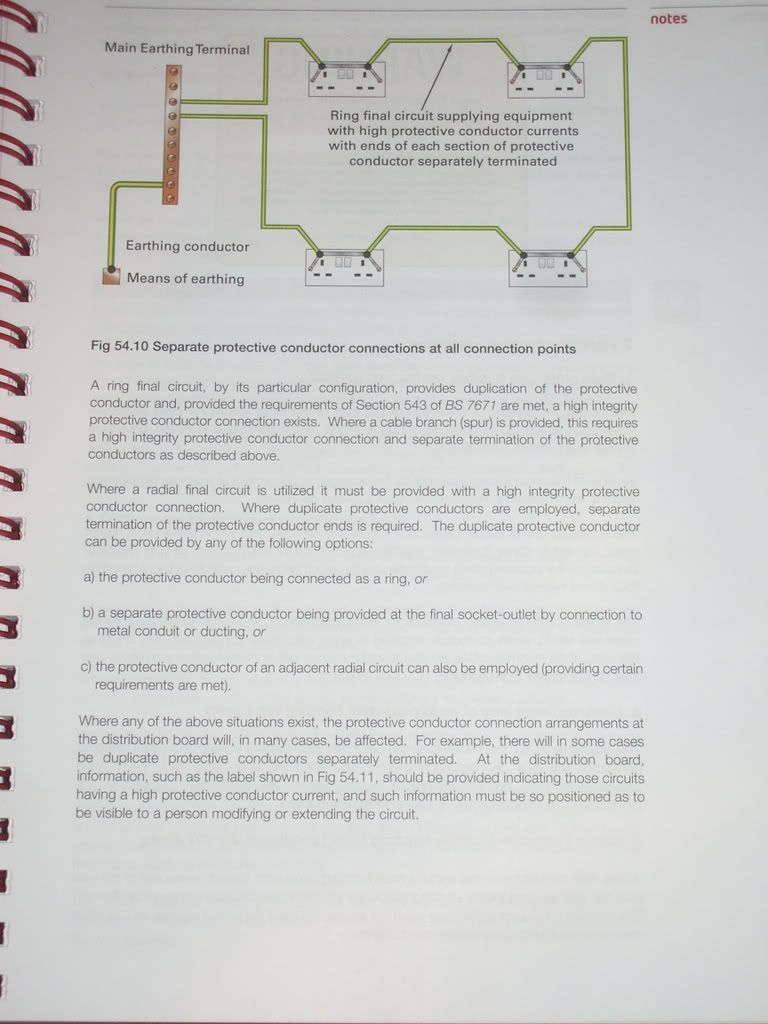
Radial for lights and ring for sockets, will you do the socket ring with high integrity earthing ?

http://www.diynot.com/forums/viewtopic.php?t=142565

IMGP30842.jpg


Is the main CU up to scratch re: 10mm bonding for gas / water mains ?


As for the work within the loft, since you are happy to work outside the rules then I doubt you need any advice on routes or methodology.
 
1/ I'm not to worried about it being legal!
You will become very worried, and seriously out of pocket, if you ever try to sell the house.


2/ Loft is strong enough,
Are you a structural engineer?


Borded, the roof will have two Velux and I,m using very expensive insulation on the roof then plaster bording it all out.
You're doing an illegal loft conversion.

Madness.


I'm open to all advise here.
OK - I advise you to apply for Building Regulations approval. Part of that will involve you specifying how you intend for the electrical work to comply with Part P. Depending on your council's approach to DIY electrical work it may be cheaper to use an electrician.


It's not that I'm tight, but I can't see why I should pay for the work I like doing myself as long as it's done properly and tested (Self Cert)
An electrician can only (lawfully) self-certify work that he has done, not work done by someone else even if he has tested it.

Yes, there are bent ones who will take bribes to lie, but would you really want to have anything to do with such a cowboy?


How many circuits?
Radial / Ring

Any thing else I've forgot or could be useful to have?
 

If you need to find a tradesperson to get your job done, please try our local search below, or if you are doing it yourself you can find suppliers local to you.

Select the supplier or trade you require, enter your location to begin your search.


Are you a trade or supplier? You can create your listing free at DIYnot Local

 
Back
Top