• Looking for a smarter way to manage your heating this winter? We’ve been testing the new Aqara Radiator Thermostat W600 to see how quiet, accurate and easy it is to use around the home. Click here read our review.

Problems with smart TRV

Joined
27 Mar 2011
Messages
171
Reaction score
2
Location
Buckinghamshire
Country
United Kingdom
I've got about 10 radiators connected to a Vaillant 637 Eco Tec Plus system boiler. All the rads currently have dumb TRVs but I've been keen to upgrade to smart TRVs. However, I recently saw this video which raises concerns:

If I understand correctly, the summary is that if you close off too many radiators then the radiators cannot dissipate the minimum heat that the boiler can put out. So, while it's not a problem unique to smart TRVs, it's probably an easier situation you can get into with it.

My question is, how do I find out what the minimum heat output is for my boiler? And how can I know the minimum number of radiators I need to have on to avoid issues?
 
I've got about 10 radiators connected to a Vaillant 637 Eco Tec Plus system boiler. All the rads currently have dumb TRVs but I've been keen to upgrade to smart TRVs. However, I recently saw this video which raises concerns:

If I understand correctly, the summary is that if you close off too many radiators then the radiators cannot dissipate the minimum heat that the boiler can put out. So, while it's not a problem unique to smart TRVs, it's probably an easier situation you can get into with it.

My question is, how do I find out what the minimum heat output is for my boiler? And how can I know the minimum number of radiators I need to have on to avoid issues?
From looking at the technical documentation the 637 minimum output is 7.1kW. You need to work out what the individual radiators outputs are so that you can judge how many need to be open in order for the boiler not to short cycle.
 
Leave a few radiators without smart TRV's. We have a towel rail + 1 radiator with no TRVs at all and a radiator in the bathroom with a legacy TRV. That basically means that even if only 1 smart TRV calls for heat there will always be enough rads open to dissipate the minimum output of the boiler. It is also very rare in practice that only 1 smart TRV wants heat at the same time.
 
Leave a few radiators without smart TRV's. We have a towel rail + 1 radiator with no TRVs at all and a radiator in the bathroom with a legacy TRV. That basically means that even if only 1 smart TRV calls for heat there will always be enough rads open to dissipate the minimum output of the boiler. It is also very rare in practice that only 1 smart TRV wants heat at the same time.
It depends on the outputs of the non “smart” TRV radiators. I would be surprised if your two towel rails and one radiator added up to your boilers minimum output. Not impossible though if your boiler had a very very low minimum output.
 
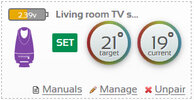
1} Setting the lock shield valve is easier once the programmable TRV is fitted. 4 TRVs-1.jpg Many programmable TRV heads tell you the current and target, and if the current is above the target, then the lock shield needs closing a little so it does not over shoot.
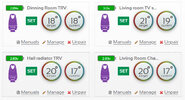
2) My house is on three floors, and the boiler does both DHW and CH and this is 19 kW, so 35 kW would be for a mansion over 5 bedrooms.
3) Yes, my TRV heads can use blue tooth or Wi-Fi. The Energenie needs the Wi-Fi as very little can be set without it, for the eQ-3 the Bluetooth allows multi TRV heads to be linked together. So with two TRV's in the living room, they both can run together.
4) Battery life does vary, my Kasa TRV they don't last long, less than 1 year, the Energenie batteries last 2 years.
5) There are two basic types of programmable TRV heads, linked and non-linked, the whole idea is they don't turn the heating on/off, they turn it up/down, and it really does not matter if you use an electronic or mechanical TRV they both can turn radiators off, so swapping from electronic to mechanical is rather pointless, all it says is he did not know how to set up the mechanical TRV head, which is not a surprise, *123456 is not very good at telling one the temperature, 20°C is far easier to understand. But we don't really turn the radiator off anyway. I will have the bedroom set at 18°C at night and 16°C in the day, the living room 19°C 8 am to 6 pm then 22°C until 10 pm, and 16°C overnight, it is never turned off as such.
6) The linked TRV head I have found can cause a problem, the radiator is under the window, so it is colder than the room, so it can fire the boiler prematurely. On an internal wall, OK, so one has to consider linked TRV or non-linked with a wall thermostat, a TRV can open, and it does nothing unless the boiler is running. So with 4 bedrooms up-stairs, assuming all are used, it only needs a linked TRV head in one room.
7) All systems should have a by-pass valve, I know with my system even with all TRV's closed, the boiler will run for 20 minutes, this is what happens when it is switched on for DHW in the summer.

I started another thread over what is smart, to me, it is to have some sort of algorithm which improves the heating by recording what has happened in the past and using that information to improve performance in the future, so for example a TRV turns on, and it is found it takes 30 minutes to heat the room, so next time it turns on 30 minutes before the set time. The problem is, the TRV head does not have a clue if the door to the room is open or closed, so unless the door has an automatic closer, it will not work.

As to geo fencing, the one I have with Nest the only setting is Eco temperature and Comfort temperature, you can't set the distance, and it turns on the heating when one is far too close to home to be of any good. It waits for you to nearly arrive home before turning the temperature up.

So the debate is linked or not linked. The Wiser system you can from memory have 9 walls thermostat firing the same hub, but a wall thermostat is more expensive as to a linked TRV head, so you could fit Terrier i30 or eQ-3 TRV heads and wall thermostats and not link the TRV to the boiler.

Price since Brexit means today one can get cheaper Wi-Fi TRV heads to Bluetooth or local setting types. I have one odd Kasa head, only complaint is batteries are short-lived. The Energenie head is nearly as expensive as the Wiser. I have not tried to run Wiser not linked to the boiler. The eQ-3 head does not show current, so not as easy to use to set the lock shield valve.

So I have 3 x Energenie (was 4, but carpet fitters killed one) they are now around 6 years old, I have 5 x eQ-3 around 4 years old, 1 x Kasa around 18 months old, and 1 x Wiser around 6 months old, so not really tested as yet, the eQ-3 were £15 each in 2019, now far more expensive.

I do set times to match, so hall, kitchen, and living room plus two wall thermostats in hall and living room all change temperature together, but if cold will say hey google turn living room to 23°C, and it will change 3 devices. And if I ask the temperature, it will read out what each is set at and current temperature.

I can manually turn up heading before getting home, but have disabled most of the so-called smart features. I can say it has both made the home more comfortable, and reduced bills. And the boiler does not modulate, or gain latent heat, it simply turns on/off and runs on oil.

 
I've got about 10 radiators connected to a Vaillant 637 Eco Tec Plus system boiler. All the rads currently have dumb TRVs but I've been keen to upgrade to smart TRVs. However, I recently saw this video which raises concerns:

My question is, how do I find out what the minimum heat output is for my boiler? And how can I know the minimum number of radiators I need to have on to avoid issues?
Why do you think it matters? If it's a modulating boiler (which I assume it is) it will turn down to minimum, and if the heat demand is lower it will work On/Off, until the roomstat switches the system off.
It's sometimes said on this forum that good turndown is essential, even to the extent of implying the system won’t work properly without. I’m sceptical and don’t think it makes more than a marginal improvement in efficiency. My boiler, heat-only, installed in 1999 works On/Off, no modulatiion.
 
Last edited:
It's sometimes said on this forum that good turndown is essential, even to the extent of implying the system won’t work properly without. I’m sceptical and don’t think it makes more than a marginal improvement in efficiency. My boiler, heat-only, installed in 1999 works On/Off, no modulatiion.
Same with my boiler, on/off only. However, late mother's house had a modulating boiler, I had to cheat, 7 am the TRV heads set to 22°C then at 8 am to 20°C as the anti-hysteresis software in the TRV heads was OTT. So radiators hot from 7 to 8, but after that the radiators only stayed warm, just enough to maintain the rooms' temperatures.

This resulted in if the sun was shining through the bay windows, it did not take the radiator long to cool, so it did not cause the room to get stinking hot due to the sun.

Heart of winter it worked well. Spring and Autumn were a bit of a problem, how to turn off the boiler when not required. This required some careful setting of the hall wall thermostat and the TRV. A mechanical TRV was used in the hall, as set to around 2.5 on the *123456 scale, it would start to close at around 18°C and fully close at around 21°C so with wall thermostat set to 19°C this temperature was only reached on warm days. And this seemed to work very well, it also resulted in if the front door opened we would get fast recovery to 17.5°C, but it slowed up then to allow the rest of the house to heat up.

But the same method did not work here in this house. The main problem in this house is the hall cooled too slowly, one can adjust heat up speed with the lock shield valve, but there is no way to control cool down speed. In this house, no one room suitable for the wall thermostat, either open fires, patio doors, cooking appliances, or cools down too slowly. So the only option is multi wall thermostats. But last house of mine, had a single wall thermostat between the living and dinning room with an open-plan house design, and TRV's only fitted upstairs to stop bedrooms over heating if door left open.

There is no one design suits all, it all depends on your home's design, and also what you are willing to pay for the control. I could not afford, to heat all my 14 heated areas 24/7, the programmable TRV head allows me to decide when and by how much each room is heated. My last house, as said open-plan, could not do that, and my gas bill was twice the oil bill for this house.
 
I would be surprised if your two towel rails and one radiator added up to your boilers minimum output.
So would I but If a smart TRV is calling for heat then that radiator will also be on, so as a minimum I have 3 radiators and 1 towel rail on.
 
So would I but If a smart TRV is calling for heat then that radiator will also be on, so as a minimum I have 3 radiators and 1 towel rail on.
I have 11 radiators and two towel rails, my boiler only goes down to 7kW so I have to have a minimum of five radiators open plus two towel rails (always open).
 
I have 11 radiators and two towel rails, my boiler only goes down to 7kW so I have to have a minimum of five radiators open plus two towel rails (always open).
Why? If demand is less than 7kW the boiler should work On/Off. It just needs a minimum water flow, via a bypass valve if necessary.
 
Why? If demand is less than 7kW the boiler should work On/Off. It just needs a minimum water flow, via a bypass valve if necessary.
Yes, the boiler will short cycle which is not ideal for efficiency.
 
Last edited:
Yes, the boiler will short cycle which is ideal for efficiency.
Is it? Anti-cycle software should increase space time the more it is activated, but the longer the mark time in the mark/space ratio, the more efficient the boiler will be, but if the space time becomes too long, the home will cool before it reactivates.

There has been a lot of debate on pros and cons of a bathroom towel rail without a TRV as it can stop the space being increases as it takes too long for hot water to return to the boiler. Theory is if all TRVs satisfied then by-pass opens straight away and hot water returns to boiler very fast.

However, one each make of boiler likely has their own algorithms, and two it is rare for central heating to actually have TRV's and lock shields set correctly.

The *123456 on the TRV head is not very intuitive as to what it does. I have played with one not fitted, and blown through it while closing it down, to see what 20°C is on the number scale, however there is around 2 numbers between fully open and fully closed, so 20°C is somewhere between 2 and 4, and it depends on the radiator and room size and losses in the room as to what number equates to 20°C.

I tried with Energenie to start with. The PC and Phone show the target and current, Flat Battery TRV.jpg so if current exceeds target then the lock shield is open too wide, adjusting the lock shield, so current does not exceed target, and I found it was within 0.5°C if setting. But the wall thermostat needed turning right up, so the boiler did not turn off.

So then it was how to set the wall thermostat and hall radiator, I tried and tried to set lock shield so it would heat the hall, but would not stop the rest of the house heating up. If the front door was opened, the hall would clearly get cold, and the heating would stay on for an extended time even when all other rooms satisfied.

In the end, I fitted a TRV to the hall radiator. Bingo, that worked. But not easy to adjust lock-shield, TRV, and wall thermostat to work together.

Of course, we now have linked TRV heads, which does make it easier, but in real life we often need multi thermostats which can cause the boiler to fire. But even they are not without problems. After getting mother's house working, A1, I tried with this house, same ideas didn't work. So three homes and non-worked the same.

In this house I have 3 wall thermostats, the TRV stops a room over heating, and the wall thermostat stops it under heating. It now works, but that does not mean same setup in another house will work.
 

If you need to find a tradesperson to get your job done, please try our local search below, or if you are doing it yourself you can find suppliers local to you.

Select the supplier or trade you require, enter your location to begin your search.


Are you a trade or supplier? You can create your listing free at DIYnot Local

 
Back
Top