Query about installing a mixer tap for hose attachment...

Joined
23 Dec 2007
Messages
770
Reaction score
16
Location
Barnsley
Country
United Kingdom
Evening 'all...

Hoping some Plumbers or Central Heating Engineers might be browsing the forum while having some scran and be in a mood to offer advice...

I originally wanted an external mixer tap for the pressure washer and hosepipe, but found out these are like hen's teeth and fraught with various issues re. freezing etc. so I went off the idea.

A Plumber suggested I just have the mixer tap internally - and have a Hozelock connection to it, with a longer run of hose, as necessary. Sounded like a great idea. I have internal capped-off hot and cold pipes ready-and-waiting for this.

So, he came around this evening to fit the mixer tap that I'd purchased. It was easy enough to turn off the water supply to the house from the stop-cock, but he then said he wanted to see the boiler so he could turn off the hot supply.

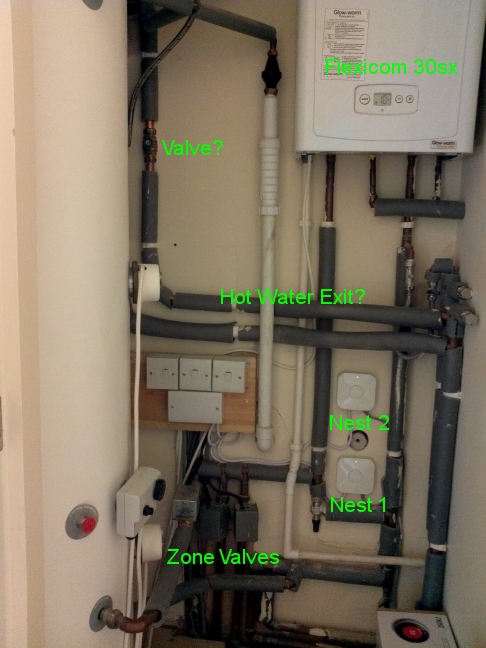
Up we went and found this...
CH.jpg


Which he was confused with.

He has now gone away, saying that he needs to research how to turn the hot water off. He suggested there should be some kind of isolation valve on the pipe you can see going horizontally (the top one)... but I do see a big valve on that pipe - when it was turned, it didn't seem to stop the hot water when it was ran. He said he doesn't want to just tinker with a pressurised system and would prefer to go away and research it (which is fine by me, I don't really anyone tinkering with it either).

My first question... obviously you can turn the entire water supply to the hose off at the stop-cock, with a system like you see in the picture, is there a convenient way of turning off the hot supply so the Plumber can get to work on installing the tap?

My second question... if that green valve in the picture isn't the valve I need, and there is no other way of turning off the hot water supply, should I be asking a Central Heating Engineer to perform some remedial work on my system?

I don't know much about this system, I only moved into the house in June, and the first thing I did was have those Nests installed... other than that, well, it has just worked.

I'd really appreciate any thoughts anyone might have.
 
I don't really understand why you need hot water to your garden hose and pressure washer. They both just connect to an outside garden tap. If fitted with a thru wall kit, its unlikely it would freeze.

And more importantly, what is a 'Scran?' :lol:
 
OK, so "scran" is snap, grub, food, sustenance.

http://www.oxforddictionaries.com/definition/english/scran

Anyway, the pressure washer works much, much better with warm water (it doesn't need to be hot, in fact the manual says "not hot") rather than just cold water... it's night-and-day for cleaning patios and decking. We have some chickens who really enjoy the shade on the decking and as they (poor things) can't control when they poo (and they really don't seem interested in learning - brains the size of a walnut) having warm water in the pressure washer to clean-up dried chicken poo is a real convenience.

Sorry, but you did ask.

Now... onto the problem at-hand... can I turn off the hot water supply with what you see here?
 
P.S. - I would add - this is what I was looking at for an external mixer tap - but it needs to go through the wall to where it will be placed (not along - and you can't cut down the pipes it comes with) and the sellers confirmed that it would not be suitable for my requirements.

http://www.drainage-systems-online....AWCKbq9DtD0jbh4zqJiwMw8ep1jc0l5uCzt0exHPD_BwE

Hence, the internal mixer tap route... which is what I'll be happy with, once it can be installed.
 
Can't you fit a blending valve (TMV) inside and connect the output to a conventional outside tap?

There should be a valve on the cold feed to the cylinder. If you turn the cold mains off the hot will also stop once the pressure has been released in the hot water system.
 
Sure, if we turn the cold mains off - then, yes, eventually, the hot water will stop as well because the pressurised cylinder will become empty. The Plumber gets that... I thought so too.

But isn't there loads and loads of water in there?

I actually prefer the idea of the inside mixer tap - and whether there's a blending valve inside or whether I went for that external mixer tap - the problem I have still remains, right? The Plumber is saying he'd like to be able to stop the hot water supply before un-capping the pipe.

That problem doesn't go away if we went with a blending value or the external mixer tap, right?

If I'm not right, tell me...

But - from the picture I posted - is there nothing obvious for stopping the hot water? I take it no-one is saying it's that big green valve near where the cylinder is?
 
You wouldn't drain the whole cylinder, just the pipework from the outlet onwards.

I suspect your plumber isn't a plumber
 
Your photo cuts off where I would expect the isolation to be near the bottom. But if you turn off the mains to the house and open a hot tap the pressure will die away and you'll be left with a cylinder full of unpressurised hot water. It will NOT all drain out.
 
You wouldn't drain the whole cylinder, just the pipework from the outlet onwards.

I suspect your plumber isn't a plumber

I've just moved to the area, this Plumber was recommended by a Sparkie. Not my usual Plumber, but he's too far away now.

Which outlet are you referring to? Is that something that's in the photo or something that would be near where the mixer tap is going to go, I just see two copper pipes there, so I expect not?

Forgive me, but I'm definitely not a Plumber. :wink:
 
Your photo cuts off where I would expect the isolation to be near the bottom. But if you turn off the mains to the house and open a hot tap the pressure will die away and you'll be left with a cylinder full of unpressurised hot water. It will NOT all drain out.

Thanks. I can easily take another photo, but I'm not seeing much down there.

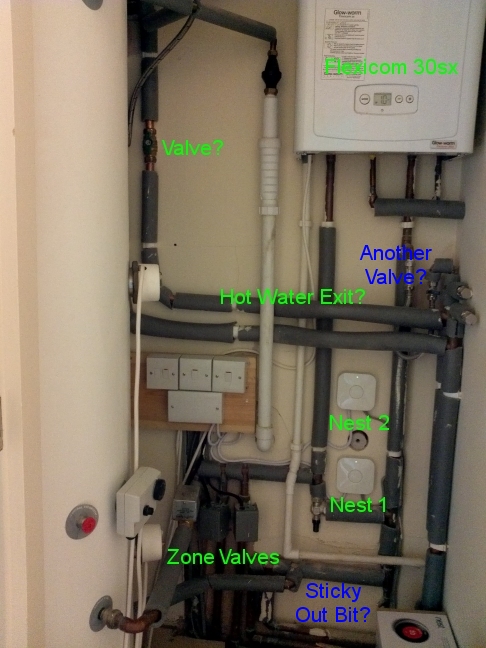
I amended the image with two things I spotted (in blue)... a black valve near the boiler and a brass thing behind where the Nest boxes are sitting. All the rest is just lagged pipes (it seems) then it's the wooden floor.

CH2.jpg


Appreciating the input.
 
If you shut the cold supply, you can drain the hot pipework by opening the taps, this will not drain your cylinder and only the pipework from the outlet on the cylinder allowing you to work on the hot supply

A plumber/heating engineer would. Know what to do, it's very basic
 
Have to agree with terry there... It is incredibly basic stuff. Whether it's a vented or (in your case) unvented it's never necessary to drain a cylinder to add on or change a tap!
 
Thanks both.

OK, it makes more sense now... he did ask me to run the hot water, which I did, but it just kept on coming... then he was suggesting an isolation valve from the hot output from the cylinder would be something that he'd hope to see.

I can try this again tomorrow... I can turn off the stop-cock, then run a hot tap and hope to - eventually - observe the water pressure drop to nothing, while the cylinder remains as-is.

Final questions from me, then... what is the big green valve at the top left likely to be for, same question for the smaller black valve just under the bottom of the boiler? Do valve colours mean something in central heating?
 
The valve under the boiler is the filling loop for your central heating system

Turn the green valve off and see what happens?

I would have to see the rest of the pipe to know what it was isolating
 
thanks for letting me know what a scran is - and I was actually doing that whilst reading your post.

As suggested, turning off at the mains will stop the hot water. The reason it runs on is the emptying of the water in the pipework from upstairs. If you have used a compression end cap, just loosen and gradually drain into a bucket. If you have used a soldered end cap, slowly cut with a pipe slice until water starts to appear and drain into a bucket. If no water is coming out of your hot tap at the sink, then you know there will NOT be an endless amount of water coming out of the pipe you are cutting.
 

If you need to find a tradesperson to get your job done, please try our local search below, or if you are doing it yourself you can find suppliers local to you.

Select the supplier or trade you require, enter your location to begin your search.


Are you a trade or supplier? You can create your listing free at DIYnot Local

 
Back
Top