Radiator diagrams - where can 22mm change to 15mm?

Joined
25 Nov 2006
Messages
785
Reaction score
17
Location
London
Country
United Kingdom
Hello

Am starting a new thread as, based on the advice I got (thank you), I need to upgrade my central heating pipework from 15mm to 22mm.

I'm hoping to find out how much of it can stay and how much of it needs changing.

In total there are 21 radiators totalling 23 Kw, across three floors including loft.
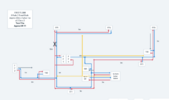
Ground floor: 8 rads 9kW (G1-8). Flow and return pipe run 110m
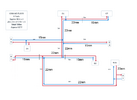
First Floor: 8 rads plus 3 towel radiators, 11kW (FF1-8 TR1-3) Flow and return pipe run 91m
Loft:
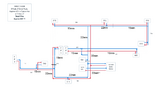
3 rads 3kW (L1-3) Flow and return pipe run 20m

I've cobbled together a diagram which I hope helps. It's not exactly to scale so I've added approximate lengths of pipe run as an indicator .

From what I've read you need have the 'backbone' in 22mm and you don't want 15mm pipe to more than 3 radiators on any one branch, but I'm not sure how close to the radiators you need to get. For example I have a branch (First Floor FF7, FF8, TR3 - Landing, Bedroom & Towel Rad), but the distance is approx 11m - does it all need to be 22mm? It would be great if someone could highlight the areas that need to be 22mm but any advice at all would be gratefully received. Thanks!

Ground floor

1762443070173.png


First floor
1762443103994.png


Loft
1762443140777.png
 
OK - the rule of thumb is - 22mm run from top to bottom and out onto each floor and then branch out in 15mm to each rad on each floor. Try and keep the 15mm runs similar lengths, this will allow the rads to heat up at similar rates.

Ideally you would have 22mm on each floor running out to a central location and then 15mm runs, as equal length as possible, from there out to the rads. A lot of the time that's not feasible though so the 22mm may have to travel a bit and try and get the branches as centralised as possible. All else fails then as short a route to the rads as possible but do know the more uneven the lengths of the 15mm runs out to the rads are, the more balancing that needs to be performed. I would recommend no more than 2 average sized rads (600x1000 K2) from a single 15mm feed.

The ground floor flow seem to be short circuited by that 4m length running from between G1 and G2 up to the length between G2 and G3? The 3m>4m length between G1 and G2 would probably be removed
 
The ground floor flow seem to be short circuited by that 4m length running from between G1 and G2 up to the length between G2 and G3? The 3m>4m length between G1 and G2 would probably be removed

Funny you should say that- it's the only run of pipe that's in 22mm!

Thanks for your help. I think the only way to achieve runs of 15mm will be to run 22mm up to the rads themselves! Can it be 22mm Hep? I know the diameter is less but will the increased size be sufficient?
 
I think the only way to achieve runs of 15mm will be to run 22mm up to the rads themselves
Sorry but that doesn't really make sense to me, especially given your layout diagrams.

Grnd floor - a 22mm spine right up the middle with 15mm supplies out to the rads - just because they are 5m doesn't matter, it's the similarity of the lengths that would matter, even then a m or 2 out towards the rads will help massively but not needed right out to the rads
First floor - same again - extend the run on TR1 up to the run on FF5/FF6, 15mm left to FF5 and elbow 22mm out to FF6 then drop to 15mm to FF8 and TR3 - also take the 22mm out left towards TR2. FF2&3 off that 22mm and then drop to 15mm to feed TR2 and FF2
Loft is easy - 22mm up to L2 and elbow left towards L3 then drop to 15mm

There may also be a case to add a supplementary pump, depending on available head and overall height.
 
Thank you Madrab, I mistakenly thought that if there was a radiator within 12inches of a 22mm pipe then all rads needed to be within 12 inches. If I'm now understanding it correctly, if I at least get 22m whereby there's a similar run of 15mm to the furthest of a 'family' of rads, even if it's 5m, then it will help things massively.

Taking that on board, and mindful of where I can and can't access, I've modified it slightly. For example, FF8 is the extension area with chipboard flooring and the joists running the opposite way so it would be difficult to join that to FF6.

You've already been very helpful and I don't want to hog your time, but would you mind casting your eye over it to see if it's adequate? I've marked the 22mm in yellow. Either way, thank you very much.

1762511353472.png


First Floor
1762511866349.png
 

Attachments

  • 1762511503994.png
    1762511503994.png
    53.8 KB · Views: 17
More like this I would think to even it all up. Then 22mm up and out into the loft. If the loft is struggling to heat up then a supplementary pump may be solution to overcome the height

1762551424504.png 1762552699712.png
 
If your existing pipes are run in notches under the floorboards, cutting out and replacing with copper is the best solution. Rodents can't chew copper!
 
Thank you Madrab, I mistakenly thought that if there was a radiator within 12inches of a 22mm pipe then all rads needed to be within 12 inches. If I'm now understanding it correctly, if I at least get 22m whereby there's a similar run of 15mm to the furthest of a 'family' of rads, even if it's 5m, then it will help things massively.
Just reading this again too - you want to avoid taking 15mm out to any more than 2 average sized rads and even then if they are miles away then that's to be avoided due to the drop in pressure and balancing issues. What I meant is as long as the run to a rad isn't overly long then 15mm will manage it but that should really still be fed from a 22mm flow and return.

As far as using plastic is concerned then yes it can be used, there has been a lot said recently about the inserts dropping 22mm down to effectively 15mm and that is true but that is only at those single points, in the main the pipe is still 22mm so will flow greater albeit the velocity will have to increase at those points, as long as the head of pressure is adequate. Another good point is that plastic can be chewed upon and again that can be correct but that is only really if the area it is to be run in has been shown to contain vermin.
 
Thanks
If your existing pipes are run in notches under the floorboards, cutting out and replacing with copper is the best solution. Rodents can't chew copper!
It's a mix of notches and holes but will bear that in mind!

Madrab - Thank you very much for taking the time to update the diagram, I am very grateful.

I have one radiator (G2) which is 7000 BTU/2kW. G6 and G7 are both in the region of 5000BTU/1.5kW so together are 10000 BTU/3kW so I presume that would be inadequate if it was 15mm but okay if upgraded to 22mm.

None of it will be easy but the most challenging would be putting a run between FF6 and FF8 (because of a brick cavity wall, chipboard flooring and the joists going in the opposite direction). Far easier would be to upgrade the existing run between FF7 and FF8, where the joists are in its favour, would that work?
 
G6 and G7 are both in the region of 5000BTU/1.5kW so together are 10000 BTU/3kW so I presume that would be inadequate if it was 15mm but okay if upgraded to 22mm.
Not inadequate per sé but ideally 22mm up to G6. The best practice for any central heating system is to minimise imbalances and maximise flow, especially when the run length become longer. The ideal is to have a 22mm backbone to a central location on any given floor and then all the 15mm feeds are as close to the same lengths as possible. This allows the system to balance itself and allows the radiators to warm up at similar times.

(Just for clarity too when it comes to CH systems, I use the term balanced/balancing in 2 ways. One whereby the system will warm the radiators up as close to the same time as possible, the other is to ensure that each rad delivers it's heat at the correct delta across the rad. This allows the efficiency of the system output to be maximised and also allows the boiler to condense as much as possible due to a lower return temp.)

If FF7 and FF8 is easier then run 22mm out to FF7 then just after that drop to 15mm for TR3 and FF8, keep FF5 the same and run a 15mm feed to FF6 off the 22mm
 
Thank you so much Madrab, you’ve been very patient and I’ve learned a lot from you. (y)
 

If you need to find a tradesperson to get your job done, please try our local search below, or if you are doing it yourself you can find suppliers local to you.

Select the supplier or trade you require, enter your location to begin your search.


Are you a trade or supplier? You can create your listing free at DIYnot Local

 
Back
Top