
You are using an out of date browser. It may not display this or other websites correctly.
You should upgrade or use an alternative browser.
You should upgrade or use an alternative browser.
Radiator mean temperature
- Thread starter Johnytuono
- Start date
And a final? few calcs showing the effect of running with a constant 60C boiler flow temp and throttling the lockshield valve to give flow/return dTs of, 20C, 15C, 10C, & 5C. A rad with a fully open lockshield valve can give (I think) ~ 2.5/3.0LPM.
Attachments
Last edited:

- Joined
- 27 Jan 2008
- Messages
- 29,812
- Reaction score
- 3,696
- Location
- Llanfair Caereinion, Nr Welshpool
- Country

There are four reasons for setting the lock shield valve.
1) So the TRV has time to open and close without causing a hysteresis.
2) So the return water is cool enough for the boiler to gain the latent heat.
3) So it shares the water with other radiators.
4) Before the TRV it was used so each room got it's fair share of heat, and it still can before the TRV starts control helps that way.
However, it does depend a lot on the home and boiler type, with micro bore piping and an oil boiler I find with this house they can be left wide open. But with parents old house, with 15 mm pipe work and a gas modulating boiler, the lock shield valve setting were critical.
With my old house, also micro bore, I found it impossible to set radiators to heat each room in the proportion wanted, and I had to fit TRVs in the upper rooms to stop over heating. No TRVs were fitted on the ground floor, and the fan assisted radiator had no lock shield fitted, or for that matter a TRV, output was controlled by the fan speed. (Used with a non modulating boiler)
For fan assisted radiators maybe plumbing in series would be better? Since I only had one, it was not a problem, but can't see how if all fan assisted it would every work plumbed in parallel with a condensing boiler?
measuring the actual surface temperature of the radiator in the top/middleWhat exactly do you mean by, and how are you measuring, the "radiator mean temperature"?
won't the water take the least resistance path and return to the boiler and cause it to modulate down too early?@Johnytuono why not try it based on the outside temperature model, open all the lockshield valves fully, they can then be throttled individually later, then just keep reducing the boiler target flowtemp which reduces mean rad temperature and obviously the return temperature necessary for effective condensing and increased boiler efficiency.
Lots of technical advice about balancing on the Stelrad site. Fully opening lockshields and using weather compensation (water law in Samsung language) is not the solution. I've never seen reference to measuring mean temperatures across radiators, I just balance them to spec (12-15C in/out drop for traditional GCH boilers) and leave them to do their designed job.
The house needs to be up to temperature and stabilised before balancing else you'll be measuring incorrect temperatures of the pipes as they are still heating voids and floor slabs before they come up to temperature.
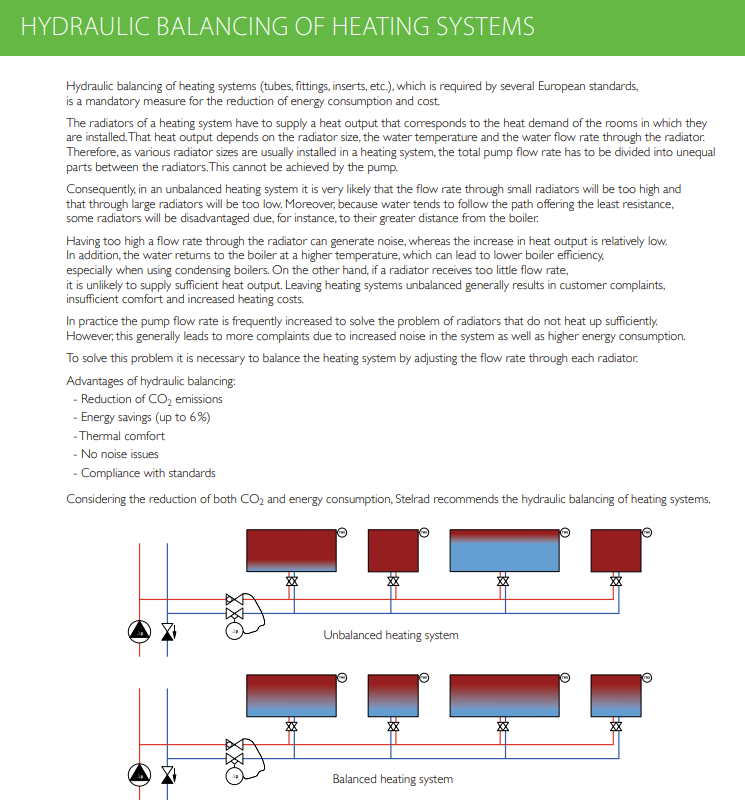
The house needs to be up to temperature and stabilised before balancing else you'll be measuring incorrect temperatures of the pipes as they are still heating voids and floor slabs before they come up to temperature.

- Joined
- 22 Jan 2007
- Messages
- 24,751
- Reaction score
- 3,754
- Country
Are you having heating issues or does the house generally heat up ok?Hopefully someone can explain this.
Boiler flow is 60c, have balanced the rads to about 12c with a differential thermometer.
For some reason the flow pipes show 51c and the return 39c yet the rad. mean temperature is around 50/52c, why is this if the flow pipe is less than the mean temp.?
I have 10mm Microbore tails, the boiler does show water heated to 60c and the return is about 10c(ish less) but obviously this rises as the boiler modulates.
Anyone?

- Joined
- 22 Aug 2006
- Messages
- 7,949
- Reaction score
- 1,540
- Country
This is the point imho.Are you having heating issues or does the house generally heat up ok?
Yes you have to have balancing somewhere about right, so all the rads get enough water flow. Too much flow in one will make little difference. It's not linear either. If you have "just enough" flow, an alteration on one rad somewhere can grossly affect another such that almost no flow goes through it - typically the furthest rad in the system.
Any attempt at accurate calculation and control goes 'out of the window' if you leave the internal doors open too, which most do.
Of course you can't have a rad flow pipe hotter than the boiler flow pipe, steady state. How are you measuring it? IR readings depend on optical emissivity and contact ones on insulating paint etc.
I can't speak for all but proper bypass valves only open if the pressure is at peak due to other paths being closed, so shouldn't be an issue.
I have a FLIR camera, which is a quick and easy check. If you let the system go cold then watch the rads as it all warms up, they typically all look a bit uneven, but after a few minutes they're all much the same. It quickly shows a shortage or blockage in a rad too. Good for finding heat or water leaks, too!
Last edited:
For some reason the flow pipes show 51c and the return 39c yet the rad. mean temperature is around 50/52c,
What exactly do you mean by, and how are you measuring, the "radiator mean temperature"?
measuring the actual surface temperature of the radiator in the top/middle
What exactly do you mean by “top/middle”?
If you mean “the middle of the top of the radiator”, then I think what you’re seeing is as expected: the 51C water enters the radiator and rises immediately to the top, where you measure it as 50/52C. It then cools and falls and leaves the radiator at 39C.
If you mean something else, ….. ?
Boiler flow is set at 60c but the radiator flow pipe (even on the very first rad) is around 51c, surely it should be about 60c,
Measure the temperature of the flow pipe where it leaves the boiler.
- Joined
- 22 Jan 2007
- Messages
- 24,751
- Reaction score
- 3,754
- Country
Agree with this, there are far too many variables to start worrying about precise temperatures.This is the point imho.
Yes you have to have balancing somewhere about right, so all the rads get enough water flow. Too much flow in one will make little difference. It's not linear either. If you have "just enough" flow, an alteration on one rad somewhere can grossly affect another such that almost no flow goes through it - typically the furthest rad in the system.
Any attempt at accurate calculation and control goes 'out of the window' if you leave the internal doors open too, which most do.
Of course you can't have a rad flow pipe hotter than the boiler flow pipe, steady state. How are you measuring it? IR readings depend on optical emissivity and contact ones on insulating paint etc.
I can't speak for all but proper bypass valves only open if the pressure is at peak due to other paths being closed, so shouldn't be an issue.
I have a FLIR camera, which is a quick and easy check. If you let the system go cold then watch the rads as it all warms up, they typically all look a bit uneven, but after a few minutes they're all much the same. It quickly shows a shortage or blockage in a rad too. Good for finding heat or water leaks, too!
If the rads are all heating ok then, if you feel a bit cold turn the heating up a bit and if you feel hot then turn it down.
Measuring individual rooms to a tenth of a degree is pointless, IMHO.
What exactly do you mean by “top/middle”?
If you mean “the middle of the top of the radiator”, then I think what you’re seeing is as expected: the 51C water enters the radiator and rises immediately to the top, where you measure it as 50/52C. It then cools and falls and leaves the radiator at 39C.
If you mean something else, ….. ?
Here are some readings I took some years ago from a 1.5kW rad, I repiped this rad temporarily, to test its output piped TBOE, I got basically very similar results even though I think TBOE is better than BOE. What is interesting is (BOE) how the hot water rises up in the first ~ 20% of the rad and then runs along the rad top and drops down in parallel paths.
Attachments
At what boiler flow temperatures is best to balance at please?Lots of technical advice about balancing on the Stelrad site. Fully opening lockshields and using weather compensation (water law in Samsung language) is not the solution. I've never seen reference to measuring mean temperatures across radiators, I just balance them to spec (12-15C in/out drop for traditional GCH boilers) and leave them to do their designed job.
The house needs to be up to temperature and stabilised before balancing else you'll be measuring incorrect temperatures of the pipes as they are still heating voids and floor slabs before they come up to temperature.
View attachment 426495

DIYnot Local
Staff member
If you need to find a tradesperson to get your job done, please try our local search below, or if you are doing it yourself you can find suppliers local to you.
Select the supplier or trade you require, enter your location to begin your search.
Please select a service and enter a location to continue...
Are you a trade or supplier? You can create your listing free at DIYnot Local
Similar threads
- Replies
- 3
- Views
- 812
- Replies
- 31
- Views
- 5K
- Replies
- 31
- Views
- 9K
