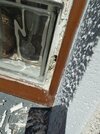
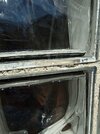
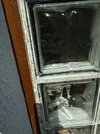
Thanks, just to understand when you say joints - do you mean all the joints around every block or just around the outside?
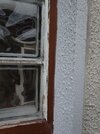
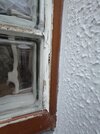
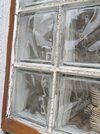
There are joints between the individual glass blocks and between them and the masonry or timber surround. I thought from what you wrote that the joints you were interested were the ones between the timber and the glass? Timber moves a lot more than glass, so a flexible sealant between the two is probably a good idea. I've seen these joints done in mortar (where the glass bricks were built into masonry walls), but I've also come across a couple which were sealed with some kind of semi-flexible mastic as well. Can't say I ever came across a glass block window in a timber frame, however
Would there have been some sort of sealant /putty between each block originally and it's worn away ?
Yes, there would have been something between the blocks (otherwise they window would fall apart when you as much as sneezed at it - the blocks don't interlock). It may well have been putty - that was commonly used for all sorts of glazing, especially indoors - but without a piece of the filling material I can't say what it is. If you can pick it out and it is gritty, then they possibly used either burnt sand mastic or mortar, if the stuff you dig out is whitish or creamish in colour and can be crushed into a sort of powder but isn't gritty, then it's possibly putty.
BTW I am neither a glazier nor a "mastic" man nor a brickie for that matter, but I have seen the installs/repairs done a number of times by the foregoing trades, and I'm reasonably adept, if somewhat slow, caulker. So it's a job I have done occasionally.
I have read that putty is hard to work with and newer sealants would do the job just as well or better ?
Putty isn't difficult to work with at all - it comes pre-mixed in tubs (just check that it's fresh), in cold weather it needs to be warmed up a bit (the tub is popped into a bowl of hot water for 10 minutes), then you dig a chunk out, roll it into a ball in your palms and press it into the gaps, finishing with a clipt point putty knife which can be used to both pack the joint and run along the joint to smooth it. Takes a few days to set, all depending on temperature.
Puttying up is one of those old skills, like sash window recording or french polishing which many trades and homeowners could do at one time, but which are now thought to be arcane knowledge
Any tips on how to remove or just hack away at it ?
Basically the same type of tools you'd use to remove tile grout joints or putty from sash windows. You can get little pick tools for grout removal, bigger joints packed with putty can be cleaned out with an old thin chisel or a glaziers leather-handled hacking knife
very carefully. Bigger joints can even be cleaned out with a multitool and appropriate blades (bimetallic saw blades for putty, carbide tile blades for burnt sand mastic/mortar - but you need to be very careful using a multitool as it is easy to damage the glass. Uses a lot if blades, so a task for old blades, not new ones