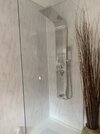
Yes, because the most powerful electric shower is around 10kW, many are less. Your combi is 30kW, 3x more.
As shower with side jets
and a large rose above you, may be able to use 30 kW, but a shower head which one can be unattached to reach the parts covered by the side jets with the larger units, can't have a massive amount of water through it, or if dropped it would be like a snake soaking everything.
So the shower head is designed to take enough water so has a reasonable pressure without getting cold, so a 7.5 kW shower head passes less water than a 10 kW shower head to keep the pressure reasonable, but a 30 kW shower head would need fixing, it could not have the option to remove it.
With my 20 kW Main 7 boiler, it was a struggle finding a shower head to match, if it did not allow enough flow it would cause the boiler to turn off, and too much flow, and there would be no pressure, the range of output for todays combi boiler is better to my old DHW only boiler, but it does need the head matching to the boiler, and in the main complaints that electric instant showers have no pressure is due to using the wrong head.
My parents moved from an electric power shower, from stored hot water, to a combi boiler shower, the power shower is illegal from a combi boiler as it could suck dirt into the main feed, there was a notable reduction in pressure, but really did not need to wash down the ceiling in the wet room, so the pressure reduction was not a problem, what was a problem, is so the rest of the taps in the house can be turned on with less than a full flow, there is a small reservoir in the boiler, works well with all taps but the shower. The shower used too much water for the boiler to fire up and keep a continuous flow, so it would go cold, with a wet room not too much of a problem one can step to one side, only a problem for my mother in a wheelchair, however, most shower cubical are not large enough to allow one to step to one side.
With my instant electric shower I can unhook the head and point it away from me while it warms up, although that does not take long, but with a stored water or combi boiler, it takes time for the hot water to reach the shower, so unless a wet room, having a fixed shower head can be a problem. There is simply not the room to step to one side.
And showers within a bath, even with a special bath with an area designed to stand in, there is another problem, the chimney effect, because the door does not go to the bottom of the bath, air flows up the chimney formed by the doors, and into the room as a whole, meaning the whole room gets wet, but with a shower cubical with door sealing at bottom, water is retained in the cubical.
So showers over baths often result in a problem with mould, not so showers in a cubical or wet rooms, as in both cases nothing to circulate the wet air throughout the room. So less area to dry, so mould is not a problem. I could mop the floor of the wet room, mopping inside a bath is not easy.
When I had a problem with mould with a shower over a bath, I just thought normal, needs more ventilation, it was not until I came to use a wet room and cubical shower, that I thought why is there no mould, we had extractor fans in the wet room and cubical but never used. With a cubical shower, likely they make it worse, drawing wet air out of the shower area, fan wants turning on after having a shower, not during having a shower.
Likely my electric shower is cheaper to run as well, normally see around 4 kW being drawn from the grid, the rest is from solar or battery, it would be better using a power shower, then non would be drawn from the grid, but the cost to get DHW into the shower, does not really warrant the change, but would fit a shower from DHW if I had to change it. Since the shower is downstairs, and the header tank in the loft, unlikely I would need a power shower, only if I wanted a shower upstairs would that be required.