Solar Panels... and I'm not good with numbers!

Joined
13 Feb 2013
Messages
33
Reaction score
0
Location
Cardiff
Country
United Kingdom
Hi folks, I was wondering if someone would be able to help me make some calculations for numbers of solar panels needed? I've got an opportunity to get my mitts on some due to someone else's upgrade.

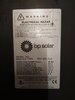
I have various numbers and a photograph of the label (attached), and we use ~400 kWh a month, but I've never been confident with numbers and trying to work out a) if they're suitable and b) how many I'd need is making my head swim.

Grateful for any guidance.
 

Attachments

  • WhatsApp Image 2022-02-22 at 17.37.59.jpeg
    WhatsApp Image 2022-02-22 at 17.37.59.jpeg
    173.2 KB · Views: 139
I have various numbers and a photograph of the label (attached), and we use ~400 kWh a month, but I've never been confident with numbers and trying to work out a) if they're suitable and b) how many I'd need is making my head swim.
Your total consumption per month is of limited usefulness.

For a start, assuming that you are not contemplating any large-scale battery storage, what is relevant is your consumption during daylight hours. Furthermore, the extent to which you could satisfy your requirements even during daylight hours would be dependent upon the peak power requirement (at any point in time) you would require during that period.

For what it's worth, I'm personally far from convinced that domestic solar panels in UK ever make much sense.

Kind Regards, John
 
Quick maths noting that what John said above is 100% correct and relevent.

The panel you show when operating at 100% efficiency and best daylight conditions will provide 35W(peak) of power (when illuminated by 1,000W of sunlight at 25°C).

Note that new panels are all greater than 250W per panel. Not 35W. These are very old and you need 8 for every 1 new panel.

If it stays on at that 100% efficiency and the sunlight does not dip the panel will provide 35Wh after 1hour.

I guess it will have have less than 50 efficiency as it is old. So maximum provision will be (50% of 35Wh =) 17.5Wh after 1hr in great sunlight

Panel will produce only work when it is light during a day, so let's say that is 8hrs (out of 24hrs),

So maximum power in great sunlight will be (17.5Wh x 8hrs = ) 140Wh in one day in great sunlight.

One panel will then produce (30days x 140Wh ) = 4,200Wh over one month if in great sunlight for 8 hrs every day and with 50% efficiency.

Convert this into kWh by dividing by 1,000 =

one panel will produce 4.2 kWh over one month if in great sunlight for 8 hrs every day and and the panel has 50% efficiency.

You need 400kWh per month, so that means you need
(400kWh / 4.2kWh per panel =) 92 panels.

But as John says, that is not true as the panels will only address the power you need when it is actually daylight (and also when it is sunny).

I used 8hrs of sun in 24hrs above. So if you use your power evenly over a day (which I am sure you do not as most use more at night) then you need
(8hrs/24hrs) X 92panels = 30 of these 35W(peak) panels to address your daytime usage.

This might be about right as I ignored that the sun can go behind clouds etc.

If budgeting, remember that this only saves you a maximum of (8/24 =) 33% of your 400kWh electricity cost, and you will also have to pay for a controller and fitting.

Reminder that John's comments are 100% correct.
 
Last edited:
Bear in mind modern panels are more like 300-400W the above figures would convert to 3 panels, but a 3KW system (whatever that actually means dependant on which salesman is involved) with 12 panels typically doesn't go very far towards ones usage.

Explains why the upgrade happened.
 
Thank you both - you've been very helpful in breaking it down and explaining it to me! You are definitely right about the battery storage and additional costs of inverters, etc, and whether this whole investigation would prove it a realistic project or not. I knew I'd come to the right place!

I was originally thinking 25 panels, so (although weather and general climate is another factor) I'm glad I wasn't too far off in some way.

Another thought... instead of using them on the house, we were planning on taking electricity out to our workshop which is currently lightless. If we were to invest in the panels and inverter, plus some form of battery storage, do you think we could realistically power some overhead lights in a small workshop with these?

Apologies if these are all ridiculous questions.
 
These are 35W panels.

How much money are you thinking on spendiin on these? They might be better option.

And how big is workshop?.
 
A solar panel mppt solar charge controller matches the voltage through the day, but a pair of panels and a zenor diode can also be used, but output per panel drops.

What voltage are you looking for, they say 8.5 volt so assume looking at 12 volt. What to do depends in the main on cost.
 
£7 each.
For tiny old panels, that's overpriced.

New can be had for about 45p/watt.
https://www.bimblesolar.com/solar/large-panels/655w-canadian-solar-panels

Those BP things are 20p/watt, but that assumes that they still have 35W output which they won't, and how much life they have left is unknown.
They will also take longer and cost more to install as they will need far more connectors and cabling, and that also means many more possible connections to fail. Generally are to be avoided unless you can get them for a low price, such as £2 per panel.

For total output, if you don't have battery storage, then you just want enough so that you use as much of the generated electricity as possible.
Too large and it just results in what's generated being shoved into the grid, where you might get 5p/kWh if you are set up with an electricity supplier that supports such things. Later in the day you can buy that same electricity back from them at more than 4x the price.

With battery storage the ideal is to have enough generation to supply the house during the day AND also charge the batteries fully.
Batteries being sized so that you can run all of your house from them in the evening/night with some spare, but not an excessive amount as that will increase the costs significantly for little or no benefits.
Batteries are a case where oversized panels can be of benefit, as in the summer the battery will be charged in only an hour or two with the rest given away to the grid, but in the winter it could take all day to charge, but that avoids having to buy grid electricity for almost all of the year.

 
Thank you both - you've been very helpful in breaking it down and explaining it to me! You are definitely right about the battery storage and additional costs of inverters, etc, and whether this whole investigation would prove it a realistic project or not. I knew I'd come to the right place!

I was originally thinking 25 panels, so (although weather and general climate is another factor) I'm glad I wasn't too far off in some way.

Another thought... instead of using them on the house, we were planning on taking electricity out to our workshop which is currently lightless. If we were to invest in the panels and inverter, plus some form of battery storage, do you think we could realistically power some overhead lights in a small workshop with these?

Apologies if these are all ridiculous questions.
A friend wanted exactly this situation for his home garden office, that's a posh name for a 10ft x 6ft fully insulated/carpeted wooden shed. For a period he used a pair of 12V 85AH leisure batteries to power 2 laptops, wireless hotspot, cordless phone & mobile chargers and 2 lengths of LED tape. Each night the batteries were moved to the garage and connected to LIDL 3.6A smart chargers for between 8-12 hours.

This was supposed to be a very temporary arrangement pending a house move but that came to a halt when lockdown happened.

To put this into perspective they live in a pokey first floor flat with the garden the other side of the walkway and the garage is the other side of another walkway & drive. Something like this in green:
upload_2022-2-22_23-11-28.png

When it was obvious he was not moving he fitted a pair of 29V 275W PV panels in parallel directly across the batteries, on a sunny day he was seeing about 9A but over the course of a week or so it proved to not be enough to keep the batteries sufficiently charged, he fitted 1 more PV and every couple or 3 weeks he would put them on charge for a couple of nights. A bit more frequent in the winter.

He is fully aware a proper management system is likely to be more efficient.
 
For tiny old panels, that's overpriced.

New can be had for about 45p/watt.
https://www.bimblesolar.com/solar/large-panels/655w-canadian-solar-panels

Those BP things are 20p/watt, but that assumes that they still have 35W output which they won't, and how much life they have left is unknown.
They will also take longer and cost more to install as they will need far more connectors and cabling, and that also means many more possible connections to fail. Generally are to be avoided unless you can get them for a low price, such as £2 per panel.

For total output, if you don't have battery storage, then you just want enough so that you use as much of the generated electricity as possible.
Too large and it just results in what's generated being shoved into the grid, where you might get 5p/kWh if you are set up with an electricity supplier that supports such things. Later in the day you can buy that same electricity back from them at more than 4x the price.

With battery storage the ideal is to have enough generation to supply the house during the day AND also charge the batteries fully.
Batteries being sized so that you can run all of your house from them in the evening/night with some spare, but not an excessive amount as that will increase the costs significantly for little or no benefits.
Batteries are a case where oversized panels can be of benefit, as in the summer the battery will be charged in only an hour or two with the rest given away to the grid, but in the winter it could take all day to charge, but that avoids having to buy grid electricity for almost all of the year.
Oh of course it's just occurred to me these are the 'SRT' solar roof tiles. I don't believe these ever really took off due to reliability, I don't know if that's actually correct but I loved the concept and would have installed them if it hadn't been for the high cost (ended up not installing any PV).
 
With battery storage the ideal is to have enough generation to supply the house during the day AND also charge the batteries fully. ... Batteries being sized so that you can run all of your house from them in the evening/night with some spare, but not an excessive amount as that will increase the costs significantly for little or no benefits.
All true, but what about the financial sums?

It wouldn't surprise me if when any eventual financial benefit arose (after one reached the 'break-even point'), it would only be seen briefly (after a good few years), after which (if not before!) there would be another large capital outlay to replace the batteries and/or panels - i.e. one would be 'out of pocket' for most of the time, with just a brief period 'in the black' (the first several years away) once every few years.

Kind Regards, John
 

If you need to find a tradesperson to get your job done, please try our local search below, or if you are doing it yourself you can find suppliers local to you.

Select the supplier or trade you require, enter your location to begin your search.


Are you a trade or supplier? You can create your listing free at DIYnot Local

 
Back
Top