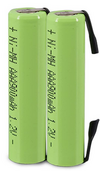
soldering AAA batteries

This 1777157093378.pngis what most replaceable batteries look like. The problem with old equipment is charging them. Old phones would have NiCad not Ni-MH and the charger is not the same. What seems just a battery often has some electronics built in
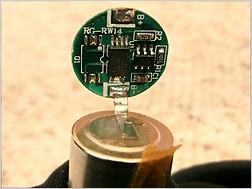
1777157502685.png
the early Ni-cad would have a peak voltage when charged and this was used to tell the charger when the battery was full, as soon as the battery voltage dipped the charger would turn off. But as we moved to Ni-MH the single cells had some electronics in them, but where they are charged as a group this control is for the group as a whole. So with my cordless phone I can swap Ni-cad for Ni-MH cells without too much of a problem, but the AA Ni-Cad was 600 mAh where the Ni-MH is 1900 mAh so the charger which was timed to switch off after it had delivered 600 mAh turns off too soon with the new cells. So every so often I have to remove the batteries and put them in a stand alone charger, and my phone does tend to go discharged to early, as a house phone this is not too much of a problem, I can grab another phone, and manually recharge the batteries. With a mobile phone that is not so easy.

So it depends what type of cells the phone had to start with.
 
Perhaps very old phones had them, and the OP does appear to be trying to keep dinosaur tech alive. I’ve a Nokia 1011 somewhere (that Wikipedia says has a NiCd battery), and notionally it does still work in that it sends SMS, and makes phone calls


But… Who would use it, really? And collectors of rare tech aren’t going to want one with a battery cobbled together from modern cells
 
I miss the old fax machine, good old Scottish technology, although it was the French who built the first pair. But without someone to send a fax to, or receive a fax from, the 19th century technology is dead. Same with teletext, and phones with dials. Today we expect to send pictures, etc.

I will admit the size of the old mobile means sometimes I do wish I could return, but we have to move on.
 
Perhaps very old phones had them, and the OP does appear to be trying to keep dinosaur tech alive.
The first approximation to a 'mobile phone' I had (which preceded GSM, and hence was really a 'radio telephone'), I guess in the early/mid 80s, came as a substantial and pretty heavy 'brief case', largely full of lead-acid batteries (including spares, since a fully charged one would not power the device for very long!) ;)
But… Who would use it, really? And collectors of rare tech aren’t going to want one with a battery cobbled together from modern cells
Collectors collect all sorts of things :-) However, if they want this part of the collection to be 'in working order', they presumably have no choice but to accept some cobbling together of modern ('available') cells? (although I'm far from convinced that the very old ones would work with today's GSM network, even if they could be 'powered up'!)
 
Collectors collect all sorts of things :-) However, if they want this part of the collection to be 'in working order', they presumably have no choice but to accept some cobbling together of modern ('available') cells? (although I'm far from convinced that the very old ones would work with today's GSM network, even if they could be 'powered up'!)

Are you forgetting, that we switched in the meantime, from analogue phones, to digital?
 
Are you forgetting, that we switched in the meantime, from analogue phones, to digital?
Were true 'mobile phones' (i.e. GSM ones) ever analogue?

The 1980'sdevice I had was certainly analogue but, as I said, was not really a 'mobile phone' in the sense that we have subsequently come to understand that to mean.
 
The 1980'sdevice I had was certainly analogue but, as I said, was not really a 'mobile phone' in the sense that we have subsequently come to understand that to mean.

OK, portable phone then. You didn't suggest the 'old phones' you had in mind were GSM old phones, only old phones, and to my mind, old phones are pre-GSM/analogue. The only way to resurrect such a phone, would be to rip everything out, and replace it with the contents of a more modern GSM phone.

I have one such, of my old analogue phone, in my workshop. An old Motorola unit. It has a quite large, slide in/out battery pack, for the base unit, linked to the handset by a curly lead.
 
OK, portable phone then. You didn't suggest the 'old phones' you had in mind were GSM old phones, only old phones ...
You do like dissecting mesagses, don't you :-) In any event, I think I did more-or-less suggest that when I wrote:
The first approximation to a 'mobile phone' I had (which preceded GSM, and hence was really a 'radio telephone') ....

.... and to my mind, old phones are pre-GSM/analogue. The only way to resurrect such a phone, would be to rip everything out, and replace it with the contents of a more modern GSM phone.
Agreed - pre-GSM obviously will not work with GSM.
I have one such, of my old analogue phone, in my workshop. An old Motorola unit. It has a quite large, slide in/out battery pack, for the base unit, linked to the handset by a curly lead.
My briefcase' one (can't remember the make) was similar. It had a large lead-acid battery plus two spares in the case, and a handset on a curly lead. I can't remember whether it had a 'dial' anywhere, but I have a vague recollection that I had to talk to some 'radio telephone operator' to tell them what number I wanted to call - but this was 40 or more years ago, so my 'recollections' are a bit dusty :-)

The thing I moved onto from that was a Vodaphone "car phone" (what we then called "hand portables" were then beyond my budget), which I had installed in 1987/8. It obviously ran from the car battery and consisted of a couple of large boxes of kit which were installed under the rear seats of the car, with a handset and other bits mounted on/near the dashboard. Again being pre-GSM, I presume that must also have been analogue.
 
Analogue mobile phones were still in use in late 90's alongside their digital brothers from 1993 as a rough guess. A company I worked for 1995-6 had 2 of each and we regularly swapped back and forth depending on signal coverage.
 
Analogue mobile phones were still in use in late 90's alongside their digital brothers from 1993 as a rough guess.

That is similar to my recollection, I remember buying an early Nokia, in around '93, on Orange. The weird Orange TV ads, just mentioned 'The world being Orange', with no explanation of just what was orange :-)
 

If you need to find a tradesperson to get your job done, please try our local search below, or if you are doing it yourself you can find suppliers local to you.

Select the supplier or trade you require, enter your location to begin your search.


Are you a trade or supplier? You can create your listing free at DIYnot Local

 
Back
Top