splitting a socket

Joined
24 Jan 2013
Messages
41
Reaction score
2
Location
Argyll
Country
United Kingdom
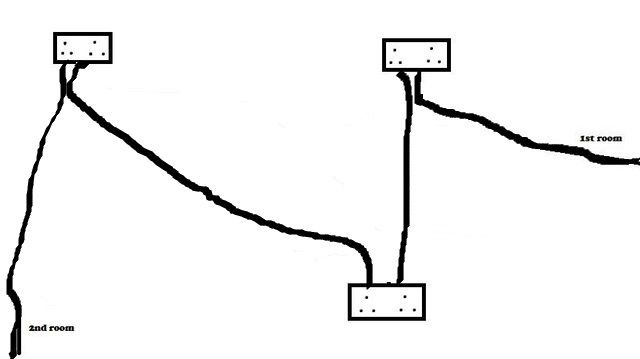
hello after a bit of info, looking to split 1 socket into 2, now i know that you cant have a spur from a spur, so is this diagram the correct way of doing this by using the JB, the JB at bottom is to extend the length of a cable


image1362477192310845.jpg
 
Is this a ring circuit or a radial circuit?

If it's a ring, then the top JB has two double outlets spurred off the ring at the same point, which is not good practice.
 
Is it possible to fit a fused connection unit (FCU)? If so likely best method for DIY for a number of reasons.
1 - No hidden junction boxed.
2 - Unlikely to have a problem with the loop impedance.
3 - If RCD not already included you can use a RCD FCU so all new wiring is RCD protected.
4 - Add as many sockets as you like daisy chained from a FCU.

The disadvantage is total for all sockets is 13A running washing machine, tumble drier, dishwasher, kettle would be a problem. But items like TV, Video, Router would be no problem and worst would be a blown fuse.

Any new wiring buried less than 50 mm needs RCD protection and nearly all 13A sockets need RCD protection.
 
Can you not just insert a new socket into the ring? Which is the new socket and which is being split on your diagram?
 
It's the bedroom anyway so wouldn't be any major appliances from it, the socket is in the middle of the two at top moved along the wall a bit
 
Before extending a ring circuit one should measure the loop impedance to see if by doing so the limits would be exceeded both for volt drop and for tripping the magnetic part of the MCB.

In real life few DIY people have the instruments or the know how to calculate to be able to measure the loop impedance. The requirements for a 13A fuse is 2.42 ohms against a B32 MCB at 1.44 ohms so it is unlikely that any spurs taken from a FCU will exceed 0.98 ohms so although for electricians we would extend the ring for the DIY guy in the main he is better replacing a socket with a FCU then taking all new sockets from that. If necessary using a twin socket box so the first socket from the spur is next to the FCU.

Even if the 2.42 ohms is exceeded it will only add a little onto the trip time where as with the MCB exceeding the magnetic limit will mean the thermal part of the trip is the only protection which will mean quite a jump in the tripping time even if only just over the limit.

So unless able to measure the loop impedance then the FCU is the safer way to proceed. OK I know we should always measure the loop impedance but I would say that's very rare with DIY jobs.
 
It's the bedroom anyway so wouldn't be any major appliances from it, the socket is in the middle of the two at top moved along the wall a bit
Never heard of a 3 kW fan heater heating a chilly bedroom while waiting for the central heating to come on.
 
If you're under the floor with cables and JBs anyway, why not extend the ring?
can this be done in this room as the rest of rooms are plastered and painted so dont want to disturb them, could someone modify my picture to show how to go about this? Thanks
 

If you need to find a tradesperson to get your job done, please try our local search below, or if you are doing it yourself you can find suppliers local to you.

Select the supplier or trade you require, enter your location to begin your search.


Are you a trade or supplier? You can create your listing free at DIYnot Local
 
Back
Top