
• Looking for a smarter way to manage your heating this winter? We’ve been testing the new Aqara Radiator Thermostat W600 to see how quiet, accurate and easy it is to use around the home. Click here read our review.

Spur from ringmain - outside socket RCD

Joined
24 Apr 2008
Messages
2,981
Reaction score
676
Location
UK, Wittering, West Sussex
Country
United Kingdom
i have an RCD protecting a small number of MCB , so it trips them all out if it goes - and at the time RCBO where very very expensive
Anyway - putting an awning in , that has a 13a plug, or can be connected to a spur, so I'm thinking of adding an outside socket so it can be isolated easily if any issues, then I thought I would add a double socket rather than just the one incase we needed an outside socket - like for xmas lights etc - we have had a window OPEN for
I was looking at maybe using this
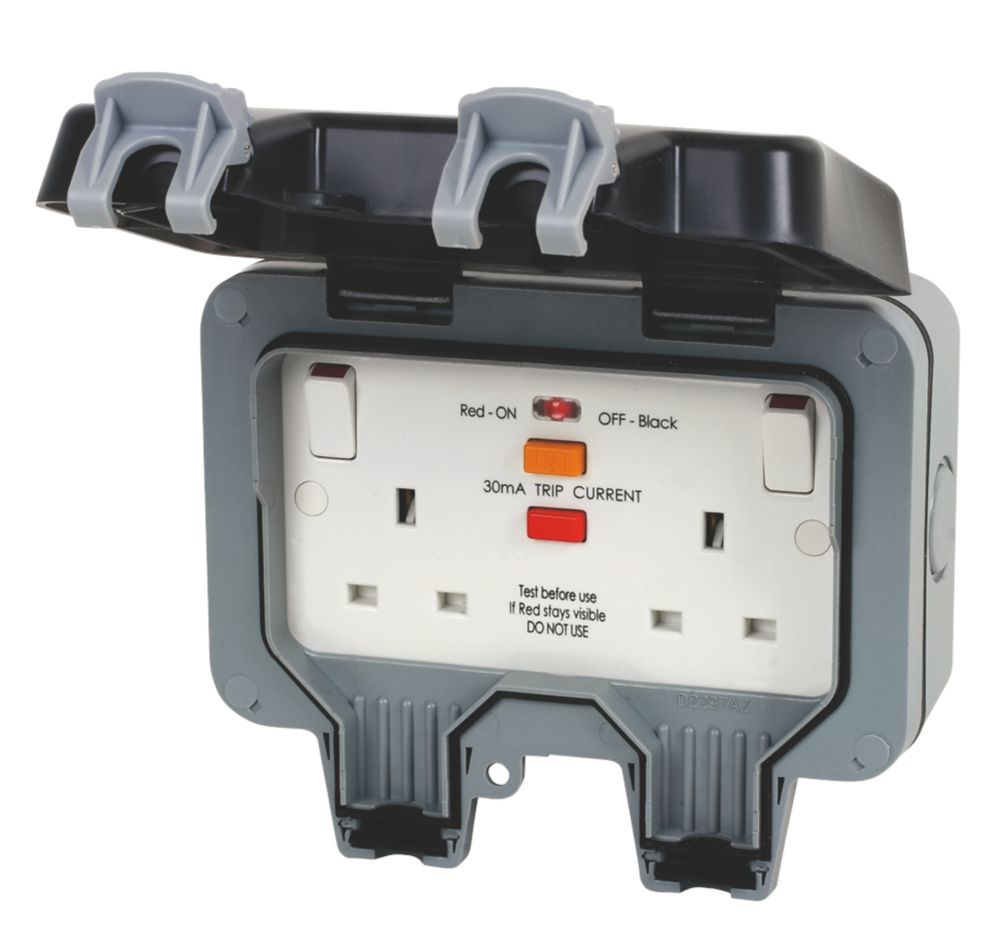
which is a double socket with an RCD
Which maybe a waste of time and maybe the one in the consumer unit may go anyway .........
consumer unit = 80A 30mA
the socket above also a 30mA trip current

As i'm typing this , if the awning or item connected to the socket , has an earth fault , due to water getting somehow - then it may just depend on the speed of the trip and which goes first - or both go together -

just trying to save a water ingress fault on the items outside tripping half the consumer unit
 
just trying to save a water ingress fault on the items outside tripping half the consumer unit

An extra RCD, on a circuit which is already protected by an RCD, of the same sensitivity, is entirely pointless. Add a double outdoor socket, without an RCD, but via a double-pole isolator, in case of problems. Make sure the socket you are planning to spur off, is not already a spur/make sure it is on the ring.
 
An extra RCD, on a circuit which is already protected by an RCD, of the same sensitivity, is entirely pointless.
Not 'entirely pointless' in some people's minds.

In terms of protection against L-E faults (including electric shocks) there is no advantage in having two, other than to provide redundancy (perhaps not to be sneezed at, given that the 'failure rate' of RCDs is said to be quite significant).

However, although the RCDs in CUs etc are virtually always 'passive' ones, those in RCD sockets and adapters are commonly 'active' - and some people feel that the extra protection that provides (to prevent power/garden tools springing back to life after a brief power cut) is worthwhile. ... that's nothing to do with 'residual current protection' but is nevertheless a useful type of protection.
 
oh ok, thanks - the one i posted was passive ... maybe i should look for active rcd sockets
That's obviously your choice - and I think you'll probably find (certainly used to be the case) that a high proportion of RCD sockets are 'active' ones.

As I wrote, provided the one in the CU is working satisfactorily, adding a second one achieves nothing in terms of 'residual current protection' (although a second one obviously has a value if the first one fails to operate as it should).

However, a passive RCD is not affected by a loss of power (as in a 'power cut') so that if a power tool is operating when the power goes off, it will start working again the moment power is restored - which clearly could present a hazard. On the other hand, an 'active' RCD actually 'trips' if power is lost - and remains 'tripped' when power is restored, until one manually re-sets it - so, protection against hazards due to loss/restoration of power, nothing to do with 'residual current' functionality.

Kind Regards, John
 
I knew of a situation where a passive RCD was faulty and replaced with an active, I know not why but it was the situation, the kidney dialysis room (fortunately not in use at the time) lost power during a fairly short power loss due to a switching issue at the substation. 2 Days later the fridge containing the required drugs was up to room temperature which in itself had not been chilled by the aircon, I believe the dialysis machine was also affected.
Not the crunch... the very large UPS system designed to run the run for 2 hours now had failed batteries due to the outage.

Exactly the same senario when RCD sockets in an councils roof plant room were deemed unsatisfactory and changed to active, every single item of their rsdio based comms systems were either on individual UPS systems or included back-up batteries and one by one they failed, this included their lone worker safety system, the elderly emergency pendants, the carparks barrier controls, the data likes to remote buildings. Their electricians were part way to running cables to get the sockets on the back-up generator supply before reality kicked in.

Active or passive really does need careful consideration of the potential hazards before installing.
 
Exactly the same senario when RCD sockets in an councils roof plant room were deemed unsatisfactory and changed to active, every single item of their rsdio based comms systems were either on individual UPS systems or included back-up batteries and one by one they failed, this included their lone worker safety system, the elderly emergency pendants, the carparks barrier controls, the data likes to remote buildings. Their electricians were part way to running cables to get the sockets on the back-up generator supply before reality kicked in.

There are much better, localised to the machine, ways to avoid the possible danger of items suddenly restarting, after a power outage, than active RCD's..
 
I have used active RCD sockets and FCU to comply with no volt drop out regulations on items like grinding wheels. However the main reason for active RCD's was to ensure they still worked with a volt drop. In the early days of RCD's a volt drop could result in the RCD not opening with a fault, however any electrical system should be designed, not thrown together with items found in the tool box.

It is so clear that we don't want life dependent machines to fail, that we have special 13 amp plugs with no fuse in them for some bits of medical equipment.

I would agree with @Harry Bloomfield there are proper motor start systems designed to not restart after a power outage, however these are expensive, and cheap grinding wheels designed for the DIY market over the 0.37 kW so 522.1.2 is valid, but for some reason it seems manufacturers do not seem to think it matters if for DIY market.

However I have found 10 mA sockets and other 10 mA RCD's are very expensive. There are some odd ones out, this one seems to be for a hot tub I note a page of information about the need for a RCD, but not one hint on the loss of PEN problems, I would have thought this was a major concern with out door items like hot tubes!
 
I wouldn’t waste money on an IP rated RCD socket
I reminded you about this recently ...

... you really should know better than to (for the second time recently) talk about an "IP rated" socket - as I said the "IP rating" could be IP00
 
I knew of a situation where a passive RCD was faulty and replaced with an active, I know not why but it was the situation, the kidney dialysis room (fortunately not in use at the time) lost power during a fairly short power loss due to a switching issue at the substation. 2 Days later the fridge containing the required drugs was up to room temperature which in itself had not been chilled by the aircon, I believe the dialysis machine was also affected.
There was clearly a serious lack of thought or understanding there. There are two situations to consider:

1... Situations in which a potentially dangerous power tool etc. could suddenly come back to life after a power cut. In that situation, some sort of 'NVR' functionality is really required for safety and (although it's nothing to do with residual currents) an active RCD provides that functionally.

2... Situations in which it is crucial that equipment is powered as continuously as possible (e.g. dialysis machines, fridges/freezers etc.), including coming back into service immediately power is restored after an interruption. In that situation, if the supply id RCD-protected, the very last thing one should install is an active RCD.
 
Last edited:
There are much better, localised to the machine, ways to avoid the possible danger of items suddenly restarting, after a power outage, than active RCD's..
For fixed equipment in workshops etc. that is obviously correct. However, in the case of 'plug-in power tools,garden tools and other 'potentially dangerous things. an active RCD is not an unreasonable way of getting NVR functionality, particularly since it also provides redundancy in relation to residual current protection'.
 
I would agree with @Harry Bloomfield there are proper motor start systems designed to not restart after a power outage, however these are expensive, and cheap grinding wheels designed for the DIY market over the 0.37 kW so 522.1.2 is valid, but for some reason it seems manufacturers do not seem to think it matters if for DIY market.

This week, I completed sorting my router, and table out. The router needed a button to be held in, all the time you needed it to run, making it impossible to use with the table. I made a little metal bracket, which bolts in place, to enable the button to be kept pressed. The table itself, has a plug and socket, a start and stop button. The start button includes a no-volt release.

My post drill, lathe also include a NVR. Disc grinders, are probably the most dangerous tools, but I have never seen either a DIY, or industrial one, which includes a NVR.
 

If you need to find a tradesperson to get your job done, please try our local search below, or if you are doing it yourself you can find suppliers local to you.

Select the supplier or trade you require, enter your location to begin your search.


Are you a trade or supplier? You can create your listing free at DIYnot Local

 
Back
Top