Hi
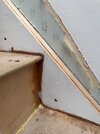
I’ve modified the stair stringer in our house. It originally had a strange wavy decorative section on top, which you can still see from the old wallpaper line in the photo. That part wasn’t structural, and the stringer has been fully reinforced underneath anyway.
I used a track saw to separate/remove the decorative top section, but because of the position it was difficult to get a perfectly clean cut.
The important bit is that the front edge of the stringer is straight — it’s only the back edge that’s uneven and a bit of a mess.
The stringer is around 45mm thick, and I need to get the top reasonably flat so I can fit some beading and then MDF panelling on top.
So far I’ve tried:
The section in the photo is actually the best one. It’s a winder staircase and the other two sections are quite a bit bumpier.
Any ideas for the best way to flatten just that back edge without ruining the straight front edge?
Thanks!
I’ve modified the stair stringer in our house. It originally had a strange wavy decorative section on top, which you can still see from the old wallpaper line in the photo. That part wasn’t structural, and the stringer has been fully reinforced underneath anyway.
I used a track saw to separate/remove the decorative top section, but because of the position it was difficult to get a perfectly clean cut.
The important bit is that the front edge of the stringer is straight — it’s only the back edge that’s uneven and a bit of a mess.
The stringer is around 45mm thick, and I need to get the top reasonably flat so I can fit some beading and then MDF panelling on top.
So far I’ve tried:
- Multitool — too difficult to keep accurate enough.
- Electric planer — can’t get the blade close enough to the back edge.
- Router — same issue, I can’t get close enough to the back.
- Track saw — not really an option now because the edge I’d need to cut is at the bottom with nothing behind it to support/guide the saw properly.
The section in the photo is actually the best one. It’s a winder staircase and the other two sections are quite a bit bumpier.
Any ideas for the best way to flatten just that back edge without ruining the straight front edge?
Thanks!