• Looking for a smarter way to manage your heating this winter? We’ve been testing the new Aqara Radiator Thermostat W600 to see how quiet, accurate and easy it is to use around the home. Click here read our review.

Suitable wall fixings??

Joined
23 Jan 2003
Messages
260
Reaction score
2
Country
United Kingdom
Hi, I dropped a clanger when revamping a downstairs bathroom for my wife. I have fitted all the wall panels onto plasterboard but forgot to fit a timber behind the plasterboard to attach a grab rail. Attached is a cross section of the wall.
Can anyone advise what fixings would work please? Or is there a product u can inject into drill holes that would take a screw directly or a rawlplug?
Taking the panels off the wall is not an option. Your ideas would be appreciated. Thanks
IMG_9812.jpeg
 
Long screws means thick screws with large heads that are too big for the fitting unfortunately
 
Get some brass expanding anchors e.g. https://www.amazon.co.uk/Anchors-Expansion-Anchoring-Concrete-Masonry/dp/B0C7XYNTNN?th=1 and some suitable thread bar - they go right down to M4, so quite small. You put the anchor on the end of some thread bar and push it as deep as you like. With a couple of nuts locked together you then wind the thread bar to expand teh anchor. Remove the locknuts, cut to length, and put any type of nut on the stub to secure whatever. You could use decorative dome nuts. Use stainless thread bar and nuts if it's in a wet environment
 
I'm not sure anything but a proper pattress behind the plasterboard is appropriate here. Anything else will rely on a couple of (4mm?) screws cantilevering 9cm off the face of the brickwork.
 
I'm not sure anything but a proper pattress behind the plasterboard is appropriate here. Anything else will rely on a couple of (4mm?) screws cantilevering 9cm off the face of the brickwork.
I think it'll be fine. I've used these loads of times. They provide an anchor that will never pull out and have as much depth as you want. You'd need to be considering stripping the threads in tension which is a huge force. The brass anchors won't pull out the brick without a very high load - 4-5mm about 40kgf each fixing, 6mm 70kgf 8mm 120kgf. The downward force is supported by the PB laterally. I agree, it's not ideal as the threadbar will try and cut downwards in to the PB, even though the PB is in compression possibly allowing the fixing to slide a bit across the surface. Worth a try though, particularly as there is also a panel which I presume is something like an MDF core which should have quite a high compressive resistance to support the end of the thread bar - better than stripping it all out first

Of course, the resistance to the panel/plasterboard squishing under cantilever pressure is always there as well, but no more than if there is a pattress behind the PB. You could, to avoid the PB pushing in to the void, fill it with a bit of expanding foam first to increase the compression resistance
 
I think it'll be fine. I've used these loads of times. They provide an anchor that will never pull out and have as much depth as you want. You'd need to be considering stripping the threads in tension which is a huge force. The brass anchors won't pull out the brick without a very high load - 4-5mm about 40kgf each fixing, 6mm 70kgf 8mm 120kgf. The downward force is supported by the PB laterally. I agree, it's not ideal as the threadbar will try and cut downwards in to the PB, even though the PB is in compression possibly allowing the fixing to slide a bit across the surface. Worth a try though, particularly as there is also a panel which I presume is something like an MDF core which should have quite a high compressive resistance to support the end of the thread bar - better than stripping it all out first

Of course, the resistance to the panel/plasterboard squishing under cantilever pressure is always there as well, but no more than if there is a pattress behind the PB. You could, to avoid the PB pushing in to the void, fill it with a bit of expanding foam first to increase the compression resistance
Well worth a try doesn't sound like you're sure, I guess if it fails his wife maybe takes the fall, literally.

A pattress works differently, the load is distributed over a much larger area and with decent fixings.
 
I guess if it fails

I'm absolutely sure it won't pull away under tension. We use those brass expanders in our work in hospitals to fix stuff to concrete soffits, and if they were prone to failing we'd be in big trouble and people would have stuff dropping on their heads through ceilings. I agree a pattress is best, but it isn't there, and taking down all the panelling and PB is a PITA. I hang heavy radiators and curtain rails through thick insulation backed PB using this method very successfully, so I'm as close to sure it'll be fine as I can be on a forum without actually being there!
 
All sorted now. Thanks for your advice. Those brass anchors are interesting and I will make a note of them for future.
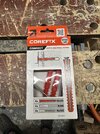
I used the attached in the end and the fixing is solid
 

Attachments

  • IMG_9815.jpeg
    IMG_9815.jpeg
    502.6 KB · Views: 32
Y those are decent, but you commented earlier in post #3 that the screw heads were too big for the fixings, also is that kingspan 45mm? if it is those corefix will barely have made it to the brick, but I expect in two layers of PB they'll be solid enough. They are a good fixing for PB lined walls for many applications, BUT if you read the datasheet for them, they state "not suitable for cantilever fixings", and they also only quote loading figures for shear forces, not tension.

If fixing to anywhere where the force is trying to pull the fixing out of a brick/concrete wall, I recommend brass expanders or other similar anchor fixings.
 
Yes nobody suggested the Corefix because they don't make any long enough, the longest are 120mm which would only give you 25mm at best in your brick so what your 100mm screws are fixed to is anyone's guess.
 

If you need to find a tradesperson to get your job done, please try our local search below, or if you are doing it yourself you can find suppliers local to you.

Select the supplier or trade you require, enter your location to begin your search.


Are you a trade or supplier? You can create your listing free at DIYnot Local

 
Back
Top