
about 6pm.In that case: When did i stop smoking the weed of life?

You are using an out of date browser. It may not display this or other websites correctly.
You should upgrade or use an alternative browser.
You should upgrade or use an alternative browser.
The London Mayor...
- Thread starter Odds
- Start date

Wrong again.about 6pm.
You're making a habit of that.
Careful now, it could become addictive.

O
I don't have an addictive personality or a stash of dope.Careful now, it could become addictive.
So, you can give up drinking today and it's no problem then.O
I don't have an addictive personality or a stash of dope.
Not often Simon Jenkins @ The GarundiA agrees with Sadiq Khan...

...(seen here in his greenhouse.)
But he does make several good points on decriminalisation:
...the divide in Britain is not between those “in favour” of cannabis and those against. It is between those who care about the impact of criminalisation and those who don’t, a subset of whom merely want to sound macho. In 2004 cannabis was reduced to class C but not decriminalised. Then, in 2009, Gordon Brown played tough and returned it to class B. The then home secretary sacked the government’s drug supremo, Prof David Nutt, for even breathing the word reform. By 2010 there were 43,000 convictions a year for drug possession, more than half of them for cannabis. An internal government report recommended decriminalisation in 2016 but was suppressed. The government even denied a freedom of information request, as if national security were at stake.
The UK is adrift in the western world in still wasting billions on its “war on drugs”. Half of US states have legalised and licensed cannabis, including cities such as New York, Los Angeles and San Francisco. In California there are cannabis cafes, cannabis farming estates and even cannabis sommeliers...more Americans today smoke cannabis than tobacco, including an astonishing five times more among those aged 18 to 34. There has been no noticeable collapse in American people’s health. Even Donald Trump favours legalising cannabis for personal use in his home state of Florida.
The damage is done not by cannabis, but by criminalisation, which draws young people into gangs that deal it and from there towards hard drugs and imprisonment. The result is that society suffers a monster misdirection of police resources. Violent crime in London has increased almost every year for the past decade. There has been a rise in sexual assault, car and phone thefts and petty fraud. Shoplifting in London rose by an extraordinary 54% last year. Imagine how much time the police would have were they not spending so much of it stopping, searching, and testing people for drugs.
The truth is that what is lacking is not more reports or more brains, it is more guts. On drugs, Britain is still in the dark ages.

...(seen here in his greenhouse.)
But he does make several good points on decriminalisation:
...the divide in Britain is not between those “in favour” of cannabis and those against. It is between those who care about the impact of criminalisation and those who don’t, a subset of whom merely want to sound macho. In 2004 cannabis was reduced to class C but not decriminalised. Then, in 2009, Gordon Brown played tough and returned it to class B. The then home secretary sacked the government’s drug supremo, Prof David Nutt, for even breathing the word reform. By 2010 there were 43,000 convictions a year for drug possession, more than half of them for cannabis. An internal government report recommended decriminalisation in 2016 but was suppressed. The government even denied a freedom of information request, as if national security were at stake.
The UK is adrift in the western world in still wasting billions on its “war on drugs”. Half of US states have legalised and licensed cannabis, including cities such as New York, Los Angeles and San Francisco. In California there are cannabis cafes, cannabis farming estates and even cannabis sommeliers...more Americans today smoke cannabis than tobacco, including an astonishing five times more among those aged 18 to 34. There has been no noticeable collapse in American people’s health. Even Donald Trump favours legalising cannabis for personal use in his home state of Florida.
The damage is done not by cannabis, but by criminalisation, which draws young people into gangs that deal it and from there towards hard drugs and imprisonment. The result is that society suffers a monster misdirection of police resources. Violent crime in London has increased almost every year for the past decade. There has been a rise in sexual assault, car and phone thefts and petty fraud. Shoplifting in London rose by an extraordinary 54% last year. Imagine how much time the police would have were they not spending so much of it stopping, searching, and testing people for drugs.
The truth is that what is lacking is not more reports or more brains, it is more guts. On drugs, Britain is still in the dark ages.
So you just have a prejudice against smokers.I gave up drinking alcohol years ago. I still go into a pub near me but I drink Guinness zero. I don't smoke either.
Okay.

sez the man callin' me a junkie.I'm not want you want me to be.
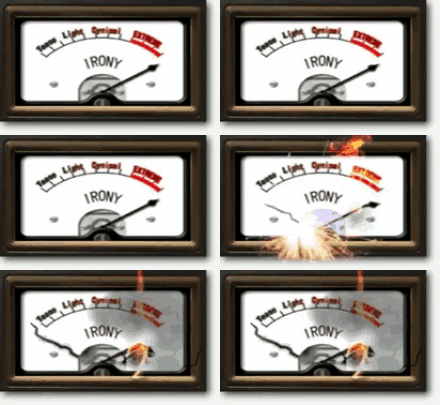
like you could tell the diff., old man.You are much more reasonable when you're not high as a kite. Keep it up, its good for you.
That's still an awful paper. Using data for Canada from 2012, pre legalisation, and then assuming it's still true now is just absurd.Pulmonary Disease
Cannabis smoking has been associated with an increase in bronchial and pulmonary disease, including chronic obstructive pulmonary disease as well as an increase in rates of lung cancer. Marijuana is reported to have 20 times the level of ammonia compared to traditional tobacco products. Marijuana is also reported to contain 3-5 times more hydrogen cyanide, nitric oxide, and aromatic amines than tobacco [13]. Similar to cigarettes, marijuana contains carcinogens, including phenols, polycyclic aromatic hydrocarbons and nitrosamines. Marijuana is reported to contain 50% more benzopyrene and 75% more benzanthracene than cigarettes; both of which are carcinogenic.
Public Health Impacts
Despite the economic benefits of legalization and decriminalization of cannabis, the impact on public health needs to be ascertained. In Colorado, marijuana use in undergraduate college students increased substantially after legalization [3,4]. The number of emergency department visits for cannabis-related medical problems increased in the US after legalization [5]. Uruguay reported a 52.4% immediate increase in motor vehicle fatality rates after legalization in 2013 [6]. There is also a growing concern that legalization and decriminalization will lead to increased underage use, which can have negative impacts on brain development. Data from Canada also demonstrates adverse effects in the work force, including increased industrial accidents, decreased productivity and increased employee turnover in workers who use cannabis compared to those who do not [7].
Accidents
In Canada, impaired driving is the number one contributor of cannabis-attributed disease [8]. Wettlaufer, et al. [9] evaluated the cost of cannabis-related motor vehicle accidents in Canada. They found that in 2012, driving under the influence of cannabis cases were reported to have a prevalence of 4.1% with the highest rates in the 16-19 age group [9]. Drivers were reported to be the most at risk for injury following a motor vehicle accident that involved cannabis. The estimated overall cost of cannabis associated motor vehicle accidents was reported at $1.09 billion Canadian dollars. Canada legalized recreational cannabis use in 2018, suggesting that these numbers are likely higher today.
Mental Health Impacts
The legalization and decriminalization of marijuana and cannabis proposes an increase in cannabis use disorder. European data has reported an increased rate of cannabis-related hospitalizations for mental health [17]. Marijuana use has long been associated with mental health disorders, including depression and drug dependency. Tetteh, et al. [18] reported that globally, approximately 13 million students aged 15-16 years old use marijuana [18]. With the use of the Global School-Based Student Health Survey, they conducted a cross-sectional study of 32,802 students from ten African countries. They concluded that marijuana users had a 12% increased likelihood of suicidal ideation, 18% suicide planning and 31% repeated suicide attempts.
Conclusion
Legalization of cannabis poses both benefits and threats to the countries that do so. Despite the economic benefits of legalization and decriminalization of cannabis, the impact on public health needs to be ascertained. In Colorado, marijuana use in undergraduate college students increased substantially after legalization. In Canada, impaired driving is the number one contributor of cannabis-attributed disease. Data from other countries has also demonstrated an increase in motor vehicle related accidents and deaths after legalization of marijuana. Cannabis smoking has been associated with an increase in bronchial and pulmonary disease, including chronic obstructive pulmonary disease as well as an increase in rates of lung cancer. Respiratory effects from marijuana use is an important topic that medical providers should be aware of but likely are not. The legalization and decriminalization of cannabis also proposes an increase in cannabis use disorder in additional to negative mental health impacts, including increased rates of psychosis.
Global Impacts of Legalization and Decriminalization of Marijuana and Cannabis
Wherever you look the only reason governments want cannabis use legalised is so that it can be taxed. Revenue is worth the risk.
Jeffrey Miron speculated that in the US, legalization could reduce spending by approximately 7.7 billion to 13.7 billion due to reduced need of law enforcement, correctional and prosecutorial needs. Miron also speculated that marijuana taxation could generate up to 8.7 billion dollars in government revenue. Despite these proposed benefits, Columbia reported financial favoritism toward corporations and government and marginalization of the peasant farmers whose livelihoods depended on illicit drug crops.
The author doesn't seem to be able to tell the difference between effects of marijuana and the effects of legalisation and just mixes the two freely.
How did this get published?

Terence Mckenna. Another wastrel, stuffing his face wi' 'shrooms all day.Drugs are for losers

- Joined
- 7 Nov 2023
- Messages
- 23,857
- Reaction score
- 15,606
- Country

Get high on life man, it's way more exciting than any artificial short term high.Terence Mckenna. Another wastrel, stuffing his face wi' 'shrooms all day.


