Thermostat not switching off boiler

Joined
16 Sep 2022
Messages
32
Reaction score
0
Country
United Kingdom
The housing association put in a whole new heating system for me two days ago. (Boiler, two new thermostats to replace a single old one, new radiators and pipework)

The two thermostats are EPH CM3 models. I heated the room to 20 degrees last night and then decided to turn the thermostat down to 18 degrees. Nothing happened - thermostat light remained lit. So I turned it all the way down to 15 degrees and still nothing changed. The only way to get the thermostat / boiler to knock off was to turn the thermostat down to the bottom of the 'lockable range', which appears to be 14 degrees.

The 'Switching Differential' on this range of thermostats appears to be plus or minus 1 degree, not 6 degrees... https://www.ephcontrols.com/wp-content/uploads/2017/05/20221103_CM_-_DS_PK_Email.pdf

Not sure what is going on, and it's Saturday, so I probably won't get anyone on the phone, and certainly won't get anyone out to look at it. Hopefully it's a minor issue that I can solve myself with someone's help here.

The boiler is an Ideal Heating - Logic Combi2 - C30.
 
Not sure what is going on, and it's Saturday, so I probably won't get anyone on the phone, and certainly won't get anyone out to look at it. Hopefully it's a minor issue that I can solve myself with someone's help here.

Likely, the installer has accidentally left the 24v link in place, in the boiler. The 24v allows the boiler to ignore the controls, and just run on the boilers own stat. Best not to interfere with it at all, just turn the boiler temperature setting down to a level which provides some background heat, plus turning the boiler off at the isolator. Leave it then until Monday.
 
I started with boiler instructions find in page, opentherm, and it is opentherm enabled, I know EPH do a special thermostat which can be set to master and slave for opentherm boilers, but the one you link to is not that model.

But setting the TRV heads to temperature required it should work without any wall thermostat, so should not be a problem.

There is some debate over control methods. Back to basis, the return water needs to be cool enough for the boiler to extract the latent heat from the flue gases, and every time a boiler is switched off and back on it has to start reducing the output from scratch again, so as much as possible control needs to be analogue not on/off.

So in the main the TRV head is king, as these slowly open and close, they do not click open and closed, so the old motorised valve is no longer suitable in the majority of cases, but there are exceptions, like with my granny flat, which may be not used for months. Also with this house (not the flat under the house) we have a downstairs room which should be a dinning room but hardly used, it is more a storage area, and upstairs rooms used as an office and craft room, so splitting the house up/down in the main does not work, be it children in a bedroom doing homework, or dinning room only used on weekend, groups of rooms vary through the life of a central heating system, as to what used for, so simple on/off motorised valves don't work for most homes.

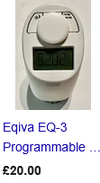
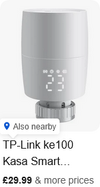
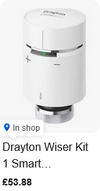
The TRV can accept a range of heads, and we select which to fit according to our needs. TRV stands for thermostatic radiator valve i.e. it is a thermostat, but it can also be a programmer as well, buying as sets thay can work out cheaper but typical starting price 1772286432201.png these are not connected to phone or internet, but are programmable. As the price goes up 1772286665604.pngso what it can do increases, so with this Wiser 1772286765253.pnghead, it can even work out how long it takes to heat the room, so auto adjust when it starts heating room so at temperature at time set, and it through the hub actually fires up the boiler, there is no need for any wall thermostats.

So I can see a problem for a housing association to decide what level of control to give. So boiler is 8 to 24.3 kW output, so minium rooms used will need to sink 8 kW, which is rather a lot, must be a big house. There is not a single room in my house which would need more than a 2 kW fan heater to keep warm, at night I use 2 rooms, in the day kitchen, living room, hall, and toilet, no way would I be able to use 8 kW to heat just those rooms, I may be able to use 6 kW, but with a house split into two zones, each zone must be able to sink more than 8 kW, most of my radiators are around 1.5 kW, so would need at least 6 radiators in each zone. For whole house, looking at 16 to 18 radiators to sink 24.3 kW. That must be a massive house?

OK we look at using a shower, so 8 to 18 kW for a shower, depending on head size, so unlikely to be able to support 2 showers however big it is, so in the main 18 kW is large enough for most homes.

Sometimes I wonder if there is any rhyme or reason why items are selected for a central heating system? In the main, the reason why some people think the heat pump is good, is simply the system has been designed not thrown together. To become an engineer, you need over level 3 training, i.e. a degree, and someone who has even just got a foundation degree, level 5, want to be paid a reasonable wage, so it seems many systems are just a collection of parts, there has been no design process.
 
I started with boiler instructions find in page, opentherm, and it is opentherm enabled, I know EPH do a special thermostat which can be set to master and slave for opentherm boilers, but the one you link to is not that model.

They are just basic, old fashioned mechanical thermostats. If correctly fitted, then turning BOTH down to a low setting, should switch the boiler to off, unless the installer has made some error.
 
turning BOTH down to a low setting
Yes, true, they are there to stop boiler cycling in warm weather, not to control room temperature I would guess.
These
1772289841152.png
do connect to the TRV, so not all wall thermostats connect to the boiler direct. Often they connect to a motorised valve in the old days, in the same way as today they connect to the TRV, and then the motorised valve or TRV connects to a hub or direct to boiler. It is quite rare for a thermostat today to connect direct to the boiler.
 
But setting the TRV heads to temperature required it should work without any wall thermostat, so should not be a problem.
I'm in a 1 bed flat. The living room and bedroom each have their own thermostat, and no TRVs. Supposedly the thermostat in the living room controls all the radiators, bar the one in the bedroom, which should be controlled by its own aforementioned thermostat.

For whatever reason, the other rads - bathroom, kitchen, hall and hot-press / airing cupboard do have TRVs.
 

If you need to find a tradesperson to get your job done, please try our local search below, or if you are doing it yourself you can find suppliers local to you.

Select the supplier or trade you require, enter your location to begin your search.


Are you a trade or supplier? You can create your listing free at DIYnot Local

 
Back
Top