• Looking for a smarter way to manage your heating this winter? We’ve been testing the new Aqara Radiator Thermostat W600 to see how quiet, accurate and easy it is to use around the home. Click here read our review.

What is the purpose of this pipe?

+1 - A secondary vent system, in a domestic setting, are no longer standard these days. They were only really employed where runs are overly extended and these days individual vents (AAV's) would now be placed at the head of the run or anti vac traps used rather than going to the expense and complexity of running a supplementary vent system from the stack.

You do need to understand where it is all connected though, so you know everything that may be effected. Just because they aren't really standard these days doesn't mean chopping things out of a systems that is set up that way, wont then create issues.
 
+1 - A secondary vent system, in a domestic setting, are no longer standard these days. They were only really employed where runs are overly extended and these days individual vents (AAV's) would now be placed at the head of the run or anti vac traps used rather than going to the expense and complexity of running a supplementary vent system from the stack.

You do need to understand where it is all connected though, so you know everything that may be effected. Just because they aren't really standard these days doesn't mean chopping things out of a systems that is set up that way, wont then create issues.
Thank you for that.

One thing I should add, I think the sink and bath drains are connected under the floor (and I assume then connect to the soil stack but I can’t see that join without removing some boxed in pipework).

When I run the sink tap, I can hear very audibly the sound of water running from the bath drain. Could it be that water running down the sink drain is pulling water from the bath trap, which might mean the secondary vent is necessary? Or would fitting an anti vac trap on the bath drain prevent that issue?
 
Thank you for that

When I run the sink tap, I can hear very audibly the sound of water running from the bath drain. Could it be that water running down the sink drain is pulling water from the bath trap, which might mean the secondary vent is necessary? Or would fitting an anti vac trap on the bath drain prevent that issue?
then the bath trap is dry - you could verify that by a small stick dipstick - coffee stirrer - waterless trap Hep V O on the bath (it's anti vac/non return ) so the lashed up "vent" system is not working.
 
I think it may be time to open a few bits up just to get a better understanding of how you system is set up. It isn't bog standard as per modern standards if its using a secondary vent setup, so it would certainly be of benefit to understand how it's all run and joined together.
 
I should have said that it's "vital" to deal with the problem somehow. Tall buildings still often have a supplementary vent. But commentators are correct, self sealing traps, anti siphon traps, Durgo air admittance valves etc etc are usually used instead.
I've not seen a crazy web like that picture on a 3 storey bldg, but wanted to suggest the reason.

For a pretty full range of what's available in traps, look at the range at BES.co.uk.
It's possible that the pipe you have was put in to solve a problem by someone Old School, which could be resolved another way.
Most shower trays are not up to British standards on the depth of the "seal", so they're very inclined to gurgle. I can't remember the numbers - it's 15 vs 25mm or 25mm vs 50mm, or something like that. Again, BES states it.
There's a version of a bath trap with an extended horizontal,effectively a better seal.
The HepVo trap I put in a renter 30 odd years ago, hasn't caused any problems though, guess they're OK.

There's always a better mouse sink trap!
 
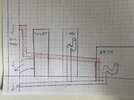
Finally got around to opening it all up. Here's a diagram of the pipework setup.

Given this, do you think it would be safe to remove that vent pipe (highlighted in red). What's the worse that could happen if the pipe is removed?

Could an anti-syphon trap on the sink waste (highest waste point) mean I could remove that vent pipe?
 

Attachments

  • IMG_1411.jpeg
    IMG_1411.jpeg
    320.9 KB · Views: 28
Ah so it was the "old boy" approach.

Could an anti-syphon trap on the sink waste (highest waste point) mean I could remove that vent pipe?
I would do that.
The bath trap could be one of those with the extended horizontal part of the trap, giving effectively a better "seal " on the trap.
 
Ah so it was the "old boy" approach.


I would do that.
The bath trap could be one of those with the extended horizontal part of the trap, giving effectively a better "seal " on the trap.
Great. Just so that I’m clear, would I keep the bath trap the same and only change the sink trap?

The bath trap is in an awkward position to change with limited space and it’s quite a shallow trap (if that makes any difference).
 
OK - certainly seems to be a secondary vent, to vent the basin/bath waste run and protect the traps. Cut the vent as it leaves the vertical stack and seal it up, then fit a McAlpine anti vac trap on the basin. Fill the bath right up and let it go and make sure it doesn't self syphon the bath trap.

There shouldn't be a shallow bath trap fitted on that type of waste run and if there is one then it could self syphon, possibly why they fitted the vent in the first place. An anti vac on the basin may not correct that as it won't affect the bath trap.
 
This is the 20mm seal, bath trap, as described. 20mm is tiny:
1761596162445.png


This is the one I described as having a longer horizontal part:
1761596293027.png


38mm versus 20mm seal.
The extra wiggle/adjustment you get is useful too.

I have never seen one of these afai remember. Blimmin eck £38 +vat:
1761596691110.png


I used these a few times. I see they're about 5x the price now, at £55 + vat.
So whether I would now I don't know!
1761597123814.png


Ah, same place (BES.co.uk) does these, under £20 inc vat
1761597643972.png


OR, if you can't move the current trap, you could cut off the existing vertical vent pipe under the bath, and stick one of these on it IF you find you have a problem:
1761597876192.png


There are other simpler looking designs of those, and ones which look like US fire hydrants..

You can fit them like this:
1761598040705.png
 
Last edited:
You would always want any AAV to be above the highest spillover level of the highest fixture it is connect to. Why I didn't suggest an Antivac bath trap.

If the AAV is placed anywhere other than close to the bath trap, then shallow bath trap seal could still be pulled if the bath empties quickly. All needs tested though.
 

If you need to find a tradesperson to get your job done, please try our local search below, or if you are doing it yourself you can find suppliers local to you.

Select the supplier or trade you require, enter your location to begin your search.


Are you a trade or supplier? You can create your listing free at DIYnot Local

 
Back
Top