
Whole house heating, or room by room?

Joined
27 Jan 2008
Messages
28,343
Reaction score
3,450
Location
Llanfair Caereinion, Nr Welshpool
Country
United Kingdom
I was watching YouTube, and it auto moved to next video, and some guy was saying how we should heat the whole house, and heating room by room was a bad move, as heat moves room to room, I have seen the chimney effect on the stairs with some houses, so I suppose he does have a point.

I suspect size matters, I have also seen where thermostats and thermometers have shown vastly different temperatures within the same room. Never mind room to room.

I remember being told, fit the thermostat in a downstairs room (as heat raises) with no outside door, or alternative heating, and in a room not kept too warm, so as summer arrives the heating will auto stop, it then went on about how the set the lock shield valves to regulate how much heat to each room. I tried, and it simply did not work, as upstairs room temperatures were altered so much if a door left open or closed.

So upstairs all radiators with TRVs to stop bedroom over heating if door left open.

He was correct, very little insulation between rooms, but I was born in an era when only down-stairs rooms had fires. And bedrooms were heated by the heat from the room below. But this means even today, I want the bedroom cooler than the living room, and I see no point in heating a bedroom at 9 am as will not be used until 10 pm.

I do see a problem splitting a house into just 2 zones, one is likely some rooms in each zone will be either not used, or used at different times to other rooms in the same zone. And two, with a modern modulating boiler, nothing should turn on/off, every control where it can, should be analogue and turn up/down, and no real point having zoned zones. i.e. if using TRVs then no point in zone valves as they do the same job.

OK, there will be exceptions, my flat is hardly ever used in winter, so a zone valve does turn it off.

But I have 14 programmable TRV heads, and each room has times and heat levels adjusted to suit what the room is used for. I allow bedrooms to cool during the day, and living rooms to cool overnight. And I have three devices in the main house, which can turn the boiler on.

He was saying all this is wrong, and I should heat all rooms 24/7. I can't see why?
 
But I have 14 programmable TRV heads, and each room has times and heat levels adjusted to suit what the room is used for. I allow bedrooms to cool during the day, and living rooms to cool overnight. And I have three devices in the main house, which can turn the boiler on.

He was saying all this is wrong, and I should heat all rooms 24/7. I can't see why?
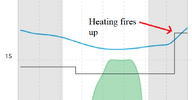
Some background heat throughout, and a living room gas fire for a bit of additional local heat works for us, and is reasonably economical. Hall stat, set to 14C overnight, 18C during day. It's barely firing at the moment.
 
The main house, we have 16 thermostats, 14 are TRVs, two are wall thermostats, and one of the TRVs can fire the boiler. I am still learning how to heat the home. Seems daft at 75, but every home has been different. My first house had hot air central heating, and I had no option but heat all rooms. The next house also since open plan, very little option, had to heat all rooms.

My late mothers house and this house have internal doors, mother house the hall, stairway and landing was a problem, with loads of heat raising up the stair well. And we had curtains so we did not need to heat up-stairs, which my mother could not use due to being in a wheelchair. And the poor front door (designed for wheelchair access) did not help, and hall was always cold.

This house, the reverse has been a problem, the hall cools slower than other rooms, so a single thermostat in the hall, did not work, I had to place a second thermostat in the living room.

The one bedroom was a problem also, the room under it hardly used, and two of the four walls are outside walls, and they both have windows. The other problem is the TRV is against an outside wall, and so is cooled by outside 1773881398536.pngso yesterday for example, heating fired for a short time, when not really required.

All the other TRVs can be set a bit on the high side, if the boiler is not running they do nothing, the odd one out, will fire the boiler.
 
Go for the middle option you haven't considered - zones. It's been around for decades, it's easy to manage and logical and doesn't require much more pipework than a single loop system.

Each zone has one master room that includes the timer/thermostat on the wall. Its radiator is set to max. The other rooms have their rads set to whatever's a preferred heat level.

So overall timing is controlled by zone, temperature is set per room.

Don't get obsessed with the armchair internet science. Yes, heat will inevitably move from warm rooms to colder ones. It really doesn't matter. If we have the hallway heated and bedrooms not then the bedrooms remain a few degrees cooler, even with the doors open. If they're cooler then you're saving money. There's no need to heat them until an hour or two before you're going that way, no need to spray heat out of the walls and roof for 6 hours before you even go in there.
 
Each zone has one master room that includes the timer/thermostat on the wall. Its radiator is set to max.
Don't understand that bit, why set radiator to max? At the moment wife's bedroom controls overnight heating, if her TRV calls for heat, the boiler will fire, so the 3 other bedroom TRVs will only heat rooms if both they are calling for heat and wife's TRV also calling for heat.

There seems to be no reason to have two valves to control the same room, so I have really made an error fitting two zone valves, one for upper two floors, and one for the lower ground floor, but using the micro switches to power a relay, which powers the selected pump and boiler, if starting from scratch would not have two pumps or their motorised valves, the motorised valves fitted to stop reverse flow.

So ideally each room with radiator on an internal wall, has a linked TRV and if on an external wall it has a wall thermostat linked to the TRV. But that is rather expensive, so want to reduce it where I can. Room names can be merged to create zones, so I could call all rooms with beds in bedrooms, and they would be controlled together, if I fit Wiser TRV heads, but why?

With living room with two radiators I can see two Wiser TRVs linked to the Wiser wall thermostat would be better, so all in the same zone, but gains seem minimal. As it is "hey google set living room to X°C" sets all three devices without using zones.

The idea of heating all rooms 24/7, or as and when required, was what I was looking at. I can see as and when required, does have some problems, like a 20 kW boiler running to just heat one room, it would use a mark/space ratio, but if all rooms heated the on/off cycles may be reduced, although I am not convinced.

The whole point of moving from open fires to central heating, was all rooms heated, but using one central thermostat to control all, clearly does not work with radiators, it did with hot air heating, as the air circulated around the house, but not with radiators, and a change in wind direction can change which is the coolest room, so most homes need at least two thermostats that can fire the boiler, my house has four.

The TRV stops a room getting too hot, and the program is set, so this changes through the day, three wall thermostats and one TRV fire the boiler when required. Clearly if a room is not heated 8 am to 10 pm, to simply change the temperature programmed on the TRV will not cause the room to heat up, unless something also tells the boiler to run, but with 4 bedrooms, only one TRV needs to be linked to the boiler.

A wall thermostat in the hall, will not ensure living room is warm enough if the hall cools slower than the living room, so it needs a linked thermostat in the living room to ensure the boiler runs, but since the living room also has an open fire, it also needs a linked thermostat in the hall for rest of the house.

But if I set all the TRVs to say 21°C throughout the house, I can't see how this is cheaper to run, to having the TRVs alter temperature throughout the day to suit when the rooms are used.
 
Don't understand that bit, why set radiator to max? At the moment wife's bedroom controls overnight heating, if her TRV calls for heat, the boiler will fire, so the 3 other bedroom TRVs will only heat rooms if both they are calling for heat and wife's TRV also calling for heat.
It's set to max so the thermostat will hit its setpoint and switch the zone off. This does mean that other rooms in that zone could be cooler, but it really doesn't matter.

Otherwise the TRV could cut the radiator off, then the thermostat would never reach its temp.

You can run a system entirely using TRVs but it's wasteful, the boiler or heat pump will maintain temperature in the circuit even while nothing needs it.
 
Otherwise the TRV could cut the radiator off, then the thermostat would never reach its temp.
Since the TRV and wall thermostat are opposite sides of the room. And the wall thermostat is set higher, in the room, the TRV typically 6" from floor, and wall thermostat 4 foot from the floor, if set to same temperature, the wall thermostat will switch off before the TRV fully closes.

When fitted in odd shaped rooms, like where a staircase leads off the room, the TRV nearly always shows a lower temperature to the wall thermostat. This room now, wall thermostat 21.5°C, TRV at 90° to wall 21.7°C and opposite 20°C the one at 90° behind a chair, so set a degree higher to compensate.

It is so easy to see what the TRV and wall thermostat is set at, easy to compensate for furniture. With silly mechanical heads, the range between fully open and fully closed is around 4°C so a wall thermostat set at 20°C and a TRV set at around 3 is unlikely to cause a problem, and it does not take much to adjust.

But since I don't have a wall thermostat at a single temperature, but it varies through the day, can't really use a TRV head which also does not vary through the day. So a mechanical TRV head for me is a non-starter.

The hall also TRV and wall thermostat, not ideal, as on the same wall, and wall thermostat closer to the centre of the house, so now they show TRV 15°C and wall thermostat 19°C. I only expect the wall thermostat to activate when some alternative heating warms up the living room, but again so easy to see what they show, and to adjust with any off-set required.

Third TRV of interest is wife's bedroom. Current 15°C set to trigger boiler at 14°C. Due to furniture and clothes, although this should have been the easy one, with same device running boiler and controlling room, heat does enter her room from the landing, but it again is so easy to monitor what is going on, not a problem.

The shower room, kitchen, office, craft room, and my bedroom, are harder, as the TRV heads don't tell me what the room temperature is, they are not as easy to monitor, but I don't have any eQ-3 TRV heads in same room as a wall thermostat. It would require a thermometer to monitor the rooms. I know my room at 18.1°C, living room 21.3°C the utility room with no heating at 13.4°C and the flat under main house at 16.8°C. Again so easy to move the monitors around, easy enough to set when required.

May as well finish it off, dinning room showing 15°C. Without leaving my chair, it is so easy to see temperatures around the house, can't see a problem setting TRV heads and wall thermostats to control the house, if I hear the boiler running when I don't expect it to run, I will quickly have a look why.
 
If you're setting the TRV to anything other than MAX then you may as well not bother with the wall thermostat. If the TRV shuts off first then the thermostat will keep demanding heat that isn't being delivered into the room therefore it will keep telling the boiler to keep heating, while the room will never get any warmer.

You'll be burning gas to maintain warm water circulating and not going into any rooms.

We once had a system like this - it had a timer but no thermostat, TRVs all round. It was very wasteful.
 

If you need to find a tradesperson to get your job done, please try our local search below, or if you are doing it yourself you can find suppliers local to you.

Select the supplier or trade you require, enter your location to begin your search.


Are you a trade or supplier? You can create your listing free at DIYnot Local

 
Back
Top