
- Joined
- 16 Nov 2006
- Messages
- 24
- Reaction score
- 0
- Country

Slightly long-winded post so bear with, but here is the TL/DR version:
Would there be any downsides to adding a relay between pin 1 (HW off) on the controller and the grey wire on the 3-port valve which is only closed when there is a call for heating? The intention is to defeat the "last port of call" issue whereby when my central heating switches off at night it leaves the 3-port valve in the heating only position which means that the synchron motor will be running hot until the hot water comes on the following morning?
I have adapted one of the helpful diagrams from Flameport.com with the proposed modification (yes, I have a Hive 2 channel controller but I guess this would apply to any CH/HW programmer which does not drop pin 1 to 0V when there is no call for CH or HW).
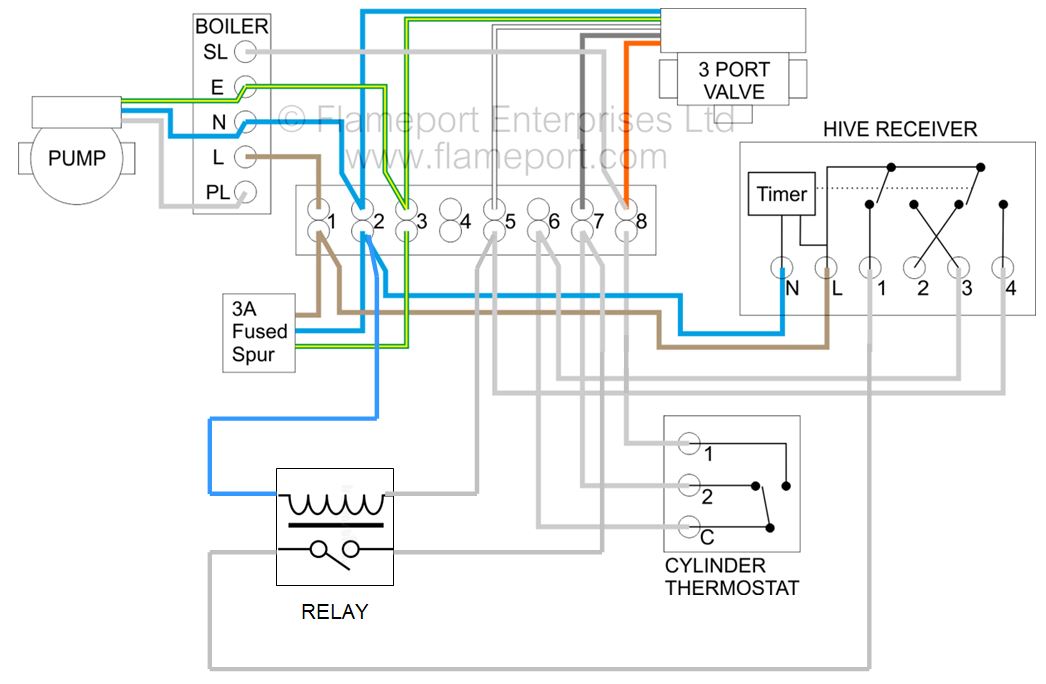
Longer version: I have just fixed a letting by problem on my Honeywell 4073 3-port valve. Luckily only a new powerhead was required, but during testing I noticed how hot the synchron motor was getting when stalled in the CH only position. To be clear. my valve is not mechanically stuck. The spindle moves freely and now that the new powerhead is fitted the valve moves between all three positions, and returns normally to HW only when power is removed from the white and grey wires. But I this "last port of call" business just sits wrong with me. From what I can gather on the web, it is normal behaviour, but some controllers do drop both the grey and white wires to 0V if there is no call for CH or HW. In fact the web isn't clear on whether the Hive controller can or should do this. Mine certainly doesn't. My house holds heat well and so typically I only need to boost the HW first thing in the morning, then I am out all day and only need CH on in the evening which goes off at 11:00pm and the house stays warm enough until I leave the next morning. Therefore, when my CH turns off at night, the controller leaves 240V on the grey wire until the controller moves to HW only in the morning. Yes, I know that synchron motors are designed to run stalled, and yes I know they get hot under normal operation. I can also understand in an older mechanical / analogue programmer which might use a pair of changeover relays and needs to be compatible with systems which had no CH only mode, this arrangement might make sense. But for a modern digital programmer it just seems lazy. I can't think of a reason why pin 1 needs to me left powered when the controller is effectively idle.
So my idea is to add a suitable relay with a 240V coil (i.e. RIB2421C ) with the coil powered from controller pin 4 (CH ON) and the relay terminals connected in the wire that normally connects controller pin 1 (HW OFF) to the grey wire. I have tested this as a proof-of-concept by fitting a light switch where the relay would go and it works. I can return the 3-port valve to the HW only position (which requires no power to the motor) by briefly turning the switch off and then on again, and then the valve moves to the required position again when there is a new demand.
My 3-port valve is 30 years old and had already had a replacement shynchron motor. This time the powerhead was jammed. Also there was noticeable signs of charring inside on the paper label inside the cover and some of the wires which I guess was from the heat of the stalled motor over the years. I realise my modification would be trading prolonged stalling / heating of the motor for increased valve / motor movement, as the valve would be cycling back and forth several times a day each time the room thermostat calls for heating. It's just a question of whether the motor would wear out first from being stalled / heated or the valve or powerhead will wear out from being cycled. But I think I would sleep a little bit better knowing that there isn't a tiny electric heater running all night in my airing cupboard
Final note: I know I could achieve almost the same thing by programming my Hive to turn the HW on for a few minutes each day just after my CH goes off. But I like the hard wired solution better.
Would there be any downsides to adding a relay between pin 1 (HW off) on the controller and the grey wire on the 3-port valve which is only closed when there is a call for heating? The intention is to defeat the "last port of call" issue whereby when my central heating switches off at night it leaves the 3-port valve in the heating only position which means that the synchron motor will be running hot until the hot water comes on the following morning?
I have adapted one of the helpful diagrams from Flameport.com with the proposed modification (yes, I have a Hive 2 channel controller but I guess this would apply to any CH/HW programmer which does not drop pin 1 to 0V when there is no call for CH or HW).
Longer version: I have just fixed a letting by problem on my Honeywell 4073 3-port valve. Luckily only a new powerhead was required, but during testing I noticed how hot the synchron motor was getting when stalled in the CH only position. To be clear. my valve is not mechanically stuck. The spindle moves freely and now that the new powerhead is fitted the valve moves between all three positions, and returns normally to HW only when power is removed from the white and grey wires. But I this "last port of call" business just sits wrong with me. From what I can gather on the web, it is normal behaviour, but some controllers do drop both the grey and white wires to 0V if there is no call for CH or HW. In fact the web isn't clear on whether the Hive controller can or should do this. Mine certainly doesn't. My house holds heat well and so typically I only need to boost the HW first thing in the morning, then I am out all day and only need CH on in the evening which goes off at 11:00pm and the house stays warm enough until I leave the next morning. Therefore, when my CH turns off at night, the controller leaves 240V on the grey wire until the controller moves to HW only in the morning. Yes, I know that synchron motors are designed to run stalled, and yes I know they get hot under normal operation. I can also understand in an older mechanical / analogue programmer which might use a pair of changeover relays and needs to be compatible with systems which had no CH only mode, this arrangement might make sense. But for a modern digital programmer it just seems lazy. I can't think of a reason why pin 1 needs to me left powered when the controller is effectively idle.
So my idea is to add a suitable relay with a 240V coil (i.e. RIB2421C ) with the coil powered from controller pin 4 (CH ON) and the relay terminals connected in the wire that normally connects controller pin 1 (HW OFF) to the grey wire. I have tested this as a proof-of-concept by fitting a light switch where the relay would go and it works. I can return the 3-port valve to the HW only position (which requires no power to the motor) by briefly turning the switch off and then on again, and then the valve moves to the required position again when there is a new demand.
My 3-port valve is 30 years old and had already had a replacement shynchron motor. This time the powerhead was jammed. Also there was noticeable signs of charring inside on the paper label inside the cover and some of the wires which I guess was from the heat of the stalled motor over the years. I realise my modification would be trading prolonged stalling / heating of the motor for increased valve / motor movement, as the valve would be cycling back and forth several times a day each time the room thermostat calls for heating. It's just a question of whether the motor would wear out first from being stalled / heated or the valve or powerhead will wear out from being cycled. But I think I would sleep a little bit better knowing that there isn't a tiny electric heater running all night in my airing cupboard
Final note: I know I could achieve almost the same thing by programming my Hive to turn the HW on for a few minutes each day just after my CH goes off. But I like the hard wired solution better.
Last edited:

