LSF / LSOH Twin & Earth

the problem with fuses in the sockets is that you can plug in a 3KW fire or a 40W table lamp into the same socket.. so you'd have to have bigger flexes on all the small things to accomodate..

it would be a piece of cake to include a fuse in a 2 pin schuco plug.. it's the reversability that's the main problem with them..
that could be addressed by making one pin larger than the other, or by offsetting the pins etc..
 
The fusing of sockets was not an ideal solution - just a means to try and get the UK to accept the 'Euro Plug'.

Radials in many countries can have 16A protection for a general outlets and this means any size flex, within the limits allowed, could be used.

It depends what you are trying to achieve with your protective device. In many situations overload protection is not actually required for a flex to an appliance, as overloads are not possible, if used as specified. The 16A device would protect most, if not all, flexes from prospective fault currents.

The issue of polarity could be removed by the use of double pole protection, this widely used throughout the world.
 
you'd have to make 16A fuses then though for the sockets..
that wa you could continue to use the 32A circuits, but be able to use the euro appliances that require more than 13A ( such as some ovens etc.. )
 
I think you need to view this as a domestic system. I have a diagram (lifted from the electrics outside the UK forum) that shows 16A radials with restricted numbers of outlets (generally 5 but I think 8 could be used) for general purpose use.

There are 20A and 32A circuits for dedicated uses such as washing machines, cooking, etc. I am not an 'expert' on non UK systems but this fits with other sources of information I have seen.

however, the challenge is to forget all of this and engineer a 'new' solution :D.
 
I think you need to view this as a domestic system. I have a diagram (lifted from the electrics outside the UK forum) that shows 16A radials with restricted numbers of outlets (generally 5 but I think 8 could be used) for general purpose use.

There are 20A and 32A circuits for dedicated uses such as washing machines, cooking, etc. I am not an 'expert' on non UK systems but this fits with other sources of information I have seen.

however, the challenge is to forget all of this and engineer a 'new' solution :D.
 
how about a skirting that has rails in it, and plugs that just click into it wherever you need power..?
 
Well that would work but it might be expensive. You would also have the problem of offering a wide enough range of shapes etc to suit a wide range of tastes.

On a more simple level you could run a high current (above 16A) distributor to a location such as a single room or a group of rooms and then have a small local DB to provide the final overcurrent protection. This might service lights and power and, in a kitchen, could have an emergency switch for rapid isolation in the event of a fire.

This could be done with existing equipment - but a range of small DBs that could be flush mounted might help.

Communications etc could be included in the package.
 
The German Schuko sockets are not allowed in the UK as reversible and that means the only existing socket which is not already on decline would be the Australian one.
Apart from the shutter problem, this existing one would be OK, as it is polarised:

800px-French-power-socket.jpg


As is the plug:

CEE_7-7.jpg


which will also go into Schuko sockets. Schuko plugs won't go into the Type E socket of course.

A complete redesign so that every country has to have new plugs & sockets would avoid any problems of apparent favouritism if a system with some degree of compatibility with existing systems was used, and it seems to me that an in-line design (i.e. 3 pins in a row) would be good, as that would mean low-profile plugs - a benefit for portable equipment, and would be appreciated by anybody who has ever trodden on a plug.

Sockets with an angled entry would allow such a plug to lie almost flush against the wall thus needing less clearance behind appliances.

The spacing and pin sizes/shapes could be chosen so that no existing plug known to man could be inserted.

Subject to how any shuttering works, compatible 2-pin plugs for DI appliances could be made.

There are smaller fuse form factors than BS 1362, so a low-profile fused plug could be made if this was required.

If ring finals are to go then RCD socket outlets providing downstream protection, like some US ones do, would be a useful option.

There's no reason why MCBs have to look like the rail-mount CU ones we are familiar with - you can already get panel-mount ones which look like rocker switches, so a visually acceptable flush mini-panel could be made which would suit any room - maybe different sizes, 6/10mm² incoming capable and it distributes 1 or more lighting circuits and 1 or more socket circuits to that room.

 
The German Schuko sockets are not allowed in the UK as reversible and that means the only existing socket which is not already on decline would be the Australian one.
Apart from the shutter problem, this existing one would be OK, as it is polarised:

800px-French-power-socket.jpg


As is the plug:

CEE_7-7.jpg


which will also go into Schuko sockets. Schuko plugs won't go into the Type E socket of course.

A complete redesign so that every country has to have new plugs & sockets would avoid any problems of apparent favoritism if a system with some degree of compatibility with existing systems was used, and it seems to me that an in-line design (i.e. 3 pins in a row) would be good, as that would mean low-profile plugs - a benefit for portable equipment, and would be appreciated by anybody who has ever trodden on a plug.

Sockets with an angled entry would allow such a plug to lie almost flush against the wall thus needing less clearance behind appliances.

The spacing and pin sizes/shapes could be chosen so that no existing plug known to man could be inserted.

Subject to how any shuttering works, compatible 2-pin plugs for DI appliances could be made.

There are smaller fuse form factors than BS 1362, so a low-profile fused plug could be made if this was required.

If ring finals are to go then RCD socket outlets providing downstream protection, like some US ones do, would be a useful option.

There's no reason why MCBs have to look like the rail-mount CU ones we are familiar with - you can already get panel-mount ones which look like rocker switches, so a visually acceptable flush mini-panel could be made which would suit any room - maybe different sizes, 6/10mm² incoming capable and it distributes 1 or more lighting circuits and 1 or more socket circuits to that room.

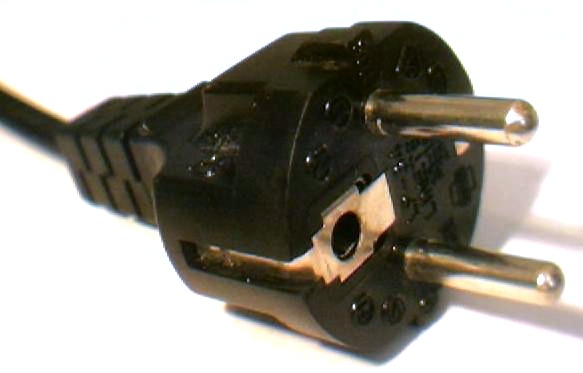
The 3 pin Shuko plug is non reversible, the 2 pin Shuko plug usually has no locating system so is reversible.

Sorry initially I managed to put my reply in the Quote.
 
it would be a piece of cake to include a fuse in a 2 pin schuco plug.
It would but it wouldn't solve the problem. If you are going to rely on fuses in the plugs to make up for unusually high value circuit protection you have to make sure that people don't use plugs that lack fuses. That means you have to make the socket incompatible with all common unfused plug types.
 
that's a hybrid plug you show there, not a schuko..

the 13A plug will never be phased out..

This design is used not only in the United Kingdom, but also in Ireland, Sri Lanka, Bahrain, UAE, Qatar, Yemen, Oman, Cyprus, Malta, Gibraltar, Botswana, Ghana, Hong Kong, Macau, Brunei, Malaysia, Singapore, Indonesia, Bangladesh, Kenya, Uganda, Nigeria, Mauritius, Iraq, Kuwait, Tanzania and Zimbabwe. BS 1363 is also standard in several of the former British Caribbean colonies such as Belize, Dominica, St. Lucia, Saint Vincent and the Grenadines and Grenada. It is also used in Saudi Arabia in 230 V installations.

as for the new plug design..
View media item 14037this would allow for existing CEE 7/7 hybrid plugs and the thinner "europlug" for small loads.. ( 2 per socket.. same as many extension leads over in europe )
the new plug would fill the oblong hole and only fit one way for polarity.

the earth is provided via the tab at the base of the socket as it is in the schuko design..
 
missed a few quote brackets there sunray?

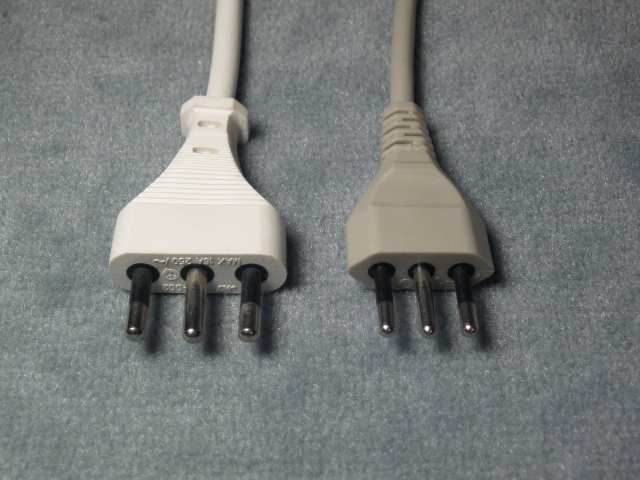
A complete redesign so that every country has to have new plugs & sockets would avoid any problems of apparent favoritism if a system with some degree of compatibility with existing systems was used, and it seems to me that an in-line design (i.e. 3 pins in a row) would be good, as that would mean low-profile plugs - a benefit for portable equipment, and would be appreciated by anybody who has ever trodden on a plug.

you mean like this one?

Ita_plug_16A_10A.jpg


which is Italian? comes in 16A (left) and 10A (right) versions..

the problem with inline is that it makes them reversible unless you used rectangular pins with one set at right angles to the other..
or a modification to the Type J swiss socket to sleeve the L + N pins would be ok..

Sockets with an angled entry would allow such a plug to lie almost flush against the wall thus needing less clearance behind appliances.
funny you should mention that. I already played about a bit for a "cooker plug"
View media item 12996
the end result could be scaled down for regular power..
the "shroud" would be small enough to prevent fingers being inserted..
 

If you need to find a tradesperson to get your job done, please try our local search below, or if you are doing it yourself you can find suppliers local to you.

Select the supplier or trade you require, enter your location to begin your search.


Are you a trade or supplier? You can create your listing free at DIYnot Local

 
Back
Top