Location of switches?

Joined
21 Aug 2007
Messages
98
Reaction score
0
Location
Cheshire
Country
United Kingdom
Hi

Can i ask if the isolation switch for an oven has to be in reach of the unit or can i have it hidden in a cupboard out of site?
Also for the extractor fan?

thanks
 
the switch must be in a prominent location so as to be clearly known what it's for by anyone using the kitchen..

YOU may know it's in the cupboard but will the next person know? or the sparky coming to fit a new cooker or the kids when they get older and start cooking their own cheese on toast..?
 
is that by law ( part P) or unspoken rule?

Surley if the people are told of its location!
 
is that by law ( part P) or unspoken rule?
Do you have a big bucket of popcorn and a large fizzy drink? This one could run and run.

Firstly, re the law, the Building Regulations don't go into this level of detail, nor do they explicitly require that the Wiring Regulations (BS 7671) be adhered to. But choosing to adhere to them is the most sensible way of ensuring compliance with the law.

So having chosen to work to BS 7671, we need to consider what that requires regarding the position of the switch.

I'll return service....

the switch must be in a prominent location so as to be clearly known what it's for by anyone using the kitchen..
What's the switch for?


The other way of dealing with all of this, gazandlucy, is for you to think why you want to put the switch in a cupboard, and not have it on the wall.

If it's for cosmetic reasons then IMO your whole design philosophy is badly prioritised, and you need to chant the following until you stop fretting about form over function, particularly if you're still choosing appliances:

A kitchen is a place of work.

A kitchen is a place of work.

A kitchen is a place of work.

A kitchen is a place of work.

A kitchen is a place of work.

A kitchen is a place of work.

A kitchen is a place of work.

A kitchen is a place of work.

A kitchen is a place of work.

A kitchen is a place of work.

A kitchen is a place of work.

A kitchen is a place of work.

A kitchen is a place of work.
 
I dont want to be unsafe or break the law.....simple...the misses wants a minimalist look.

The switch is for my oven so was hoping to have a switch / socket combo fitted in the cupboard next to the oven (intergrated) so i can plug the combo intergrated microwave in. out of site

I dont plan on moving ..............and my kids cook????...hahahahahahaha

But i do apprieciate all advice and take it to heart so thanks
 
It is basically as BAS says, it is from BS7671:2008 which is a known standard and one of the recognised methods of complying with the Law i.e. Part P.
Adding to a circuit in a kitchen is notifiable work.
It is a must to have the isolation switch in a prominent location if the appliance is fixed.
 
Hi Gazandlucy.

This is going to be a cat/pigeons moment for the regular contributors here, but putting the cooker control switch inside a cupboard will not break the law or contravene any regulation.

However, installing the switch yourself without firstly jumping through a few council hoops and paying the fees will break the law, beware!!
Might i guide you toward searching through a few of the many topics about LABC notification and suggest that it will be easier for you get a self-certifying sparky in to quote for the work.
You might get a shock (no pun intended :) ) when you find out how much the fees are for your local council to check/approve DIY work in the kitchen.
Maybe a few of the faster typists/copypasters here will provide further info on this.

IMO it removes a big unsightly switch from the wall and gives you less stuff to clean around when you get the inevitable cooking residue on your splashback.

Again IMO, you should have a switch conviently located for the purposes of maintenance ( e.g. removing all power to hob when cleaning around the controls/switches) and ideally my preference is to install these within 2 metres of the device. However, there is nothing to say you cannot put it inside a cupboard.
As a matter of convienience, i would locate the switch in the adjacent cupboard, near the top and near the front. This means even when the cupboard is loaded up, the switch can still be operated without being hidden behind pots/pans/Jif/mr.muscle etc and is unlikely to be accidentally operated, allowing you to switch it off once every ** for cleaning.

** insert appropriate frequency, depending on how mingy you are :D
 
When I recently did my kitchen I was happy to have the switches for the w/machine, dishwasher et al in view above the worktop (in hindsight a dedicated circuit and grid switches would have been the way to go but I was trying to minimise disruption).

However, when it came to the two chunky great cooker switches there is no way I was having those on the wall, vanity strikes again. They live in the cupboard to the right of the hob - my electrician was happy to surface mount them on the wall there even though he knew I planned to enclose them (which he'd probably deny strenuously in a court of law).

When all is said and done my TV obscures its socket - if it burst into flames I'd either have to move it to get at the socket or run to the CU.
 
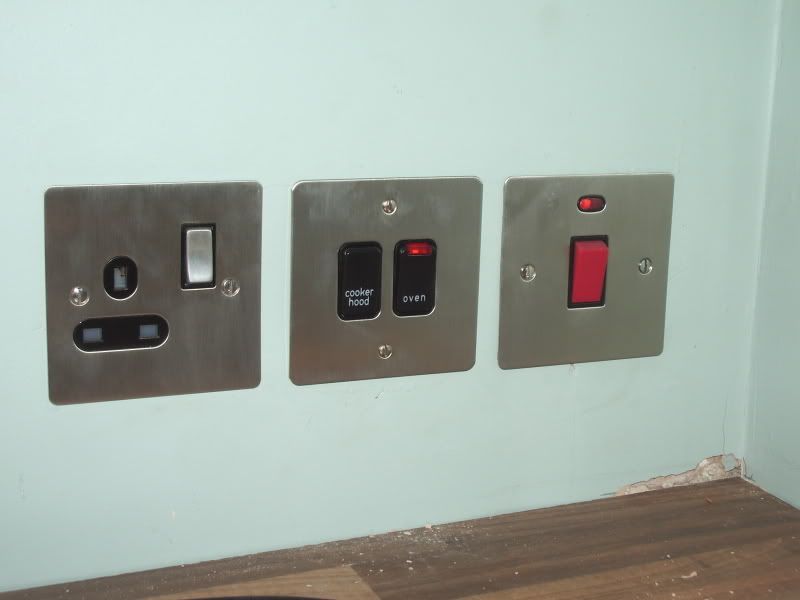
Why use chunky switches?

IMGP3595.jpg


These do the hob, oven and extractor hood.
 
So the switch is to isolate an appliance which is required for 'servicing and maintainance' purposes. there is no problem in siting it in a cupboard as long as it is easily accessable, it may not be considered good practice and may be unconventional, but i cannot see how it would not comply with BS7671.
Same goes for the socket should you decide to install a combined isolation switch with socket, as long as it is easily accessable.
 

If you need to find a tradesperson to get your job done, please try our local search below, or if you are doing it yourself you can find suppliers local to you.

Select the supplier or trade you require, enter your location to begin your search.


Are you a trade or supplier? You can create your listing free at DIYnot Local

 
Back
Top