
Light fitting wiring mix-up

Joined
2 Oct 2016
Messages
2
Reaction score
0
Country
United Kingdom
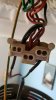
Can someone who knows look at this photo and tell me if I'm right?

I removed this light fitting today and I was a bit confused because I couldn’t find a match for the way the wires were connected anywhere online. By rights it shouldn't have been working. Suffice to say when I wired in the new fitting, nothing worked properly, and the light now comes on in the living room when I turn on the kitchen light.

I can only think of one explanation:

Has the guy who fitted the previous fitting reversed the live and neutral wires of the fitting? It used to work, but I now think it was using its blue wire as the live, and its brown wire as the neutral.

Am I right? (I have pulled the fuse in the meantime.)
 

Attachments

  • tmp_7602-20161001_1632381464981479.jpg
    tmp_7602-20161001_1632381464981479.jpg
    57.6 KB · Views: 320
Yes, you are correct. The two black wires on the left are the neutral. The single black wire is the switched live.
But the light should still work , even with the blue and brown the wrong way round.
Have you played around with the wiring of the white terminal block?
 
Thank you, that explains why the new fitting doesn’t work. I've got the switched live in with a neutral.

Kinda lucky to still be here!
 
I wonder if there would be far less mixups if people bothered to put red/brown sleeving on the switch wire. I keep red/black/brown/blue sleeving in my toolbag and fit it where needed at every light fitting, extractor fan, switch etc. that I fit or replace, even if it means going out to the van to get some more!
 
I wonder if there would be far less mixups if people bothered to put red/brown sleeving on the switch wire.
Probably easier for the people that know what these indicate, to tell those that don't, how to fix their mess up for them.
I think the ignorant will still be scratching their heads in bewilderment of what they are though!

That is providing the installer/uninstaller is capable of removing the fitting without losing the sleeves.
 
Last edited:
Well true, but one small thing is at least it would give a hint that there's something different about that core, to avoid the "connect all blacks together" scenario.
 
I wonder if there would be far less mixups if people bothered to put red/brown sleeving on the switch wire. I keep red/black/brown/blue sleeving in my toolbag and fit it where needed at every light fitting, extractor fan, switch etc. that I fit or replace, even if it means going out to the van to get some more!
I think you will find that they are already REQUIRED to do that.

Or be sensible like us here and use twin brown for switch drops. (Indeed BS7671 rightly states a preference for cores being identifiable throughout their length.)
 
I think you will find that they are already REQUIRED to do that.

Or be sensible like us here and use twin brown for switch drops. (Indeed BS7671 rightly states a preference for cores being identifiable throughout their length.)

Not any more sensible. You can't tell the difference live and switched live. What would be sensible would be brown * and some other colour (say orange or mauve as used in France).

*France uses red for line but that is immaterial for this discussion.
 
Not any more sensible. You can't tell the difference live (sic) and switched live (sic). What would be sensible would be brown * and some other colour (say orange or mauve as used in France).

*France uses red for line but that is immaterial for this discussion.

Ignoring your completely incorrect terminology referring to the line (phase) conductor as "live" despite the fact neutral is also a live conductor, why would you care which is permanent and switched line? In a 1-way switching arrangement it is completely irrelevant, and if you are looping the permanent to feed something else a simple continuity test will show you which is which. Furthermore some twin brown has two different shades of brown.
 
I'm going to say the sleeves are correct and the fiddling plumber has moved the wires about.
 
Or be sensible like us here and use twin brown for switch drops.
Having not seen it, are the two cores identical, even when looking end on at a cut section.
I was under the impression the brown coating on one core was thicker that the other core or is that a myth.

I wonder how hard it would be to space 1 core to earth different than the other.
As you say though, not hard to polarise yourself really, easy if you can see the outer sheath markings
 
I have some here, one core is lighter than the other, not sure if deliberate or poor quality control!
 

If you need to find a tradesperson to get your job done, please try our local search below, or if you are doing it yourself you can find suppliers local to you.

Select the supplier or trade you require, enter your location to begin your search.


Are you a trade or supplier? You can create your listing free at DIYnot Local

 
Back
Top