One might ask 'who actually is ELECSA?' Is it a regulatory concern or is it a Competent Persons 'club' that takes money from companies in return for the privledge of self-certifying by virtue that they inspect their members work? Plus supply advise on THEIR interpretation of various regulations. Perhaps often that advise consisting of 'use your engineering judgement' - you are the man on the spot and can see the actual situation.
Elecsa is a body similar to Gas Safe.
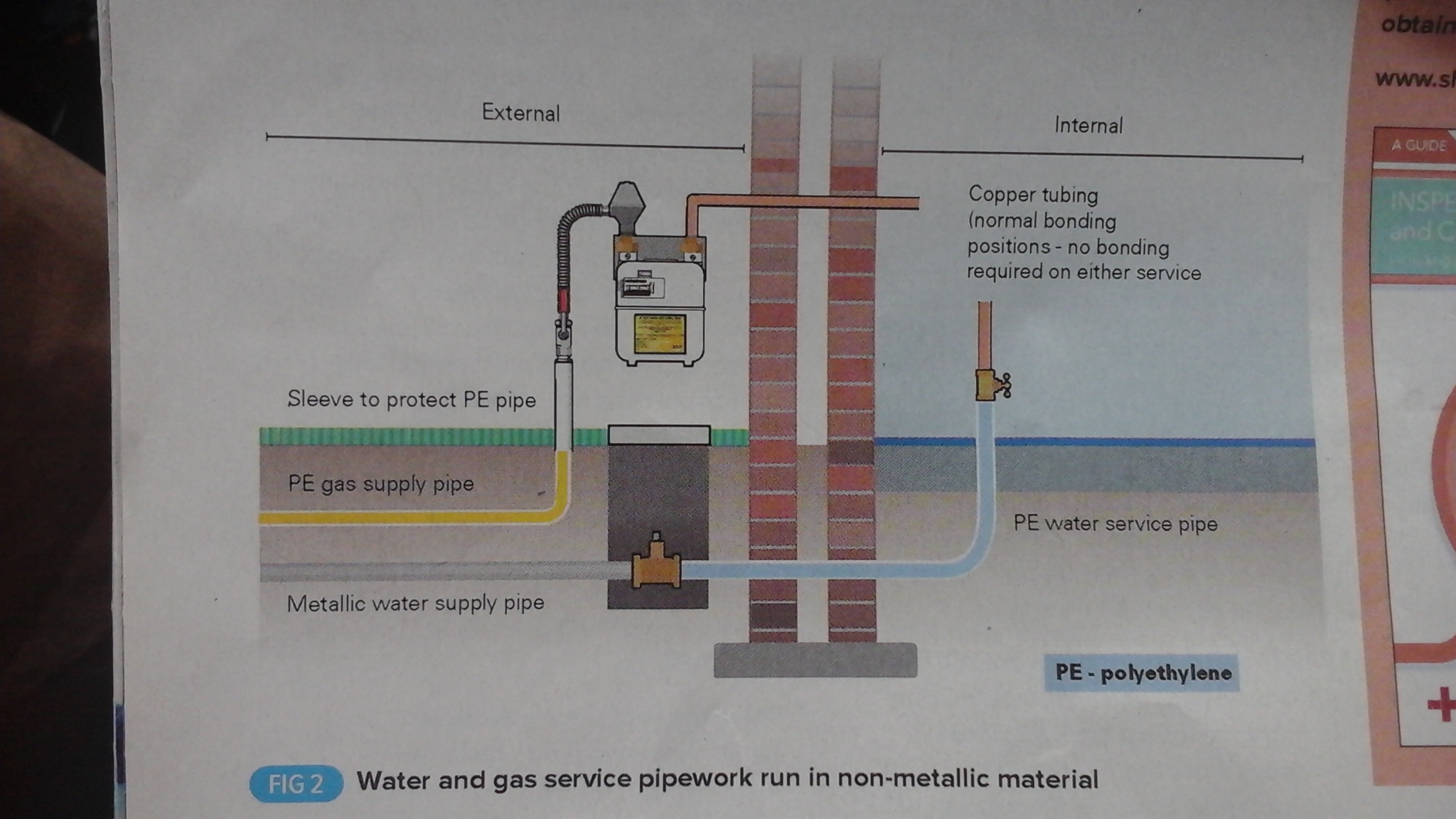
That aside the image posted lacks any indication of where it came from (ie an 'on-site guide the use of which I was critisised earlier, where as my quote was not from such a guide.) and no caption informing what it actually dispicts.
Assuming it is "technically correct" what difference does it make where it comes from?
Did you believe my diagrams because you knew where they came from?
The inage does give some clue by adding the words refering to where normal place bonding would be expected. In my opinion that image is describing not a normal domestic property but a HOMO. In that case I wouldn't expect the pipe to be bonded there but where the gas pipe entered each property I would expect an insulating fitting followed by an ECV (Emergency Control Valve), or combined, followed by the electrical bond within 600mm etc..
It doesn't matter what type of building it is.
IF bonding is required it should be in the normal place
at the point of entry to the premises.
Also bonding at the point of entry to each property (flat) is not really required but merely a precaution because the actual Main Bond is not under the control of the flat occupants.
Incidentally a house converted to flats is not a HOMO (house of multiple occupancy).
You make fun of plumbers who fit a line of earth clamps pipes under boilers but do your regulations not state central heating pipes must be bonded?
Back to square one.
ONLY IF they are extraneous-conductive-parts - which they will not be unless the go into and emerge from the ground somewhere within the premises - in which case the bonding should be from the emergence from the ground to the Main Earthing Terminal.
Some boiler manufacturers quote in their specifications that they have designed this feature into the boiler so is unnecessary but not all do so.
It is NEVER necessary.
On a seperate tract, but connected, how would you classify a copper pipe terminating outside the building virtually anywhere, within guidelines,
Not sure what you mean by terminating - an outside tap, perhaps?
that is bare, within easy touching distance by both property owners and members of the public. This copper, and must be metal, is in electrical contact with virtually all pipes in the building as well as the electrical system and could run virtually the entire height, outside, of the building?
If this pipe does not go underground then it does not require Main Bonding.
As it is connected to electrical items in the building then Bonding it will just be adding another connection and not remove any hazard.
It is true that
during a fault this external pipe could be a hazard to someone touching it while standing on wet soil.
Unless you separate it from all of its electrical connections in the property there is virtually nothing you can do.
In such a case, you would have to bond it to the ground, which is virtually impossible.
If you did decid to connect it to a rod in the ground, for whatever reason, then the pipe would become an extraneous-conductive-part within the building and would require main bonding.