18th 544.1.2

Oh, ok.

In that case a water pipe is easy to disconnect from the rest of the house (unlike a gas pipe) if you wanted to determine accurately.

If not its resistance to the MET can still be measured.
A few ohms will show it is connected to CPCs so it doesn't really matter. Connecting Main bonding will not be hazardous.
A few tens of ohms will show it is an e-c-p (like an earth rod) so should be bonded.
An open circuit will show it is not an e-c-p.
 
In that case a water pipe is easy to disconnect from the rest of the house (unlike a gas pipe) if you wanted to determine accurately.
Indeed (well, how easily it could be disconnected 'will vary') - that is (if I dare mention it!) exactly what I suggested a couple of posts ago.
If not its resistance to the MET can still be measured. A few ohms will show it is connected to CPCs so it doesn't really matter. Connecting Main bonding will not be hazardous. A few tens of ohms will show it is an e-c-p (like an earth rod) so should be bonded. An open circuit will show it is not an e-c-p.
I don't really get any of that. Assuming we're talking about (intact) all-metal plumbing, the resistance to the MET will surely be just 'a few ohms' (at most) because of all the incidental connections via CPCs, regardless of anything else. If it were in electrical continuity with the house's pipework (hence, almost inevitably, CPCs), then I can't see how it could be "a few tens of ohms", let alone "open circuit". Am I missing something?

Kind Regards, John
 
Indeed (well, how easily it could be disconnected 'will vary') - that is (if I dare mention it!) exactly what I suggested a couple of posts ago.
Yes, but I could hardly write the rest of my post without mentioning that part, could I?

You really must get over this "I said that first" need when somebody writes the same or similar?

I don't really get any of that. Assuming we're talking about (intact) all-metal plumbing, the resistance to the MET will surely be just 'a few ohms' (at most) because of all the incidental connections via CPCs, regardless of anything else.
I am not assuming that. I am trying to cover all the options.

If it were in electrical continuity with the house's pipework (hence, almost inevitably, CPCs), then I can't see how it could be "a few tens of ohms",
It could when NOT in electrical continuity with the house's pipework (plastic pipe somewhere) and solely an e-c-p.

let alone "open circuit".
When NOT in electrical continuity with the house's pipework (plastic pipe somewhere) NOR an e-c-p.
 
You really must get over this "I said that first" need when somebody writes the same or similar?
I think you're a bit over-sensitive. It's just an indication that I agree with you, and strengthened by indicating that I agreed before (not just because) you said it.
I am not assuming that. I am trying to cover all the options. ... It could when NOT in electrical continuity with the house's pipework (plastic pipe somewhere) and solely an e-c-p. ... When NOT in electrical continuity with the house's pipework (plastic pipe somewhere) NOR an e-c-p.
Fair enough. As I said, I was talking about properties with exclusively (or mainly) metal pipework.

However, I would say that what you suggested is of only fairly limited usefulness. If the pipework is mainly/all metal (which I imagine is still the most common situation), it would lead to the bonding of the incoming pipe, whether it was an extraneous-c-p or not (although I agree that 'unnecessary bonding' would do no harm in that situation). The only situation in which it would 'make a difference' (By indicating that bonding could, and probably should, be omitted) would be in the case of a pipe which was not an extraneous-c-p entering a property within which it was electrically isolated from all pipework which connected to any boiler, any electrical CH component, or any cylinder which had an immersion etc.. Not only is that probably a fairly uncommon situation, but I think it's quite common (particularly in new builds) for water supply pipes which are not extraneous-c-ps enter the property as 'obvious' plastic (give or take my recent comment about plastic-coated metal), in which case measurement may well not be considered necessary.

Having said all that, given that it would only take a few minutes, I suppose it could be argued that it was worth doing, even if it only resulted in a very small number of 'unnecessary bondings' being installed.

Kind Regards, John
 
From Elecsa
One might ask 'who actually is ELECSA?' Is it a regulatory concern or is it a Competent Persons 'club' that takes money from companies in return for the privledge of self-certifying by virtue that they inspect their members work? Plus supply advise on THEIR interpretation of various regulations. Perhaps often that advise consisting of 'use your engineering judgement' - you are the man on the spot and can see the actual situation.

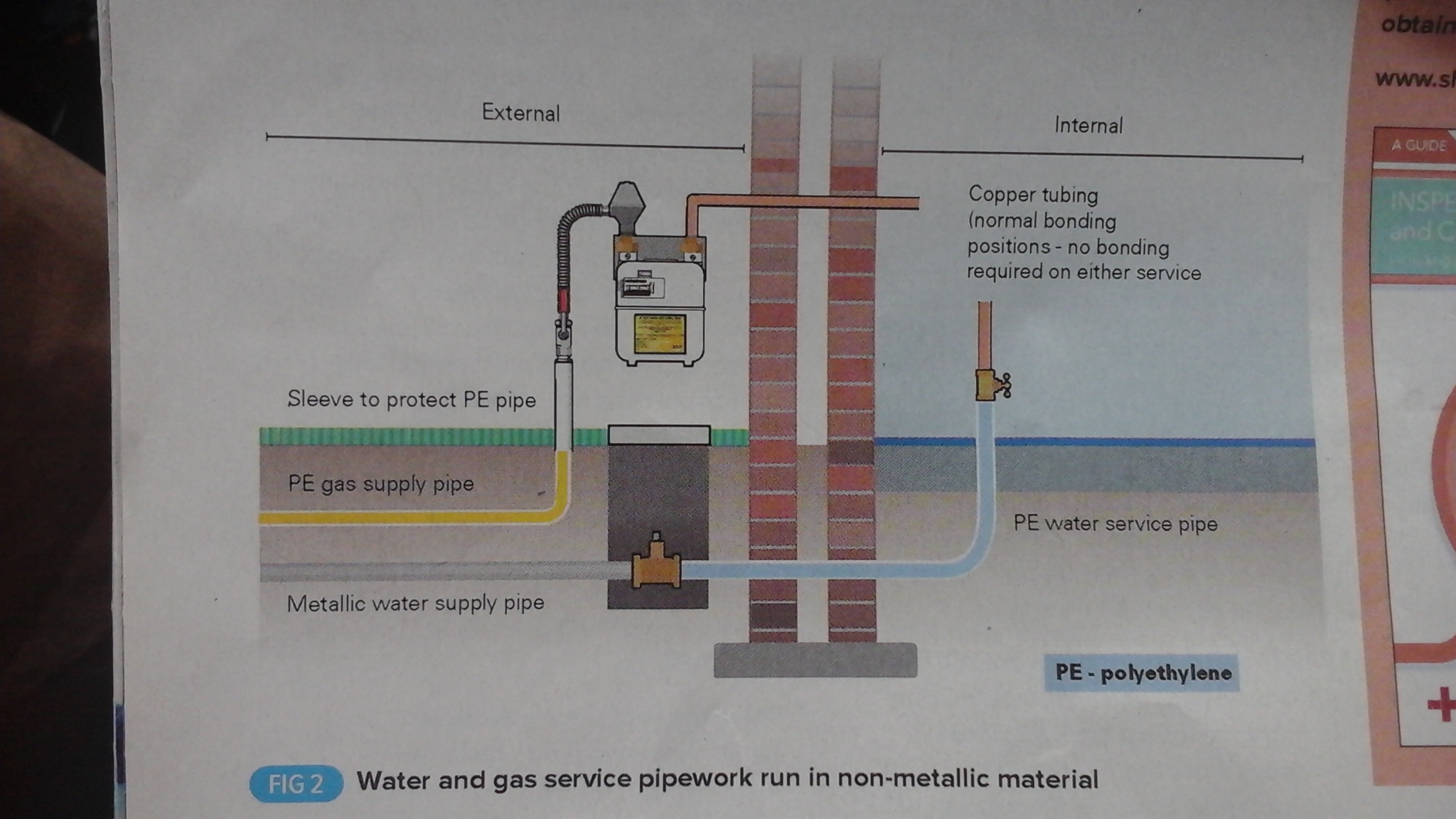
That aside the image posted lacks any indication of where it came from (ie an 'on-site guide the use of which I was critisised earlier, where as my quote was not from such a guide.) and no caption informing what it actually dispicts.

The inage does give some clue by adding the words refering to where normal place bonding would be expected. In my opinion that image is describing not a normal domestic property but a HOMO. In that case I wouldn't expect the pipe to be bonded there but where the gas pipe entered each property I would expect an insulating fitting followed by an ECV (Emergency Control Valve), or combined, followed by the electrical bond within 600mm etc..

You make fun of plumbers who fit a line of earth clamps pipes under boilers but do your regulations not state central heating pipes must be bonded?

Some boiler manufacturers quote in their specifications that they have designed this feature into the boiler so is unnecessary but not all do so.


On a seperate tract, but connected, how would you classify a copper pipe terminating outside the building virtually anywhere, within guidelines, that is bare, within easy touching distance by both property owners and members of the public. This copper, and must be metal, is in electrical contact with virtually all pipes in the building as well as the electrical system and could run virtually the entire height, outside, of the building?
 
In my opinion that image is describing not a normal domestic property but a HOMO.
Why?


In that case I wouldn't expect the pipe to be bonded there but where the gas pipe entered each property I would expect an insulating fitting followed by an ECV (Emergency Control Valve), or combined, followed by the electrical bond within 600mm etc..
Why would you expect bonding to be applied to something which is not an e-c-p?


You make fun of plumbers who fit a line of earth clamps pipes under boilers but do your regulations not state central heating pipes must be bonded?
No.


On a seperate tract, but connected, how would you classify a copper pipe terminating outside the building virtually anywhere, within guidelines, that is bare, within easy touching distance by both property owners and members of the public. This copper, and must be metal, is in electrical contact with virtually all pipes in the building as well as the electrical system and could run virtually the entire height, outside, of the building?
Is it safe to assume that it has been bonded because it is an e-c-p?
 
Not only is that probably a fairly uncommon situation, but I think it's quite common (particularly in new builds) for water supply pipes which are not extraneous-c-ps enter the property as 'obvious' plastic (give or take my recent comment about plastic-coated metal), in which case measurement may well not be considered necessary.
Yes, but the replies were in response to Securespark's query about not being able to see where the change from plastic to metal was.
 
Oh and if that is considered an e-c-p why not the piece of metal pipe outside the building in the illustration?
Simply because it is not able to be touched from inside the building.

Pipes cannot be extraneous (of external origin) if they are not present in the premises.
 
One might ask 'who actually is ELECSA?' Is it a regulatory concern or is it a Competent Persons 'club' that takes money from companies in return for the privledge of self-certifying by virtue that they inspect their members work? Plus supply advise on THEIR interpretation of various regulations. Perhaps often that advise consisting of 'use your engineering judgement' - you are the man on the spot and can see the actual situation.
Elecsa is a body similar to Gas Safe.

That aside the image posted lacks any indication of where it came from (ie an 'on-site guide the use of which I was critisised earlier, where as my quote was not from such a guide.) and no caption informing what it actually dispicts.
Assuming it is "technically correct" what difference does it make where it comes from?
Did you believe my diagrams because you knew where they came from?

The inage does give some clue by adding the words refering to where normal place bonding would be expected. In my opinion that image is describing not a normal domestic property but a HOMO. In that case I wouldn't expect the pipe to be bonded there but where the gas pipe entered each property I would expect an insulating fitting followed by an ECV (Emergency Control Valve), or combined, followed by the electrical bond within 600mm etc..
It doesn't matter what type of building it is.
IF bonding is required it should be in the normal place at the point of entry to the premises.
Also bonding at the point of entry to each property (flat) is not really required but merely a precaution because the actual Main Bond is not under the control of the flat occupants.
Incidentally a house converted to flats is not a HOMO (house of multiple occupancy).

You make fun of plumbers who fit a line of earth clamps pipes under boilers but do your regulations not state central heating pipes must be bonded?
Back to square one. ONLY IF they are extraneous-conductive-parts - which they will not be unless the go into and emerge from the ground somewhere within the premises - in which case the bonding should be from the emergence from the ground to the Main Earthing Terminal.

Some boiler manufacturers quote in their specifications that they have designed this feature into the boiler so is unnecessary but not all do so.
It is NEVER necessary.


On a seperate tract, but connected, how would you classify a copper pipe terminating outside the building virtually anywhere, within guidelines,
Not sure what you mean by terminating - an outside tap, perhaps?

that is bare, within easy touching distance by both property owners and members of the public. This copper, and must be metal, is in electrical contact with virtually all pipes in the building as well as the electrical system and could run virtually the entire height, outside, of the building?
If this pipe does not go underground then it does not require Main Bonding.
As it is connected to electrical items in the building then Bonding it will just be adding another connection and not remove any hazard.

It is true that during a fault this external pipe could be a hazard to someone touching it while standing on wet soil.
Unless you separate it from all of its electrical connections in the property there is virtually nothing you can do.
In such a case, you would have to bond it to the ground, which is virtually impossible.
If you did decid to connect it to a rod in the ground, for whatever reason, then the pipe would become an extraneous-conductive-part within the building and would require main bonding.

 
Assuming it is "technically correct" what difference does it make where it comes from?
Assume nothing!
Elecsa is a body similar to Gas Safe.
I was criticized by using quites from such publications.
Not sure what you mean by terminating - an outside tap, perhaps?
No a pipe connected internally to the system but just an open end externally.

Please correct me if this is wrong, I have no doubt this will be the case. I have tried also to avoid any 'technical terms' so as to avoid any ambiguity that way.

To pick a defined scenario, a domestic property lets say a detatched one. In order to make that property as safe as possible and reduce the risk of electric shock between various services a plan was devised to ensure that it was not possible for the metal parts of one service to become at differing voltage levels if a fault occured on any one system.

The plan was to make sure that all exposed metalwork was linked together so no mater which system faulted all metalwork would assume same level. For gas and water services this involved adding a wire at point of entry of the property. In the case of gas on the consumer side.

When metal gas pipes were the norm the gas company would often put an insulation piece between the meter and ther service pipe to prevent their network becomming live.

(It would at first glance seem that if neither electrical connection was earthed the world would THEORETICALLY be a safer place. As I understand it electrical earthing was introduced because the power companies could not guarantee it would never become possible for one or other connection to become partially, if not fully, earthed. So earthing was introduced to eliminate this causing harm.)
 
Assume nothing!
I was criticized by using quites from such publications.
Ok, but that was presumably because they were incorrect.

No a pipe connected internally to the system but just an open end externally.
Then remove it.

Please correct me if this is wrong, I have no doubt this will be the case. I have tried also to avoid any 'technical terms' so as to avoid any ambiguity that way.

To pick a defined scenario, a domestic property lets say a detatched one. In order to make that property as safe as possible and reduce the risk of electric shock between various services a plan was devised to ensure that it was not possible for the metal parts of one service to become at differing voltage levels if a fault occured on any one system.
Yes. All connected together so that all are at the same potential (voltage) so that you cannot get a shock but that is Supplementary bonding; not Main bonding which we are discussing.

The plan was to make sure that all exposed metalwork was linked together so no mater which system faulted all metalwork would assume same level.
Yes, but only IF they will become live during the fault or provide a path to earth.
IF they are not connected to anything electrical, they cannot become live and so are better left that way (isolated).

For gas and water services this involved adding a wire at point of entry of the property. In the case of gas on the consumer side.
Not exactly.
The wire at the point of entry equalises any potential differences there may be, in the event of a fault, only when and because that pipe is connected to true earth (the ground).
Main bonding is to equalise the potential between the two earths - if the pipe is NOT connected to true earth then the wire is not necessary.

When metal gas pipes were the norm the gas company would often put an insulation piece between the meter and ther service pipe to prevent their network becomming live.
That might be their reason for doing it but electrically their supply pipe should still be main bonded if accessible in the house (and for when you work on it). It is NOT necessary to main bond the consumer's pipe on their side of the insulating section. The regulation for this has for years been incorrect and only just been amended.

(It would at first glance seem that if neither electrical connection was earthed the world would THEORETICALLY be a safer place.
Yes, well done.
Earthing is not a good thing in its own right. It is a necessary evil to disconnect the power when metal parts of equipment become live because of a fault. It is unfortunate that pipes are connected to these items of equipment; insulating sections all over the place would be much better.

As I understand it electrical earthing was introduced because the power companies could not guarantee it would never become possible for one or other connection to become partially, if not fully, earthed. So earthing was introduced to eliminate this causing harm.)
No.
Earthing of electrical equipment is to operate the OPD (Overcurrent protection device - fuse/MCB) and disconnect the supply when metal parts of those items become live. It is, as said, unfortunate that pipes are connected to these items.
Supplementary bonding (joining together electrically) is applied (in wet locations) to equalise the potential (voltage) between these unfortunate pipes.
 
Last edited:
Imagine this scenario -

Your washing machine is not earthed and a fault makes the casing live - no earth to operate an OPD.

You lean on the machine. You will get a small shock of 240V. The current through your body from hand to foot is determined by the resistance of your body (1000Ω?) plus the resistance of the floor (say 1000000Ω) to earth - so current equals 240 / 1001000 = 0.0024A. (24mA).

Now pick up a metal spoon in one hand and lean on the WM with the other. No difference as the spoon is not connected to anything.

BUT, had you earthed or bonded the spoon unnecessarily so that it had a low (negligible) impedance to earth when you leaned on the WM such that the resistance of your body from hand to hand were, say 500Ω, and the earth path from the spoon were 1Ω then the current through you is now 240 / 501 = 0.48A.
Far in excess of the amount required to kill.
 
Ok, but that was presumably because they were incorrect.
By who?
Then remove it.
This is not possible it is a required part of the system.
Yes. All connected together so that all are at the same potential (voltage) so that you cannot get a shock but that is Supplementary bonding; not Main bonding which we are discussing.
Purposly said I would not use technical terminology to avoid clouding the issue.
Is the main zone not intended to be from the moment you enter the front door of the property?

Supplementry, again correct me, is to ensure that a particular area that is of higher risk e.g. bathroom, within the property, is at a consistant voltage level so eliminating the risk of shock?

Not exactly.
The wire at the point of entry equalises any potential differences there may be, in the event of a fault, only when and because that pipe is connected to true earth (the ground).
Main bonding is to equalise the potential between the two earths - if the pipe is NOT connected to true earth then the wire is not necessary.
Scenario - gas boiler develops earth fault and earth wire in flex has failed boiler casing becomes live and, if water and gas pipes not connected together, they also become live. Is that a safe situation? Touch outside tap or the pipe I previously described and it could be curtains.
That might be their reason for doing it but electrically their supply pipe should still be main bonded if accessible in the house (and for when you work on it). It is NOT necessary to main bond the consumer's pipe on their side of the insulating section. The regulation for this has for years been incorrect and only just been amended.
By who and where is this ammended?
Their pipe no doubt is earthed in a way satisfoacory to them. But now consider the scenario where a fault has developed within the property. Main supply is MDPE so there is no need to cross bond meter connections. Meterman cops it. Likewise main supply is MDPE underground is transitional fitting to steel pipe, up outside wall and 90degree fitting to meter position. that would also become live to anybody touching it, and that length of pipe could be in a public place.
Yes, well done.
Earthing is not a good thing in its own right. It is a necessary evil to disconnect the power when metal parts of equipment become live because of a fault. It is unfortunate that pipes are connected to these items of equipment; insulating sections all over the place would be much better.
Thanks for the credit.
 
Last edited:
Imagine this scenario -

Your washing machine is not earthed and a fault makes the casing live - no earth to operate an OPD.

You lean on the machine. You will get a small shock of 240V. The current through your body from hand to foot is determined by the resistance of your body (1000Ω?) plus the resistance of the floor (say 1000000Ω) to earth - so current equals 240 / 1001000 = 0.0024A. (24mA).

Now pick up a metal spoon in one hand and lean on the WM with the other. No difference as the spoon is not connected to anything.

BUT, had you earthed or bonded the spoon unnecessarily so that it had a low (negligible) impedance to earth when you leaned on the WM such that the resistance of your body from hand to hand were, say 500Ω, and the earth path from the spoon were 1Ω then the current through you is now 240 / 501 = 0.48A.
Far in excess of the amount required to kill.
Poor scenario sorry.

Change it to be a bit more realistic lean on the machine an touch a tap, fo instance, and you WOULD feel it. Would you survive who knows but it is probably one of the instances you cannot plan for. This is the reason it must be considered as a poor example it would probably be a loose loose situation whatever the earthing arrangements.
 

If you need to find a tradesperson to get your job done, please try our local search below, or if you are doing it yourself you can find suppliers local to you.

Select the supplier or trade you require, enter your location to begin your search.


Are you a trade or supplier? You can create your listing free at DIYnot Local

 
Back
Top